Exchange Ranking
 Top Exchanges
 24h Volume Ranking
 Popularity Ranking
 Exchange BTC Balance
 Proof of Reserves
 Decentralized Exchanges
 Funding Rate
 Funding Heatmap
 Liquidation Data
 Max Pain
 Long/Short Ratio
 Whale L/S Ratio
 Binance/Okex/Huobi L/S
 Bitfinex Margin L/S
 ETF Tracker
 Solana ETF
 XRP ETF
 Hong Kong ETF
 Bitcoin Treasuries
 Crypto Reversal
 Ethereum Reserves
 HyperLiquid Wallet Analysis
 Hyperliquid Whale Watch
 Large Transactions
 On-chain Movement
 Bitcoin ROI
 Stablecoin Market Cap
 Options Analysis
 News
 Articles
 Economic Calendar
 Features
 Wallet
 Contract Calculator


 Security
 Collections
 Watchlist
 Following
 ETH
BTCS submitted table 8-K confirming 81 per cent reduction in Aave 's debt, but Ethereum sales losses were not reflected in the document
On 23 November 2026, BTCS Inc. disclosed its Aave position in its 8-K form submitted. The document distinguished between the statement of fact and the explanation. In item 8.01, “Other events”, clear data were provided: The company sold approximately 27,300 Ethereum (ETH) on 20 November, receiving approximately $43.8 million in proceeds, and used the amount of $43.8 million to repay its loan on Aave Loan Protocol, leaving outstanding debt at approximately $10.5 million.
This missing data is the key to the document that deserves in-depth study. A company that sells its assets to repay its loans will inevitably produce results at the end of the asset and will change at the end of the liability, where only one of the values is shown. The debt data are accurate to millions: $43.8 million was repaid and $10.5 million was left.
8.01 The facts on record
The 8-K table, dated 23 November, dates as far back as 20 November, the Friday of the week in which the sale took place. Section 8.01 provides that the company sells approximately 27,300 ETH, with a total proceeds of approximately $43.8 million, and applies the proceeds to the repayment of the Aave loan, leaving an outstanding amount of approximately $10.5 million. Item 9.01 lists the press release as an annex 99.1, dated 23 November, with the indication that it is “provided” rather than “filed”.
“Provision” is not a decorative word game. Paragraph 7.01 provides that this part includes information, including Annex 99.1, “as a contribution, shall not be considered `filed' within the meaning of Article 18 of the Securities Exchange Act 1934” and is not referred to in other filing documents. Article 18 provides for private litigation against false statements in filing documents. The provision of material is not bound by this provision. Companies usually use this way to place announcements in the record without their description being considered as a legally valid file disclosure, a path which is also used here by the BTCS. For readers, this means that the fact of filing is limited to the short sentence in Item 8.01, while the explanations, quotations and balance sheet estimates appear in Annex 99.1.
Two arithmetical facts can be derived from the figures disclosed in the document. The implicit previous Aave debt was $54.3 million, the remaining $10.5 million plus the sum of $43.8 million repaid. As a result, the repayments reduced the balance by 80.7 per cent, which is consistent with approximately 81 per cent reported elsewhere. The company ' s stock of 51,545 ETH prior to sale was made up of 27,300 sold and 24,245 claimed to be held subsequently, which means that the disposal rate is 52.96 per cent of open interest.
Sale price of $1,604 per share unpublished press release
The average realized price of dividing the proceeds by the amount of the utensils sold was $1,604.40. This figure did not appear in the document, but it was the only price that was consistent with the two figures disclosed by the company and was key to anchoring the market price of the transaction. The sale could be understood in the context of the Etheeum daily collection price according to the CoinGecko series data. The closing price on 20 November was $1,755.59, on 21 November it was $1,619.51, on 22 November it was $1,682.85, and on 23 November it was $1,721.62.
By comparison with these marks, the average sales price is below 8.6 per cent of the closing price on Friday and 0.9 per cent of the closing price on Saturday. It is also lower than the US$ 1,722 Etheium price used by the company to prepare its own post-balance sheet valuation, which is the closest reference point for the management price in the press release. In other words, if today's prices are used, the same $43.8 million would require only 25,995 ETHs, 1,305 less than the actual coins given by the company.
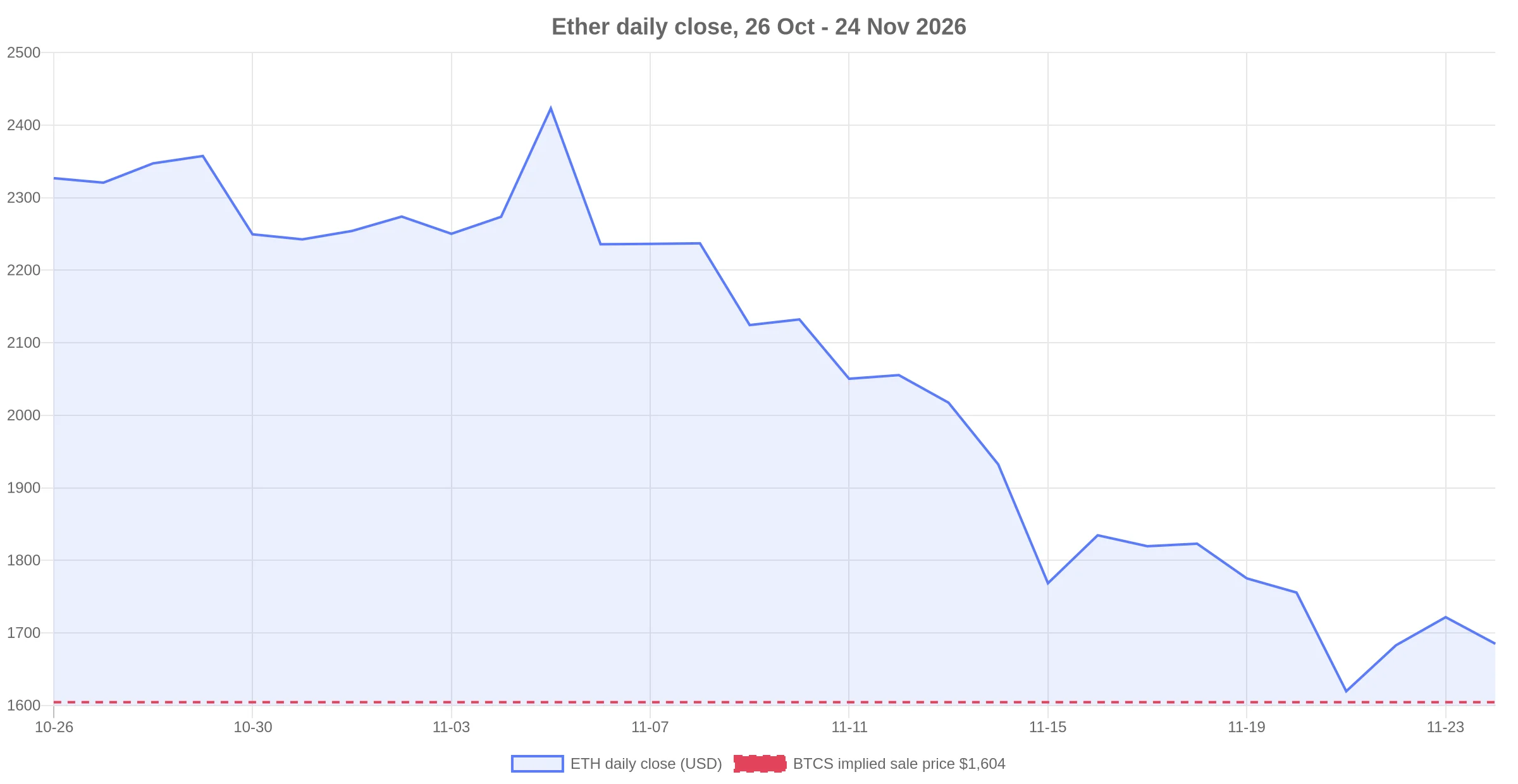
Figure: Etheeum ' s daily closing price from 26 October to 24 November 2026 compared with the implicit average sales price of $1,604. Source: CoinGecko ' s daily closing price; sales price from Form 8-K.
32 per cent of loans could not be reconciled only through stocks in utensils
According to the press release, the value of the remaining Aave position is approximately 32 per cent. However, the ratio is lower if measured in TT$, which the company claims to still hold. According to the US$ 1,722 tag used in the press release, 24,245 ETH values of US$ 41,755 and US$ 10.5 million for US$ 41,755 million are 25.1 per cent. At today’s US$ 16,84.94, the inventory value is US$ 40,855, or 25.7 per cent.
The ratio of 32 per cent of the $10.5 million balance means that the collateral base is approximately $32.8 million, which is about $9 million less than the value of the stocks of the utensils that the press release itself marks. There are two explanations that are consistent with this, but the document does not choose between the two. Either the utensils are held in part above the Aave position, and the collateral figure is not included; or the company calculates the value of the loan in comparison to the pool of assets based on its full ETH balance. Both are common, but none is stated in the text.
Why lenders price collateral, not the story itself
Aave is an over-pricing borrowing program: the borrower provides assets to borrow as collateral, and the position will be defined when the collateral value falls to a certain extent in relation to the debt. Protocol expresses this distance by means of a “health factor”, i.e., the collateral value multiplied by the threshold of the pledge divided by the debt; the position is eligible to be used as a collateral when less than 1. The mechanism is recorded in aave.com.
The press release describes the pressure to make repayments more urgent. It notes that on November 20, the NASDAQ composite index fell by 5.3 per cent, with the index 500 falling by 3.7 per cent, that Bitcoin traded for the first time since July below $60,000, and that Ethereum fell by about 12 per cent to about $1,561 from the midday height. At that low point, the press release states that Ethereum has fallen by about 24 per cent since November 11th. CoinGecko’s daily series is consistent with the scale of the volatility: Ethereum collected $2.050.34 on November 11, and $1,619.51 on November 21.
The company gave its CEO ' s words as a motive, and it was important to retain attribution:
“As ETH falls, we choose to sell ETH and repay our Aave borrowing, rather than to take on the debt during the fall of the market. Selling at these prices brings real costs to companies and shareholders, which we cannot ignore. We take these steps in order to reduce the risk of our collateral being used, to maintain our ability to meet high-level guarantee-enabled bond obligations, and to place the company on a more secure footing.”
— BTCS Inc. Chief Executive Officer Charles Allen, Annex 99.1
The document is not published at the lowest point of health, or the collateral and value of the debt that generated it. It is therefore not possible to calculate from the record how far it will be at the worst possible time, and any statement of how close the position is to the position will be deduced rather than disclosed.
The reversible debt due in 2027 is located after the mortgage decision
The above-mentioned sentence on convertible bonds is a key part of the capital structure story. BTCS reports that approximately $17.9 million of the principal amount of the high-level guaranteed convertible bonds will expire in May and July 2027, in addition to $10.5 million owed to Aave. According to preliminary data, the total debt of $28.4 million is about $2.15 times the cash and digital assets of $61 million.
These bonds are high-level guarantees, which means that their claims rank ahead of other obligations and can be secured by the same assets to which the lenders are entitled. Aave’s reference will consume the same collateral that underpins them. The company’s sales are justified by the protection of its ability to meet bond obligations, which is in line with this order of priority and is so close to maturity as to be of critical importance: in May and July 20 months, 2027, respectively. Nothing in the press release indicates how these bonds will be settled, refinanced or converted, and the forward-looking part lists their ability to repay or refinance as a separate risk factor.
Imperium now holds no cash.
The second part of the press release, concerning Imperium, the company's DeFi business, described it as the deployment of capital to the market for liquidity on the chain, including the automated marketed business pool on the Ethereum and Layer-2 networks. Imperium “still withdrew from its liquidity pool position” in response to volatility, and the press release made clear the consequences: Imperium did not earn the costs of the liquidity pool during the period of its capital deployment.
Charles Allen characterised withdrawal as tactical rather than final. “Imperium is the best part of our business this year, and where we plan to focus our efforts from here.” He said that adding that the company “had exceeded its year-wide Māori target within nine months by its strength” and intended to “redeployment when our indicators show improved conditions.” There was no indicator, no threshold given, and no date of redeployment. This allowed the firm’s strongest line to sit in cash, open return dates, while its position in halving had been halving.
Four points not mentioned in the document
Four omissions are worth mentioning, as each is the number that investors usually wish to see when assessing the remaining treasury. No realized gains or losses were disclosed for 27,300 ETH. No cost basis or average book value was sold in utensils. No indication was given whether $61 million of cash and digital assets were mainly cash or mainly in tokens, which was important if Ethereum continued to decline. Nor was there a schedule or scale for further sales: the press release merely indicated that the company would “take additional action when it deemed it appropriate”.
These estimates themselves contain warnings printed in press releases. They are preliminary and unaudited, and will vary with the price of the company’s assets, without being reviewed by the company’s independent certified accountant, and may differ from what appears in the financial statements. This is the standard language of the press release issued a few days after the incident, which means that the realized results of the sale will be determined in the next periodic report, rather than in this document.
Two data points for the same week, pointing in the opposite direction
The Aave market for BTCS borrowings is itself changing. In the same week, the risk consultant proposed a set of protocol-level cap changes, including USDC moving up to $4 billion with 34 stand-alone caps cut, which is the kind of work that would change the parameters of the cost of each leverage-level marginal borrowing on the platform.
The company Ethereum also behaved differently. Although BTCS sold more than half of its stock to settle its debt, Bitmine continued to accumulate and, as we pointed out in our November 23 report on the purchase, it was approaching 5% of Ethereum’s supply. The two public treasurys, one of the same kind, moved in the opposite direction during the same week. The difference lies not in confidence in Ethereum, but in the structure of their balance sheets: one company is providing loans guaranteed by its coins, while the other company is increasing its unaffordable position.
Common Question Answers
Did the BTCS sell it at a loss?
The 8-K table does not quantify the loss. The implied average sales price of $1,604.40 is lower than the collection price of Etheneum 1,755.59 as of 20 November and is lower than the US$1,722 mark used by the company for the subsequent balance sheet, and the CEO claims that selling at these prices “takes a real cost to the company and to the shareholders.” However, BTCS has not disclosed its cost base in utensils and therefore cannot calculate the loss on the basis of the documents alone.
How much of Aave's debt does BTCS have?
Approximately $10.5 million, lower than the $54.3 million implied before repayment, and the value of the loan as at 22 November 2026 was approximately 32 per cent. The company also reported that approximately $17.9 million of the high-level guarantee convertible bonds would expire in May and July 2027.
How much does the BTCS hold?
According to the preliminary and unaudited data in annex 99.1, there were approximately 24,245 ETH and there were additional cash and digital assets with a total fair value of approximately $61 million at the Ethereum price of $1,722 on 22 November. This was 52.96 per cent of the 51,545 ETH held prior to the sale of the company.
Why would BTCS sell Ethereum instead of adding more collateral?
The press release did not discuss the additional collateral. It indicated that the company had chosen to sell Etheleum and repay Aave ' s borrowing, rather than to assume debt during the market downturn, and that it was contributing to reduce risk and protect its ability to meet its convertible bond obligations.
Is Imperium still trading?
It states that Imperium temporarily withdrew from its liquidity pool position due to volatility and intends to redeploy capital when its indicators indicate improved conditions. It does not earn the cost of the mobility pool during the period when capital is not deployed, and the date or threshold for the redeployment has not been disclosed.
This paper is intended for information purposes only and does not constitute an investment proposal. The market price is derived from CoinGecko's time stamp data, as reported in Company Form 8-K and Annex 99.1.