Exchange Ranking
 Top Exchanges
 24h Volume Ranking
 Popularity Ranking
 Exchange BTC Balance
 Proof of Reserves
 Decentralized Exchanges
 Funding Rate
 Funding Heatmap
 Liquidation Data
 Max Pain
 Long/Short Ratio
 Whale L/S Ratio
 Binance/Okex/Huobi L/S
 Bitfinex Margin L/S
 ETF Tracker
 Solana ETF
 XRP ETF
 Hong Kong ETF
 Bitcoin Treasuries
 Crypto Reversal
 Ethereum Reserves
 HyperLiquid Wallet Analysis
 Hyperliquid Whale Watch
 Large Transactions
 On-chain Movement
 Bitcoin ROI
 Stablecoin Market Cap
 Options Analysis
 News
 Articles
 Economic Calendar
 Features
 Wallet
 Contract Calculator


 Security
 Collections
 Watchlist
 Following
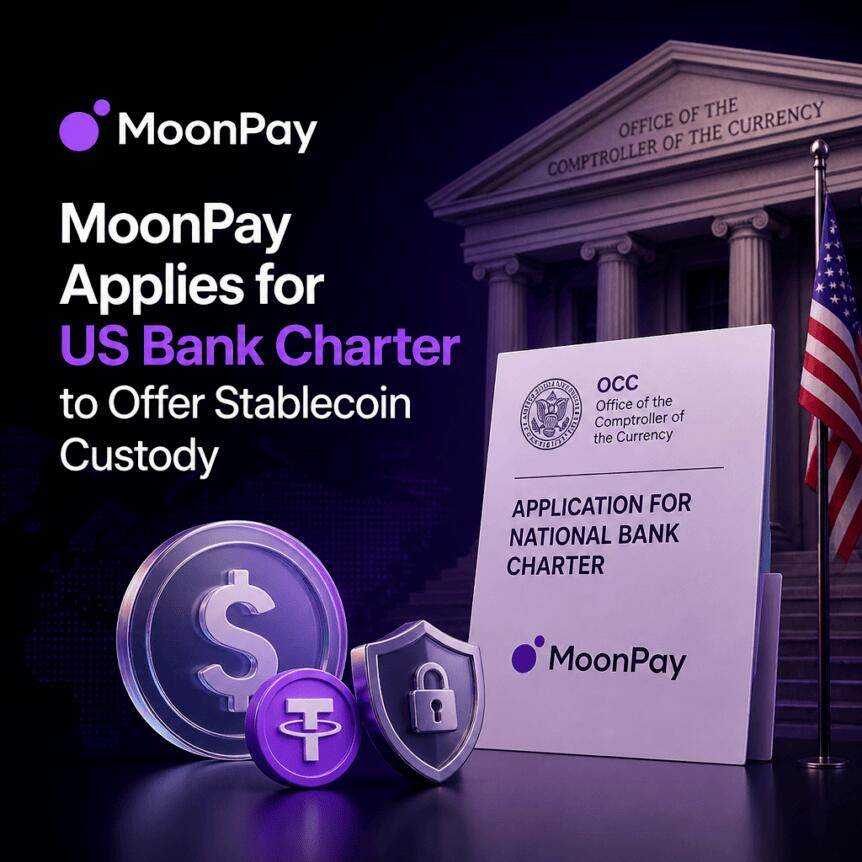
MoonPay applied to the U.S. Monetary Supervisory Agency for NTF license plates to support stablecoin operations
Crypto’s payment and stablecoin infrastructure provider MoonPay has formally submitted an application to the United States Monetary Supervisory Authority (OCC) for the establishment of a national trust bank. The proposal, the MoonPay National Trust Bank, will enable the company to manage stockcoin reserves and provide digital asset hosting services under the federal regulation, while not absorbing traditional deposits or extending loans.
Core elements
- MoonPay has applied to the OCC for a National Trust Bank licence to support the issue/foresee, reserve management and hosting of a stablecoin.
- The proposed banks are non-deposit-type institutions, which do not provide loan services, thus reducing the overlap with traditional commercial banks.
- This application coincides with the entry into force of the Federal Stockcoin Ordinance, the GENIUS Act, on 18 January 2027.
- MoonPay joined the encryption business camp that sought to increase the number of OCC Trust Bank licences, including the companies Rain, Modern Treasury and Block.
- Community banks have challenged the authority of the OCC to approve non-deposit trust banks, triggering continued regulation and political pressure.
MoonPay 's Request for Approval to OCC
In its OCC application, MoonPay seeks approval for the establishment of the MoonPay National Trust Bank to obtain a licence to the National Trust Bank.
The key point is that the proposed structure limits the typical banking function: the bank does not accept retail or commercial deposits, nor does it extend loans. Rather, the licence is intended to support core activities related to stablecoin operations — specifically, foreclosure support, reserve management, and digital asset hosting.
MoonPay is currently in the process of issuing infrastructure for the operation of a business, including branding a digital dollar tool. The new licence will allow its bank subsidiaries to provide these services within a federal framework, thus making compliance and supervision more formal and stringent than purely non-banking arrangements.
Comply with the forthcoming federal standard of stablecoin
MoonPay’s application point is critical, as the United States is moving towards a more standardized, federal institutional development. The company’s fling is scheduled to enter into force on January 18, 2027, as the agency prepares to implement the GENIUS Act.
While the specifics of how individual applicants are aligned with the future framework may differ, the overall direction is consistent: the issuer of the stockcoin will face federal definition requirements for reserve support and foreclosure.
For market participants, a trust bank licence may be one of the ways in which the relevant functions of the stationcoin can meet the expectations of the regulation. MoonPay’s application indicates that it wishes to accommodate this trend not only through compliance measures, but also by obtaining a license of an institution that can provide services under the supervision of the federal bank.
MoonPay, join the crowded trust bank for the ladder.
MoonPay ' s request also highlights a clear trend: several encryption and payment companies are pursuing federal trust bank licences as a means of legalizing and institutionalizing stablecoin-related services.
The early applications and licensing efforts cited in the application document include Rain, Modern Treasury and Block, which each explore their roles in stablecoin hosting, reserve, or banking. In the same period, mature encryption players have also made progress – Coinbase’s license plate came into effect earlier this month, while Circl received final approval from the OCC in July.
Together, these developments suggest that the OCC’s trust bank licensing approach has become the focus of corporate attention for expanding stablecoin operations in the US. It also underlines that a path is no longer a mere theory; licence plates are being granted and activated to transform “applying momentum” into real business changes for some companies.
Community banks' rebuttal of OCC practices
Despite the growing number of applicants, the trust banking model is not without challenges. Opposition from community banks is a recurring theme, especially around whether non-deposit-based trust banks should be allowed to perform functions that are closely related to commercial banks.
In October, OCC was sued by the Independent Community Bankers Association, which argued that the agency exceeded its authority by allowing non-deposit-type trust banks to carry out activities traditionally associated with commercial banks. The dispute added uncertainty to applicants such as MoonPay – not to the technical merits of a particular application, but to the broader political context.
Follow-up focus
If MoonPay’s application is accepted, the next steps may focus on the OCC’s review of its proposed structure and readiness, and how the licence’s responsibilities are reconciled with the upcoming stablecoin rules under the GENIUS Act. Investors and practitioners should pay close attention to the decision-making schedule of the OCC and the continuing legal and political challenges associated with trust bank licences.