Exchange Ranking
 Top Exchanges
 24h Volume Ranking
 Popularity Ranking
 Exchange BTC Balance
 Proof of Reserves
 Decentralized Exchanges
 Funding Rate
 Funding Heatmap
 Liquidation Data
 Max Pain
 Long/Short Ratio
 Whale L/S Ratio
 Binance/Okex/Huobi L/S
 Bitfinex Margin L/S
 ETF Tracker
 Solana ETF
 XRP ETF
 Hong Kong ETF
 Bitcoin Treasuries
 Crypto Reversal
 Ethereum Reserves
 HyperLiquid Wallet Analysis
 Hyperliquid Whale Watch
 Large Transactions
 On-chain Movement
 Bitcoin ROI
 Stablecoin Market Cap
 Options Analysis
 News
 Articles
 Economic Calendar
 Features
 Wallet
 Contract Calculator


 Security
 Collections
 Watchlist
 Following
 BTC
Deribit options data: 60,000 US$ is worth $835 million, half of which will expire at Christmas.
On November 16th, UTC time 12:20 Bitcoin's trading price on the Deribit index was $64,001.62, which is more than $6.25% of the $60,000. This difference is the location of the exchange's largest single-time-depression default futures: US$ 60,000 worth of the drop-off options for Deribit's open-time rights book, calculated by Blockchain Reporter, is US$ 835.6 million, distributed over 11 maturity days, with a nominal principal value of approximately 12,922 Bits.
The total value of the bank’s right-to-hand is $995.7 million, including watch-up options, representing a share of the total exposure of all 982 BTC options listed in Deribit of $24.4 billion. More than half ($431.6 million) of the fall-over wall will expire on 25 December. An additional $132.1 million will expire on 26 March 2027 and $93.4 million on 27 November.
This distribution is more important than the headline figure. The drop-over option, which expires five weeks later, is a counter-balance to the market volatility that has not yet occurred; while the fall-down option, which expires in March 2027, is a longer and slower position, reflecting not the expectations of the traders for this month.
What exactly does the 60,000-dollar right-of-the-hand price contain?
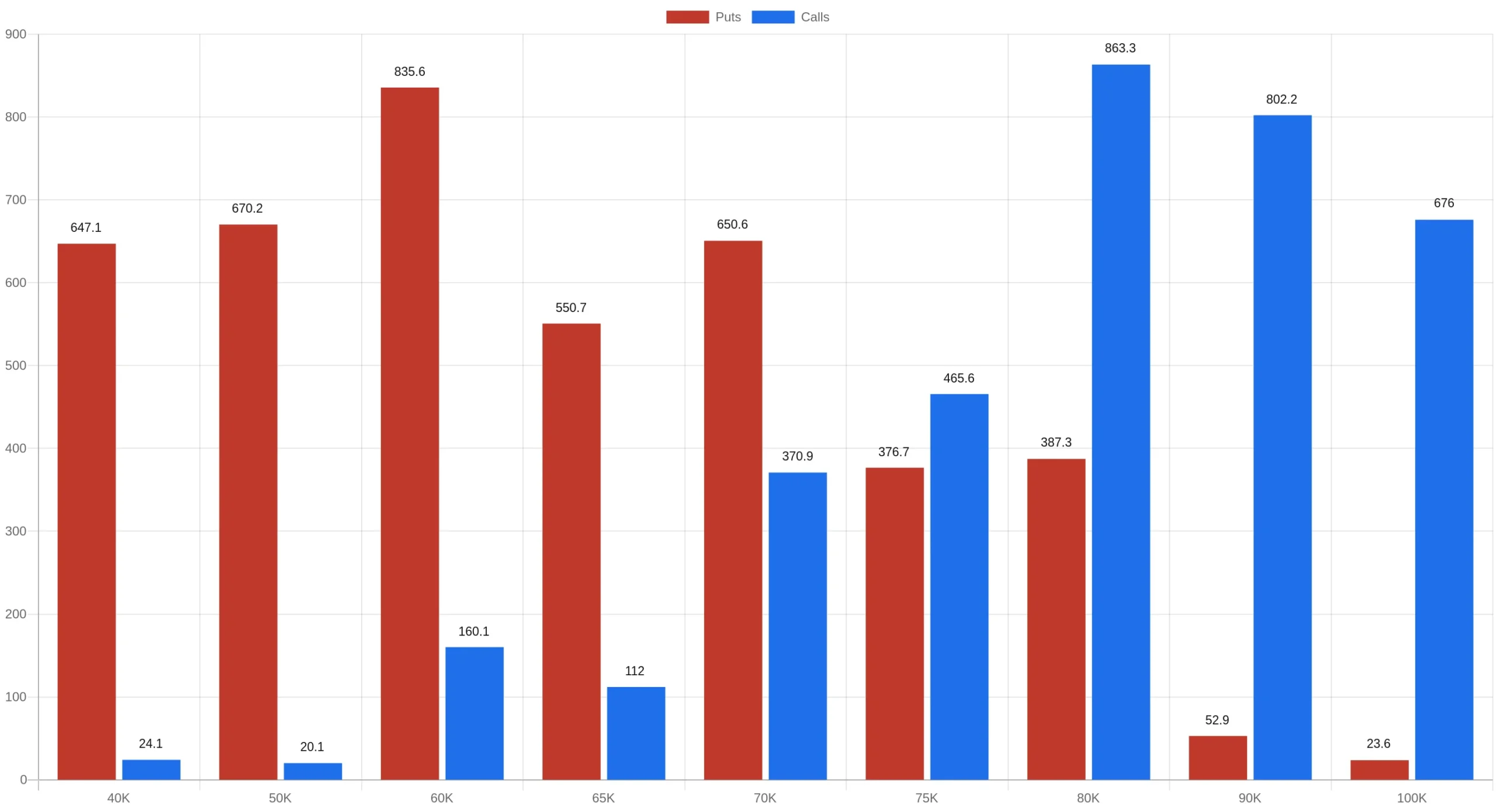
Based on the total balance, $60,000 is the third-largest right of the exchange, after $80,000 ($1,250.6 million) and $70,000 ($1,021.5 million). It is the largest single downside: at that line, the value of the downside options is $835.6 million, and the increase is $160.1 million, so the fallout is 83.9 per cent.
Within the wall, concentration is not even. For Futures, due on 25 December, it is $6,706.2 for BTC, $ 60,000 for the drop-in options; for Futures, due on 26 March 2027, 2,023.5 for BTC; for Futures, due on 27 November, 1,457.2 for BTC; and for Futures, due on 25 June 2027, 927.7 for BTCs. Compared to the smaller scale of the recently due weeks, $9.7 million on 20 November, $10.3 million on 18 November and $3.2 million on 17 November.
The total unsettled value of the top five right lines (from $60,000 to $90,000) was $4,965.2 million, or 20.4 per cent of the total balance book, and was concentrated on only five price levels.
The larger position is $80,000 to see the increase.
If the question is which single option line carries the largest amount of money, the answer is not $60,000 for the drop option, but $80,000 for the increase in the margin option, which is $863.3 million for the unwinded future, which is $27.7 million more than the $60,000 for the fall right, which is 3.3 per cent larger.
The overall unsatisfied value of $80,000 is $1,250.6 million, of which an increase in options is 69 per cent. This level is 25 per cent higher than the spot price, which was built up at a time when Bitcoin had previously fluctuated between $79,900 and $84,500 in October. The scale reflects the location of traders in Bitcoin when trading was close to $80,000, rather than a fresh bet on a rebound.
The bank’s right-to-hand interest is $676 million, less than its role in the summer. Currently, $60,000 is $1.24 times the size of $100,000 of the right-to-view ($676 million).
But this does not set the course. The right to fall can be purchased as insurance by the person holding Bitcoin, or sold by the person willing to buy it at $60,000 to obtain the right. Deribit’s public data are the unsatisfied futures of the tools, not the identities or intentions of either party. The exchange publishes the number of trading volumes and the price of the tags; it does not disclose who is long options and who is short options.
Falling options now account for 43.1 per cent of the $24.4 billion.
Of all the BTC options listed in Deribit, fall options were $10,524.9 billion, while rise options were $13,873.5 million. The fall options ratio of 43.1 per cent is the key figure to focus on against $60,000: this suggests that the next run is a large minority in the options book, not a marginal position. In June of the same year, the same line of power prices had a nominal fallover value of over $1.2 billion, when a Deribit high tube warned that a drop of $60,000 could trigger a loss of revenue.
Deribit’s DVOL index was on November 15 at an average of 39.89, 30 days, with a range of 33.6 to 47.3 days. The volatility rate was 8% higher than the recent average, 27.6% higher than the August low, but still below the October peak.
According to CoinGecko, the Bitcoin transaction price as at US$ 12:14 UTC time was US$ 64,024, a decline of 2.02 per cent in 24 hours and US$ 1.288 trillion in market caps. This is lower than the market’s recovery of US$ 65,000 later on 15 November, and higher than the lowest point of US$ 61,899.
It's insurance, not prediction.
Deribit's Rulebook sets out the contractual mechanism for determining how these positions will be settled. “Deribit provides European cash settlement options and linear options. The European option is exercised only at maturity and cannot be exercised prior to maturity.” Deribit Exchange Rules Manual clearly indicates in its contract specifications.
First, there is no 60,000 US dollars to see the right to decline, so the right-to-do price is not triggered by the individual holder’s decision to move. Second, the settlement is cash rather than Bitcoin, so that the right to fall in real terms at maturity will be paid to the holder in monetary form, without causing the coin to flow into or out of the market.
The rulebook also explains how the exchange valuees the position between maturity. “Deribit can use tag prices to determine the market value of the unsettled position in order to avoid price surges and unnecessary Liquidation during periods of high volatility.” This is a mechanism to contain the ripple effect of liquidation during periods of rapid volatility, rather than a commitment of $60,000.
A step-by-step approach is required to price in United States dollars, as described in the rule manual: “The options are priced in BTC or ETH. However, the relevant prices can also be shown in United States dollars. The price in United States dollars is determined by using the latest futures prices.” BlockchainReporter applies the price of the assets for each tool to its unwinded futures, which is why the dollar figures differ slightly from a single spot conversion.
Three due dates determine the role of the wall
Unsettled futures were unevenly distributed on the calendar. On December 25, 9,444.9 million dollars, or 38.7 per cent of the total balance book, were loaded, of which the margin was 3,801.8 million dollars and the margin was $5,643.1 million. Next month, the futures carried $6,352.9 million on November 27. The figure expired in March 2027, with the Futures carrying $3,058.6 million.
Friday, November 20, comes to a smaller date: the whole plate is $2,052 million, of which $802.1 million is the right to fall. The $600,000 right price is only $39.7 million. A huge headline maturity does not mean that 60,000 dollars is active in that week.
The date of 25 December is crucial for the “wall” because the amount of $60,000 at the BTC price for the drop-down option is due to 51.9 per cent of Futures. The settlement on that date will be determined by Deribit’s cut-off price, which is derived from the index, rather than from any single transaction. If Bitcoin is less than $60,000 at that time, these drop-out options will be converted into real value and settled, and the holder will receive the money; the funds will be transferred between exchange accounts.
What's going to change this?
The wall is a snapshot of the position, not a fixed structure. The fall of the futures when the position is levelled, the rise of the new warehouse, and the level of $60,000 can be reduced at constant prices. The figure of concern is $60,000, which is a steady decline in the number of down options, and the increase in the lower right-to-go options, which would indicate that the hedges are extended rather than lifted.
In terms of prices, the reference point is narrow. In the last 24 hours, Bitcoin has traded between $61,899 and about $65,000, with a $6.25 per cent right price of $60,000 below the current index. If the billing price is lower than the low point of $61,899 on November 15, the market will enter the area where $60,000 will be purchased to see the right to decline.
These levels are descriptive, not predictive. The data support the conclusion that traders hold more downside protection on the right price closest to the spot than on top of the open, and concentrate such protection on those that are close enough to impact and far enough to maintain a cheap integer. The right book does not show whether such protection is bought by the holder or sold by the trader willing to bear the other side.
Common Question Answers
What's Bitcoin watching the fall wall?
The fall-over wall refers to the right-to-go price of the drop-off option. On Deribit, the UTC time $12:060,000 on November 16, 2026, holding $835.6 million for the fall-in-the-life option, is the largest single drop-off line on the exchange. The term describes the size of the position, not the bottom of the price.
Is a huge fall-over wall going to stop Bitcoin from falling?
No. Unsettled futures record open futures, not orders awaiting purchase. The settlement is made on a cash basis when due, so real value falls options are paid to the holder, rather than buy the spot Bitcoin. The wall can contract or expand without affecting prices.
Why is the 60,000-dollar right price so high?
This is an integer, close enough to benefit from the continuous decline and far enough to protect it more cheaply than the flat value. For futures due on December 25, alone, $6,706.2 of the $60,000 of the BTC drop-off rights, or 51.9 per cent of the total fall-off options.
What's DVOL, why is it important here?
The higher the reading means that the higher the options cost for hedges, it will change the economic situation in which $60,000 is held.
When will the fall-over be due for $60,000?
The largest were 25 December 2026 ($431.6 million), 26 March 2027 ($132.1 million) and 27 November 2026 ($93.4 million). Deribit options were European and therefore were not viable until the expiry date.
All data reflect the Deribit order book at the time.