Exchange Ranking
 Top Exchanges
 24h Volume Ranking
 Popularity Ranking
 Exchange BTC Balance
 Proof of Reserves
 Decentralized Exchanges
 Funding Rate
 Funding Heatmap
 Liquidation Data
 Max Pain
 Long/Short Ratio
 Whale L/S Ratio
 Binance/Okex/Huobi L/S
 Bitfinex Margin L/S
 ETF Tracker
 Solana ETF
 XRP ETF
 Hong Kong ETF
 Bitcoin Treasuries
 Crypto Reversal
 Ethereum Reserves
 HyperLiquid Wallet Analysis
 Hyperliquid Whale Watch
 Large Transactions
 On-chain Movement
 Bitcoin ROI
 Stablecoin Market Cap
 Options Analysis
 News
News Articles
 Economic Calendar
 Features
 Wallet
 Contract Calculator


 Security
 Collections
 Watchlist
 Following
 SKY
SKY Core Points
Target price implies that SKY tokens are valued at US$7.6 billion. The value of SKY cannot be directly deduced from the growth of USDS alone. Surplus funds are used first to pay savers and reserves. The governance mechanism determines the allocation of rewards and repurchase ratios. The "federal bank" analogy does not eliminate potential risks.
The target price of US$0.325 implies a valuation of US$7.6 billion.
According to The Block, a research note from Standard Chartered Bank sets the target price for Sky governance token SKY to the end of 2028 at US$0.325. The note uses a benchmark price of approximately $0.065, which means the price could rise fivefold. Geoff Kendrick, global head of digital asset research at Standard Chartered Bank, described Sky as a "federal bank" on the grounds that it issues stablecoins, has a governance framework and charges wholesale interest rates to borrowers. The expression is intended to describe Sky's economic model rather than a regulated deposit-taking institution.
At the time of writing, Sky's real-time interface showed that the price of SKY was approximately US$0.061 and the market value was approximately US$1.43 billion. Assuming the supply in circulation remains unchanged, the target price of $0.325 will correspond to a market value of close to $7.6 billion. Since the real-time price was slightly lower than the reported reference price of $0.065, the increase was approximately 5.3 times based on CoinMarketCap data.
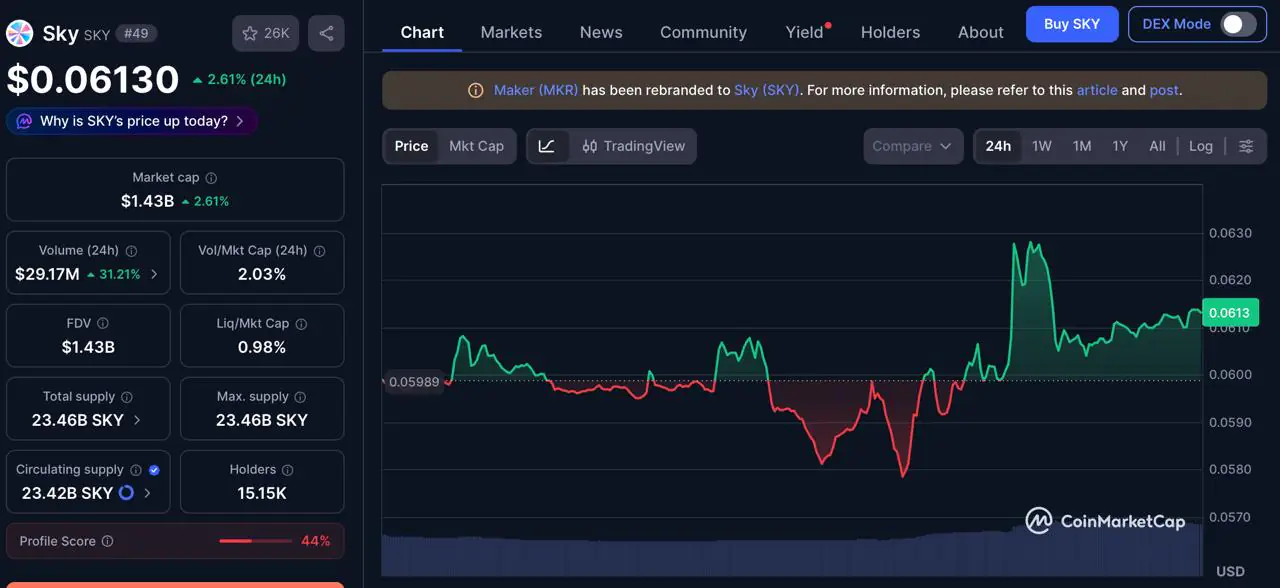
Whether this target price can be achieved depends on the operating assumptions needed to support it: the adoption rate of the USDS, a sustainable negotiated surplus, and the proportion of the surplus allocated to SKY holders.
Sky's stablecoin system has a competitive demand for revenue
Sky (formerly known as MakerDAO) issues USDS through negotiated collateral and earns revenue through lending and capital allocation activities. Users can deposit USDS into the savings module and obtain sUSDS, thereby obtaining a government-determined savings rate of return, which is derived from the agreed total surplus.
The Sky Frontier Foundation, an independent ecosystem foundation, reported total agreed revenue of $107.35 million in the second quarter and a net agreed surplus of $33.29 million. By default, this part of the surplus does not flow directly to SKY holders. It must prioritize savings interest payments, reserves, safeguards, operating costs and any government-approved holder rewards.
The second-quarter allocation reflects the trade-off: Sky reported that $53.91 million was paid through the Sky savings rate, with another $29.87 million retained in reserves. Although the growth of stablecoins can support the operation of the system, the remaining surplus available for token rewards will decrease accordingly.
Therefore, the $0.325 forecast is not based solely on the growth in USDS supply; it also assumes Sky can expand its revenue base while ensuring that savings payments for costs, reserves and risk management expenditures do not consume the surplus that should be used to support SKY's value.
Governance mechanism determines connection with SKY
Sky official documents pointed out that the total surplus from the agreement can be used to purchase SKY tokens and pledge rewards on the open market. However, ratios, reserve targets and other key parameters are determined by token holder governance and may change.
Therefore, SKY is a governance token, not a share with a defined dividend policy. Its value depends in part on whether governance continues to channel large surpluses into repurchase and pledge awards after funding the entire system.
Impact of how agreement revenue is used on SKY USDS savings rate payments can make USDS more competitive, but reduce remaining surplus. Reserves, security and operating costs can enhance agreement stability but do not directly support token value. SKY repurchase and pledge rewards establish the clearest link between operating performance and holder interests. The forecast assumes that Sky will capture more shares of on-chain credit
The target price assumes that Sky will account for part of Standard Chartered Bank's expected on-chain credit growth in stablecoins and DeFi sectors. Although Standard Chartered Bank has previously had larger forecasts for tokenized assets, as Coindoo's comparison of tokenization estimates shows, institutional forecasts vary significantly because they are based on different adoption rates, regulatory and liquidity assumptions.
Sky has a substantial foundation. Its interface lists total USDS and DAI supply as $9.79 billion, while Sky Frontier Foundation data shows that the value of negotiated collateral was $12.32 billion as of the end of the second quarter. The next question is whether USDS is increasingly used for borrowing, trading and settlement, rather than just mainly for obtaining subsidy benefits.
This difference will determine whether the system builds a larger and more lasting revenue base or simply attracts deposits by paying higher fees.
Limitations of the "Federal Bank" analogy
Sky performs some bank-like economic functions, but with a completely different risk structure. Its own risk document warns of smart contract loopholes, collateral losses, liquidity restrictions, governance changes and the risk that the USDS could lose its dollar peg.
Its yield model is also different from reserve-backed stablecoins. In our comparison of major stablecoins, sUSDS receives an interest rate set by governance from Sky's total surplus, while reserve-backed issuers typically retain revenue generated by their reserves. This makes sUSDS more attractive to users focused on revenue, but also makes Sky more dependent on sustainable negotiated revenue and prudent risk settings.
Five indicators to test this goal
Situations where indicators support this argument weaken the argument The supply of USDS achieves organic growth in lending, trading and settlement. Growth driven mainly by temporary incentives. After the net surplus covered savings fees and expenses, revenue remained strong. Revenue rose but surplus narrowed. The repurchase and reward governance layer maintains a clear shareholder return mechanism. Most of the surplus is retained or transferred elsewhere. Reserves and collateral reserves grow with diversified collateral. High risk, poor liquidity or concentrated exposure to real-world assets (RWA). Governance decisions balance growth with transparent parameters of token value. Frequent changes make earnings distribution unpredictable. Sky's revenue scale and stablecoin volume provide raw materials for achieving Standard Chartered Bank's goals. The key evidence is whether governance can continue to convert future surpluses into repurchase and pledge rewards after funding savers, reserves and risk control.
Disclaimer : This article is for reference only and does not constitute investment, financial or trading advice. Cryptocurrency and DeFi products carry significant risks, including the possibility of loss of principal.