Exchange Ranking
 Top Exchanges
 24h Volume Ranking
 Popularity Ranking
 Exchange BTC Balance
 Proof of Reserves
 Decentralized Exchanges
 Funding Rate
 Funding Heatmap
 Liquidation Data
 Max Pain
 Long/Short Ratio
 Whale L/S Ratio
 Binance/Okex/Huobi L/S
 Bitfinex Margin L/S
 ETF Tracker
 Solana ETF
 XRP ETF
 Hong Kong ETF
 Bitcoin Treasuries
 Crypto Reversal
 Ethereum Reserves
 HyperLiquid Wallet Analysis
 Hyperliquid Whale Watch
 Large Transactions
 On-chain Movement
 Bitcoin ROI
 Stablecoin Market Cap
 Options Analysis
 News
 Articles
 Economic Calendar
 Features
 Wallet
 Contract Calculator


 Security
 Collections
 Watchlist
 Following
 ETH
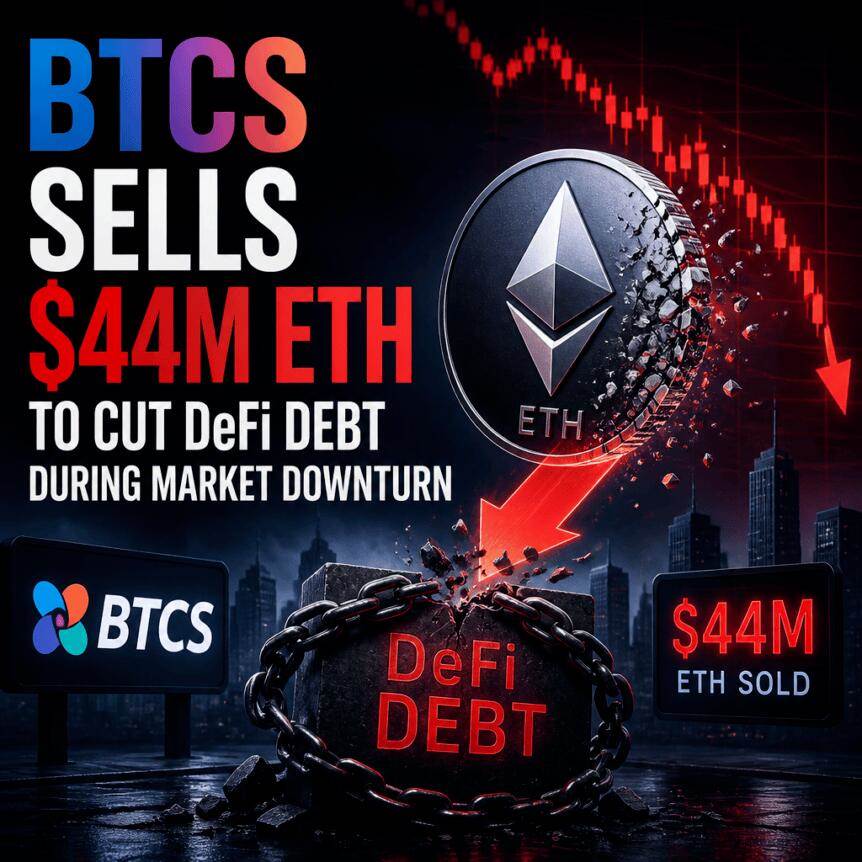
BTCS Inc. Selling 27,300 ETHs to repay $43.8 million in Aave's loan
On 20 November 2026, BTCS Inc. (Nastaak Code: BTCS) sold about 27,300 Ethereum (ETH) and received about $43.8 million in total revenue. The company then used this money to repay its outstanding loans in Aave Protocol, reducing Aave’s total debt by about 81%. The operation took place in a context of widespread sales in the cryptocurrence market, which led to encryption sentiment falling into “extreme fear” and Ethereum prices to months of low.
According to the SEC 8-K form submitted on 23 November 2026, the transaction reduced BTCS ' outstanding Aave borrowing from approximately $54.3 million to about $10.5 million. The 27,300 ETH sold represented approximately 53 per cent of the company ' s pre-merger hold. This was a voluntary sale aimed at reducing risk at prices well below the recent highs.
According to the SEC document, the Ethereum price on 20 November touched at a minimum of approximately $1,561, a decline of about 24 per cent compared to 11 November 2026. As at 23 November, according to CoinGecko, the Etheium partially rebounded to $1,724.11 This means that the BTCS sales price was about 10 per cent lower than the asset transaction price a few days later.
Aave's borrowing decreased by 81 per cent and its leverage rate decreased to 32 per cent after repayment
According to the SEC document, BTCS retained approximately 24,245 ETHs after repayment. The remaining $10.5 million of Aave’s position is worth about 32% of the loan value (LTV). The LTV level is well below the threshold normally activated by the Aave Liquidation engine, which indicates that the materiality risk to the company’s remaining collateral position has been significantly reduced compared to the exposure before the sale.
8-K documents show that after the sale, BTCS held cash and digital assets totalling approximately $61 million. This figure includes reduced ETH positions and cash equivalents, indicating that the company does not face the risk of immediate bankruptcy on the face of its balance sheet, despite the fact that it sells its assets voluntarily at reduced prices.
The SEC document states that BTCS also holds approximately $17.9 million in high-level security convertible instruments, which will expire in May and July 2027. These obligations, due within six to eight months, may increase the sense of urgency of deleverage; while the ETH mortgage base is declining, the burden of $54.3 million on Aave's debt and the negotiable instruments that are due to expire constitutes a cumulative balance sheet pressure. Management chooses to resolve this problem through asset mobilization instead of further leverage.
CEO Charles Allen: "Friday is a tough day for the market and for the BTCS."
The CEO of BTCS, Charles Allen, responded directly to the sale in the SEC document, describing the decision as a risk management choice in the context of deteriorating market conditions, rather than a strategic repositioning.
Allen said, “Friday is a difficult day for both the market and the BTCS. As ETH falls, we choose to sell ETH and repay our Aave for borrowing, rather than to continue to take on debt in a falling market. Selling at these prices brings real costs to companies and shareholders, and we are afraid to take it lightly. We take these steps to reduce the risk of our collateral exposure, to retain the ability to meet the obligations under the high-level guarantee transferable instrument and to place the company on a more secure footing.”
Allan’s statement clearly points to two motivations: avoiding the collateralization of Aave Protocol, and preserving the company’s ability to service its convertible instruments. Both are defensive objectives, not growth-oriented, which suggests that the November 20 sales were passively lost under pressure, rather than planned trosury adjustments.
Why did BTCS choose to sell ETH to leverage instead of holding
When the price of the collateral drops, bringing the position close to the threshold, the autolationization mechanism of the protocol may sell part of the collateral at a punitive price in order to pay off the outstanding debt. For the BTCS, it has $54.3 million in Aave borrowing, with ETH as collateral, and ETH falling by about 24% in nine days, a risk that is not theoretical.
BTCS faces a clear trade-off: voluntarily sells ETH at a price of about US$1,561 to repay Aave’s loan and retain control over timing and execution; or at the risk of being sold by protocol automatically ligation, which will penalize the sale of collateral with adverse health factors and where management cannot control prices or size. The SEC document confirms that the company chose the former to accept the realized loss in order to avoid the asymmetric downward risk of being forced to engage in protocol regulation.
In addition, document 8-K states that BTCS temporarily withdrew from all Imperium DeFi liquidity pool positions during the period of fluctuations, further reducing its exposure to DeFi risk during the sale. This move is consistent with a broad risk-averse position, rather than a targeted response to any single protocol.
Leaveage pressure on Aave's lending mechanism and the owners of the company's vault
Aave is a decentrazed loan program on Etheleum, where users deposit and borrow encoded assets as collateral. The borrowed funds generate interest, and the protocol continuously monitors the health factor for each position, i.e. the value of the collateral as compared to the outstanding debt, and adjusts to the risk parameters of the particular asset.
For a business vault strategy like BTCS, which built a lending strategy around ETH holdings, the sharp fall in ETH prices would rapidly and without warning compress health factors. If ETH fell to $1,561 (as shown on November 20), a conservative leverage position at $2,000 could be close to the area of lending in a few days. This compression is the difference between the DeFi borrowing risk and the traditional bank credit line, which is usually subject to contractual triggers or grace periods, rather than to automatic Liquidation at precise chain thresholds.
BTCS discloses 32 per cent of the remaining $10.5 million of Aave’s position at LTV. The disclosed figures alone do not determine the configuration of the BTCS collateral, the applicable Liquidation threshold, the health factor or the ETH price of a possible re-emergence risk.
Market context: Extreme fear and 30 days of ETH fall by 26 per cent
The sale on November 20, which triggered BTCS to leverage took place in the context of a widespread cryptocurrency market weakness. As of November 23, 2026, the readings of Crystal Fear and Greed Index (encrypted fear and greed index) were only 11/100, which was in the category of “extreme fear” and was consistent with the surrender market environment that forced Leverage holders to reduce open access. According to CoinGecko, the ETH had fallen by about 26.28 per cent over the past 30 days, or about 38.89 per cent over the same period.
The scale of the market decline has provided the context for the positioning of BTCS: during the same period, other corporate entities that use ETH as a treasury asset faced similar pressures. Bitmine Immmension Technologies reported that they hold 6.09 million ETHs, with a total encryption and cash position of $11.1 billion, highlighting the differences in the size of the enterprise's ETH Treasury strategy and the different risk tolerances required for different asset sizes.
Impact of post-sale balance sheet signals on the obligations of the BTCS in the near future
BTCS owns approximately $61 million of total cash and digital assets in the face of the remaining Aave obligations of approximately $10.5 million and the high-level guarantee convertible instruments of $17.9 million. Based on the data in the SEC document, the total liability disclosed by BTCS is approximately $28.4 million. These disclosures do not establish the full liability of the company, liquidity restrictions, operating cash requirements or the valuation of all assets.
Convertible instruments that will expire in May and July 2027 represent the clearest recent financial milestones for BTCS. If ETH rebounds before these dates, the company will retain 24,245 ETH positions that will add value, thus enhancing its ability to refinance or repay these instruments without extra sales of assets.
Key variables of concern in the first half of 2027 include: the ETH price trend vis-à-vis the remaining BTCS Aave collateral; the company ' s ability to generate sufficient operating cash flows to service convertible instrument obligations without obligating ETH; and whether management has re-established the DeFi liquidity pool following the stabilization of market conditions through its Imperium strategy. The SEC document does not indicate a timetable for re-entry into Imperium positions, and therefore the decision depends on market conditions.
BTCS ETH Sales and Aave Loans Common Question Answer
How much ETH did BTCS sell?
According to the 8-K documents submitted by the company to the SEC, on 20 November 2026 BTCS sold approximately 27,300 ETHs, about 53 per cent of its pre-merger ETH holdout.
How many Ave loans did BTCS repay?
According to the SEC document, BTCS used the gross proceeds from ETH sales to repay its Aave loan of approximately $43.8 million. The repayment covered all gross proceeds from sales.
How much has BTCS reduced its Aave borrowing?
According to the SEC 8-K document, this repayment reduced BTCS' outstanding Aave debt from approximately $54.3 million to about $10.5 million, a reduction of about 81 per cent. The remaining LTV ratio of $10.5 million position is about 32 per cent.
What does BTCS hold after sale?
According to the SEC document, upon completion of the repayment, BTCS held approximately 24,245 ETH, with a total cash and digital assets of approximately $61 million. It also retained approximately $17.9 million in high-level guarantee convertible instruments, which will expire in May and July 2027.