Exchange Ranking
 Top Exchanges
 24h Volume Ranking
 Popularity Ranking
 Exchange BTC Balance
 Proof of Reserves
 Decentralized Exchanges
 Funding Rate
 Funding Heatmap
 Liquidation Data
 Max Pain
 Long/Short Ratio
 Whale L/S Ratio
 Binance/Okex/Huobi L/S
 Bitfinex Margin L/S
 ETF Tracker
 Solana ETF
 XRP ETF
 Hong Kong ETF
 Bitcoin Treasuries
 Crypto Reversal
 Ethereum Reserves
 HyperLiquid Wallet Analysis
 Hyperliquid Whale Watch
 Large Transactions
 On-chain Movement
 Bitcoin ROI
 Stablecoin Market Cap
 Options Analysis
 News
 Articles
 Economic Calendar
 Features
 Wallet
 Contract Calculator


 Security
 Collections
 Watchlist
 Following
 BTC
 ETH
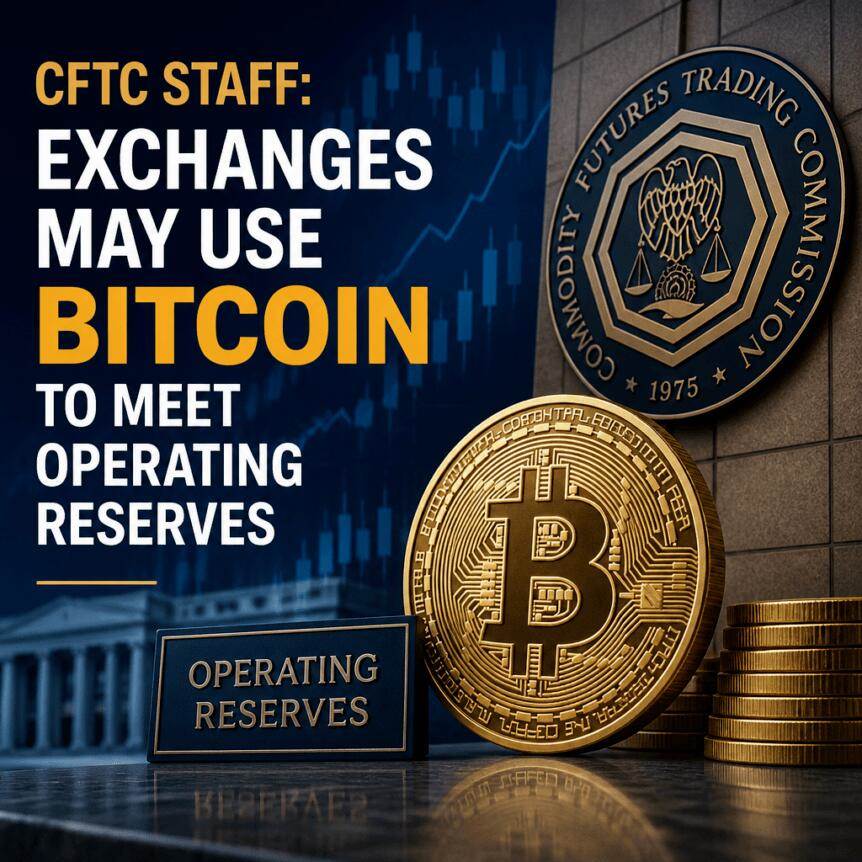
CFTC's employee advice allows cryptocurency to be included in the exchange's financial requirements.
Bitcoin, Ethereum, and stablecoin may now help to meet part of the reserve obligations of the United States Commodity Futures Trading Commission (CFTC) registered entities. On Monday, CFTC employees issued an advisory opinion on how to use encrypted assets to meet financial resource requirements.
According to CriptoBriefing, the advisory opinion specifically named Bitcoin, Ethereum and stablecoin, noting that these assets could be included in part of the financial requirements. Cointelegraph reported that this change allowed the exchange to include Bitcoin in its operating reserve. Both media characterized the consultation as staff-level guidance and informal rule-making.
Background and evolution of financial resource requirements
The financial resource requirements are designed to ensure that the places and institutions subject to regulation hold sufficient liquid assets to absorb losses. Traditionally, they favour cash, United States Treasury bonds and other instruments with established liquidity and low volatility. Allowing encrypted assets to be included in the calculation is representative of a shift in the perception of regulation of the role of digital assets in market infrastructure.
CFTC 'encrypted sprinting 'leading to advice
- By the end of 2025:CFTC has started a multi-stage exercise called "encrypted sprinting".
- December 2025:The agency initiated a pilot project on digital assets, which allows the use of cryptocurrence as a futures bond collateral.
- On 23 November 2026:CFTC staff advice allows cryptocurency to be included in the operating cost reserve requirement.
The advisory opinion was issued in the context of the CFTC's continued expansion of its digital asset monitoring framework. In recent years, the agency has been developing a registration path and compliance expectations for encrypted derivatives platforms. Such staff-level advice usually clarifies how existing rules apply to new situations without changing the underlying text.
Given that stablecoin is designed as a dollar-linked tool to minimize price fluctuations, it is worth noting that it has been listed. They are listed in the advisory opinion alongside Bitcoin and Ethereum, which shows that regulation institutions distinguish different types of assets according to their volatility and liquidity characteristics. By contrast, the prices of Bitcoin and Ethereum are much more volatile than those of stablecoin or United States Treasury debt.
The long-standing demands of market participants were answered
Market participants have long sought to clarify whether cryptocurrency holdouts can be regarded as legitimate capital in the sense of regulation. Previously, the stock-sheet holding of cryptocurrency exchanges and liquidation companies faced uncertainty as to whether these holdouts met the financial resource test.
However, the guidance does not eliminate the need for risk management around volatile assets. Companies that rely on cryptocurrency to meet their financial requirements may still need to consider price fluctuations and liquidity restrictions.
Conceptual analysis: What is the “Haircut” in finance?
The “discount rate” refers to the discount that is applied to the stated value of an asset when it is used to meet the requirements of regulation in order to cope with the risk of a possible fall in market prices. The greater the discount rate, the smaller the value of the asset is counted at the time the requirements are met.
Market impacts
In the case of the CFTC-registered exchange and organization, the advice may ease the pressure to hold a reserve of pure cash or national debt. Companies that already hold Bitcoin, Ethereum, or stockcoin may now have greater flexibility to build balance sheets to meet capital obligations. This may lower the threshold for using encrypted start-ups that register or expand derivative services under the CFTC regulation.
The guidance is tailored to the financial resource requirements of entities subject to regulation, rather than to the standards of retail trade or hosting generally. Nevertheless, the advice reinforces the trend of US regulation agencies to integrate digital assets into existing financial infrastructure rules, which may affect the future treatment of encrypted balance sheet strategies by agency players.
Analytical perspective
What does that mean:This gives CFTC-registered derivatives exchanges and liquidization more flexibility in demonstrating that they have sufficient financial resources, allowing them to account for some of the cryptocurency requirements already held on their balance sheets. This is particularly important for companies such as Coinbase Derivatives, Crypto.com’s NADEX and Bitnomial, which already hold Bitcoin, Ethereum or stablecoin.
This indicates what (unaccomplished changes):The advisory opinion was a staff-level guide, not a rule approved by the Commission, and several media noted that it did not change the separate liquidity requirement, which still had to be met by cash or highly mobile securities.
What is next:
- (a) Whether the entire Commission will eventually translate this staff advice into a formal rule;
- How the exchange would apply the discount rate in the calculation of actual reserves;
- Will other encrypted assets other than Bitcoin, Ethereum and stablecoin be added later?
The advisory opinion reflects the continuing shift in the way United States derivatives are encrypted assets within the established framework of financial compliance. Its practical effect will depend on how the exchange and liquidation companies apply this guidance to their own stock calculations.
Common Question Answers
What exactly has the CFTC staff opinion changed?
It clarifies certain encrypted assets, including Bitcoin, Etheleum and stablecoin, which may be included in part of the financial resource requirements of the CFTC registered entity.
Does this apply to all the encrypted exchanges?
This guidance applies to entities registered with the CFTC, such as derivatives exchanges and liquidation organizations, and does not generally apply to all encryption trading platforms.
Is this a formal change of rules?
No. The report describes it as a staff-level guide designed to clarify the applicability of existing requirements rather than creating new regulations.
Why is it important to include stablecoin?
Stablecoin is intended to maintain price stability, which may bring it closer to cash equivalents than highly volatile assets such as Bitcoin or Ethereum.