Exchange Ranking
 Top Exchanges
 24h Volume Ranking
 Popularity Ranking
 Exchange BTC Balance
 Proof of Reserves
 Decentralized Exchanges
 Funding Rate
 Funding Heatmap
 Liquidation Data
 Max Pain
 Long/Short Ratio
 Whale L/S Ratio
 Binance/Okex/Huobi L/S
 Bitfinex Margin L/S
 ETF Tracker
 Solana ETF
 XRP ETF
 Hong Kong ETF
 Bitcoin Treasuries
 Crypto Reversal
 Ethereum Reserves
 HyperLiquid Wallet Analysis
 Hyperliquid Whale Watch
 Large Transactions
 On-chain Movement
 Bitcoin ROI
 Stablecoin Market Cap
 Options Analysis
 News
 Articles
 Economic Calendar
 Features
 Wallet
 Contract Calculator


 Security
 Collections
 Watchlist
 Following
Zenora Network works: transactions, ZNR tokens and certifiers
Zenora Network is still being built, so most guides blur the line between “current reality” and “only at the design stage”. The guide aims to present both parts at the same time. All statements are from the official page and are dated 25 November 2026 (Indian Standard Time IST).
Core elements
- The user signs the transaction through the private key. The certifier sequences the transaction, and the Ethereum Virtual Machine (EVM) executes the transaction.
- The total supply is fixed at 1 billion.
- Mainnet has not been activated. Consensus mechanisms, block generation time and end-point indicators are still unpublished before the release of the testnet.
What's Zenora Network?
Zenora Network is a planned Layer-1 blockchain that runs the Ethelium Virtual Machine (EVM) and is built using Polygon CDK. Its original token ZNR is used to pay fees and secure the network through staking. As of November 25, 2026 (IST), the official website shows that community applications are being developed and that mainnet is about to be launched.
The official front page refers to it as the Layer-1 chain compatible with EVM and lists five construction phases.
Zenora Network Workstream: From Wallet to Final Block
Zenora Network Trade Process Spacing:
- Hold:ZNR is stored in a self-hosted Wallet. No one, including the project team, is able to move the funds without the owner's signature.
- Sign:Transfers, staking, or futures call on secp256k1 ECDSA (the elliptical curve digital signature algorithm) to sign and broadcast via the private key. private key will never leave the device.
- Sort (Order):The certificater agrees on the order of the transaction. The design allows some of the certifiers to be offline or misbehaved.
- Implementation:EVM executes transactions so that the Solidity Futures and standard Ethereum tools can be used directly.
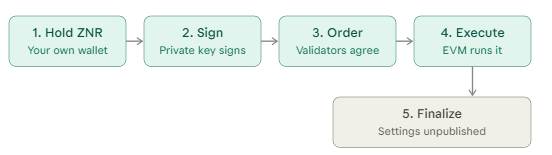
Zenora, how does the deal reach finality?
After the execution is completed, the result state will be locked into the final state. The consensus and finality settings for Zenora will be published before the open testnet.
The official white paper labels each line as testnet. Any data cited in other sources is speculative, not prescriptive.
ZNR for Zenora Network
ZNR is the only original asset. The White Paper states that there is no single Gas, staking or governance token.
ZNR function
- Gas Fees:Pays the cost of each transaction and the call for futures.
- Staking:Could not close temporary folder:%s
- Governance:Votes for upgrades, cost structures and treasury expenditures, with weights based on the number of ZNRs in staking.
- Applying advanced features:The optional fee level in community applications is for convenience only and not for additional profits.
- dApp cost:An application built on Zenora is defaulted to settle costs with ZNR.
Gas cost for Zenora Network is paid for by ZNR
Costs are proportionally scaled according to the calculation and storage resources required for the transaction. Simple transfer costs are lower, while complex futures call costs are higher.
The base rate table and the lowest Gas price have not yet been published. The total supply is fixed, so that, according to the White Paper, the certifier rewards 200 million ZNR pools, which are pre-allocated, rather than new casting.
Zenora Network Verifyer and Consensus Detailed
The certifier locks up ZNR to obtain the right to propose and vote for block. Holders of unrun nodes can entrust ZNR to the certifier and share their reward. They also bear the risk of being cut down (Slashing), i.e. deducting a fine from the locked staking.
Handling of violations
- Dual signature or proven misconduct:Severely reduced bound staking.
- Long offline:The lesser penalty is proportional to the extent of the missed participation.
The minimum certificationer bond has not yet been established. Zenora Node Programme (node plan) has a ceiling of 10,000 nodes, which is an independent status system, not the role of the certifyer.
Zenora Compatible with EVM Layer-1 Detail
Sayer-1 blockchain is a basic network with its own certifier and its own tokens. EVM compatibility means that it operates in the same environment as Ethereum. Zenora lists Solidity and Vyper Futures, Ethereum accounts, and standard JSON-RPC (teleprocess call) interfaces as fixed requirements.
Wallet supports the plan at the testnet stage. The white paper shows that the network settings for MetaMask are not currently available.
Zenora uses Polygon CDK (Chain Development Kit, a chain development package), an open-source framework for initiating the Ethereum compatibility chain. The White Paper points to its trade-off: the re-engineering is less liberal and relies on upstream publishing for maintenance.
Independent Verification, November 25, 2026 (IST): Polygon's file describes the CDK chain as full EVM equivalent, which supports its compatibility statement. The same document identifies the CDK box as the Ethereum Layer-2-chain toolkit, while Zenora's page calls it Layer-1. Zenora has not published its settlement settings and therefore the label is not yet valid.
Zenora Miner: Current status on line
Zenora Miner 's web page is marked online. iOS and Android are listed for upcoming launch.
The official session process consists of six steps: creation of a walklet protected by Passkey, start of an eight-hour session, observation of accumulation, receipt of the security check, increase of the balance and duplication of operations.
The Mining mechanism is not a workload certificate (Proof-of-Work). It is a participatory mechanism, which rewards the points before mainnet, which will be converted into a chain at launch. The average return at an early stage is about 1 ZNR per day, with a limit for each person. The preview screen shows the Hashi rate, but the page shows the screen as an illustrative data.
Community pool scheme
The recommended incentive runs across 10 levels, from 1.0 ZNR per certifying proposer in Level 1 to 3.0 ZNR in Lever 10. The exact incentive formula and the anti-abuse rule are confidential.
Reality and design: status of progress in construction
Due diligence before accession
- Can not open messageMining balance, airdrop qualification and ZNR value.
- Team identity:This guide does not verify the identity of the individual.
- Audit:The White Paper planned to conduct an independent audit prior to the Mainnet and stated that the audit coverage had not yet been completed.
- KYC (know your client):The page you read does not specify the KYC requirement. Please confirm the official domain name before uploading any identity card.
- Wallet Security:Do not share notes or notes.
- Sales:ZNR is not yet on the market, so any offer to sell it is a dangerous signal. The official link does not prove the project safe.
Glossary
- EVM:The Etheium Virtual Machine, running the smart environment.
- CDK:Chain development package, Polygon for the frame for the start-up chain.
- ECDSA:An elliptical curve digital signature algorithm is used to sign a transaction.
- Gas:Calculates and stores the costs to be paid in ZNR.
- Slashing (decrease):Deducted penalty from a certifier's locking stocking.
- Delegation (commission):ZNR is allocated to the certifier to share the incentive.
- JSON-RPC:Wallet is a standard interface for communication with the EVM network.
Conclusions
Zenora Network works on paper, but in practice it has not been proven. It was verified on 25 November 2026 (IST): official page, draft white paper and Polygon ' s CDK file. Unverified: Mining balance, airdrop qualification, token value, team identity and audit.
Next update of trigger conditions: release of testnet consensus settings, issuance of Chain ID or completion of audit reports.