Exchange Ranking
 Top Exchanges
 24h Volume Ranking
 Popularity Ranking
 Exchange BTC Balance
 Proof of Reserves
 Decentralized Exchanges
 Funding Rate
 Funding Heatmap
 Liquidation Data
 Max Pain
 Long/Short Ratio
 Whale L/S Ratio
 Binance/Okex/Huobi L/S
 Bitfinex Margin L/S
 ETF Tracker
 Solana ETF
 XRP ETF
 Hong Kong ETF
 Bitcoin Treasuries
 Crypto Reversal
 Ethereum Reserves
 HyperLiquid Wallet Analysis
 Hyperliquid Whale Watch
 Large Transactions
 On-chain Movement
 Bitcoin ROI
 Stablecoin Market Cap
 Options Analysis
 News
News Articles
 Economic Calendar
 Features
 Wallet
 Contract Calculator


 Security
 Collections
 Watchlist
 Following
 BTC
BTC 埃塞俄比亚因水电短缺削减比特币挖矿供电至合同水平的23%
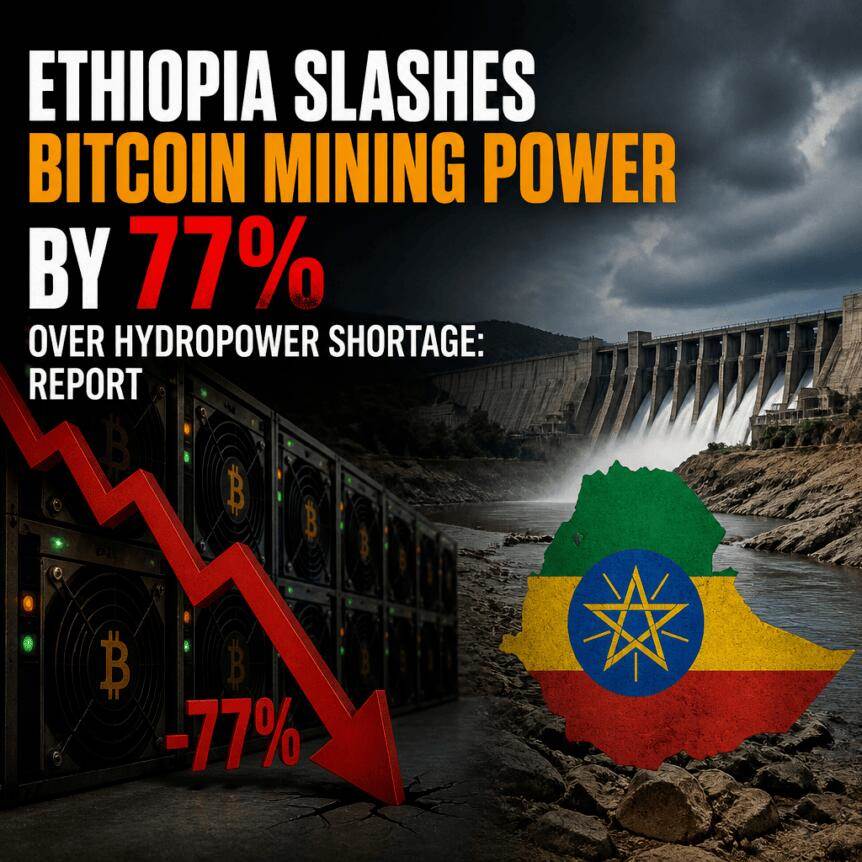
据彭博社报道,受厄尔尼诺现象引发的干旱加剧影响,埃塞俄比亚已大幅削减向比特币挖矿业务输送的电力。此次调整导致矿工的用电额度降至合同约定水平的23%,因为入流量减少给该国的水电系统带来了巨大压力。
彭博社在周二的一份报告中指出,厄尔尼诺现象加剧了东非地区的干燥天气,使水库入水量减少了20%。埃塞俄比亚电力公司(EEP)首席执行官阿什比尔·巴尔查在接受采访时表示,随着水电供应的下降,公用事业部门必须优先保障家庭和工业客户的用电需求。
核心要点
- 据彭博社报道,由于水库入水量下降20%,埃塞俄比亚将比特币挖矿的电力供应削减至合同约定水平的23%。
- EEP表示,其对矿工供电的削减是分阶段进行的——最初降至合同水平的75%,随后进一步放宽至50%,最终降至23%。
- 鉴于矿工在上一个财政年度占据了EEP收入的35%,并消耗了近三分之一的全国电力产出,这一决定凸显了挖矿供应对水文条件的依赖。
- EEP计划于10月重新评估形势,届时可能会面临更深的削减或限制向邻国出口电力的情况。
水电短缺迫使EEP优先保障基本需求
EEP的决定凸显了依赖廉价且灵活的水电资源的挖矿运营的脆弱性。彭博社报道称,EEP最初将供应量削减至合同水平的75%,随后降至50%,最终随着水库入水量的持续减弱而达到23%。
管理层理由十分明确:在水电发电受限时期,公用事业公司通常必须首先分配电力以满足基本消费。巴尔查表示,EEP将在10月重新评估局势,如果供应紧张状况持续,该公司可能会采取进一步的削减措施,甚至限制向邻国出口电力。
对于拥有长期电力协议的矿工来说,分阶段的限电会显著影响运营成本和正常运行时间。这也引发了人们对可再生能源导向型电力合同在极端天气下如何构建的思考——尤其是在同一电网必须同时服务于居民和工业用户的情况下。
为何埃塞俄比亚的挖矿份额使得限电影响重大
与许多司法管辖区相比,比特币挖矿在埃塞俄比亚的足迹异常庞大,因此由水电驱动的削减会对能源经济学以及更广泛的挖矿产能决策产生连锁反应。
Bloomberg reports that miners accounted for 35% of EEP revenue last fiscal year and consumed nearly one-third of Ethiopia's electricity output. This concentration means that shrinking deliveries not only affects EEP's revenue stream, but also demonstrates how miners 'operating capabilities are constrained by national supply constraints.
The country's low hydropower costs have also attracted overseas mining capacity. Bloomberg pointed to strong international interest, including Phoenix Group, which expanded its mining capacity in Ethiopia to 132 MW in April 2025, after other expansion projects have been reported. Early construction suggests investors are willing to bear costs based on a promise to obtain relatively cheap electricity-an assumption that is being directly challenged by drought conditions.
The outlook for the mining economy after halving is even more severe
In addition to the current supply pressure in Ethiopia, Bitcoin analysts are also discussing another topic: mining's demand for electricity and capital may face greater headwinds. Economist Saifedean Ammous, author of "Bitcoin Standards", pointed out in a platform X post on Tuesday that power consumption and capital expenditures for global Bitcoin mining may peak between 2024 and 2025.
Amius's arguments focus on Bitcoin's halving mechanism, which halves the block rewards that miners receive approximately every four years. He suggested that if dollar-denominated mining rewards continue to shrink, mining activity may slow or contract unless there are significant offsetting factors (such as a continued rise in Bitcoin prices).
In the same post, Amius said that even without taking into account the depreciation of the dollar, the price of Bitcoin would need to increase by more than 18.92% annually to maintain the growth in the dollar value of newly mined coins. This argument effectively links mining profitability to two variables: mechanical reductions in circulation and offsetting effects of market prices.
He also cited weak prices, pointing to Yahoo Financial data showing that Bitcoin has fallen by more than 35% in the past 12 months. In this context, Amius believes that unless mining indicators improve, mining activity is expected to slow down, contract, or at least not expand.
Artificial intelligence computing competition may further complicate the power equation of mining
Amius also raises a competitive perspective: AI data centers may provide alternative uses for electricity and infrastructure that miners originally use to monetize. The logic is that when mining returns weaken, power access and dedicated connectivity may be more attractive to other high-demand computing consumers.
To support this view, he cited VanEck's data and Miner Weekly's estimate in June that publicly traded miners could need about $50 billion to build planned AI infrastructure. The implication is not that miners will abandon Bitcoin completely overnight, but that weaker mining economics may encourage some companies to redirect capital to AI-related opportunities.
Amius expressed his conclusion as a testable hypothesis. He acknowledged that significantly higher transaction costs-or a continued recovery in prices above Bitcoin's previous peak power consumption-could overturn the idea that mining power demand is peaking.
Currently, Ethiopia's power rationing measures provide a specific and recent reminder: Mining depends not only on market prices and halving cycles, but also on local energy availability and national policy trade-offs. Readers should pay close attention to the EEP's October reassessment to see if there are additional restrictions, while watching the industry's overall signals to determine whether global mining electricity consumption will stabilize or decline as incentive economics tighten.