
 Exchange Ranking
 Top Exchanges
 24h Volume Ranking
 Popularity Ranking
 Exchange BTC Balance
 Proof of Reserves
 Decentralized Exchanges
 Funding Rate
 Funding Heatmap
 Liquidation Data
 Max Pain
 Long/Short Ratio
 Whale L/S Ratio
 Binance/Okex/Huobi L/S
 Bitfinex Margin L/S
 ETF Tracker
 Solana ETF
 XRP ETF
 Hong Kong ETF
 Bitcoin Treasuries
 Crypto Reversal
 Ethereum Reserves
 HyperLiquid Wallet Analysis
 Hyperliquid Whale Watch
 Large Transactions
 On-chain Movement
 Bitcoin ROI
 Stablecoin Market Cap
 Options Analysis
 News
News Articles
 Economic Calendar
 Features
 Wallet
 Contract Calculator


 Security
 Collections
 Watchlist
 Following
 BCH
BCH  BTC
BTC  PAXG
PAXG  XMR
XMR  XAUT
XAUT Developers have been envisioning a better Bitcoin (BTC) almost since the launch of the Bitcoin network: a cryptocurrency with cheaper payments, greater privacy or a more stable price. To date, no single coin has replaced Bitcoin, but several have broken new ground in their respective fields, and their history reveals what qualities a successful successor needs.
To discuss this issue, we must first start with Satoshi Nakamoto's original intention of creating Bitcoin.
What was the original intention of Bitcoin?
There are many more failed cases of digital cash than most people think. David Shaum's eCash pioneered crypto payments in the 1990s, e-gold has provided gold-backed money transfers since 1996, and Liberty Reserve handles billions of dollars in transactions as "PayPal for unbanked people." All three rely on a centralized operator and end up in the same way: bankruptcy, prosecution or seizure. In 2013, U.S. prosecutors closed Liberty Reserve on suspicion of laundering approximately $6 billion.
Satoshi Nakamoto canceled the role of operator. Drawing on the proof-of-work mechanism used by Adam Buck's Hashcash, as well as the concepts of Dai Wei's b-money and Nick Saab's Bitkinzhong, Satoshi Nakamoto proposed in a 2008 white paper an "electronic payment system based on cryptographic proof rather than trust." He criticized banks that gambled with deposits and central banks that led to currency devaluation, writing in 2009:"The history of legal tender is full of breaches of this trust."
According to Satoshi Nakamoto's vision, Bitcoin's mission is to become a peer-to-peer cash that no one can freeze, censor or issue. Its supply is fixed, allowing it to preserve its value for the long term. Any potential successor must compete with it on this dimension.
What are Bitcoin's main competitors?
Monero
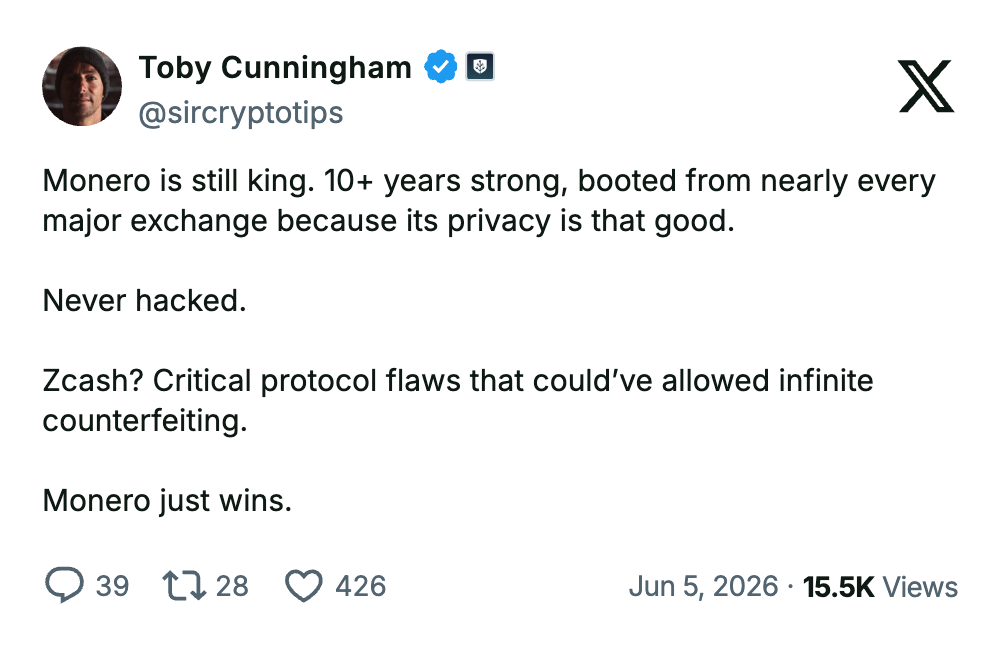
Monero (XMR) provides something Bitcoin does not have: transaction privacy. Bitcoin's public ledger permanently records every transaction, while Monero's ring signature and invisible address hide the sender, recipient and amount, making each coin interchangeable like a physical paper currency. However, this design has brought continued pressure, and in 2025 alone, 73 exchanges will remove XMR. Despite this, the Internet remains strong. In a February 2026 report, TRM Labs found that Monero's on-chain activity was higher than before 2022, and liquidity was shifting to peer-to-peer markets and atomic exchanges. As of July 2026, XMR's market value is approximately US$6 billion.
Bitcoin Cash
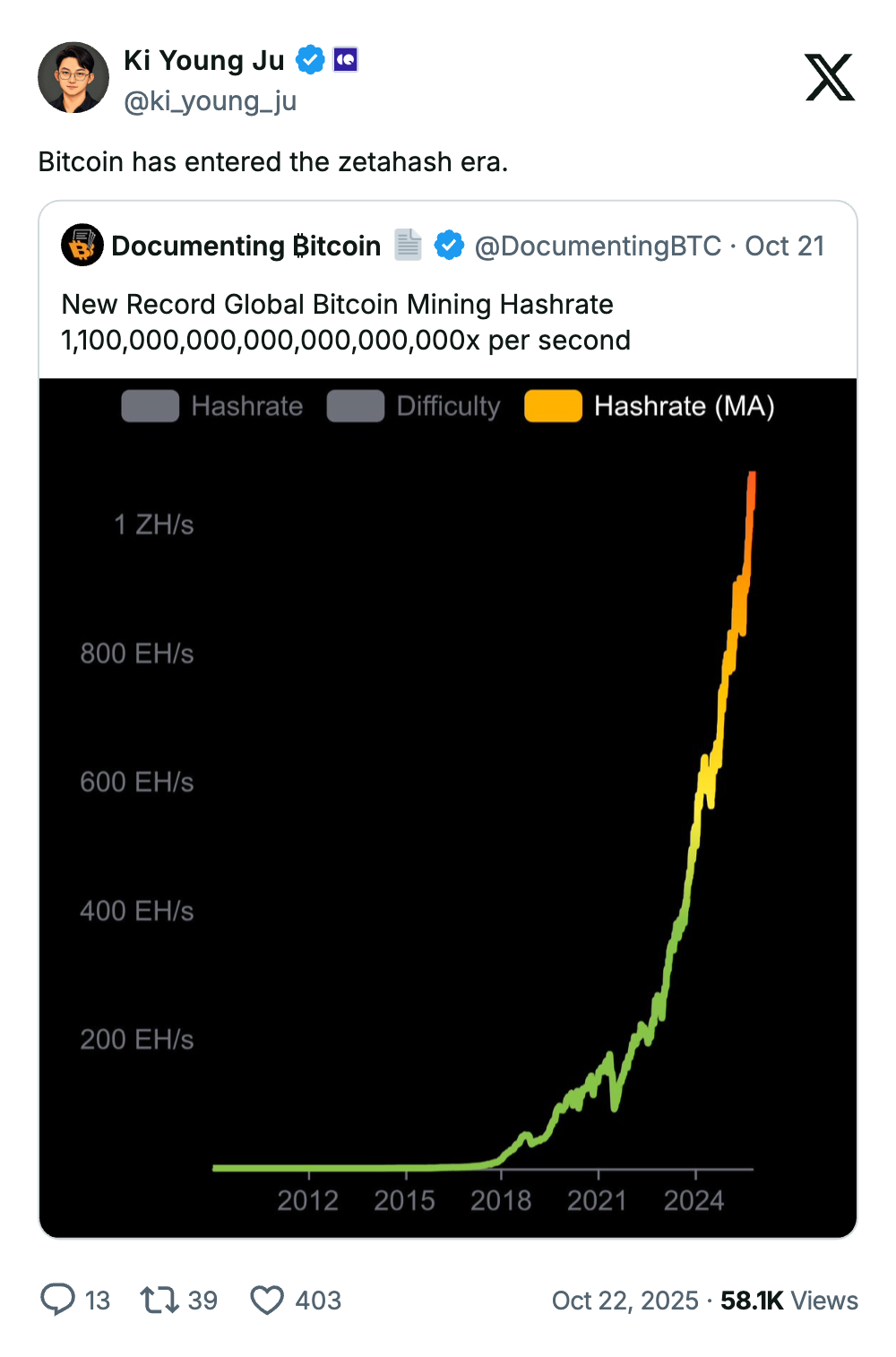
Bitcoin Cash (BCH) was bifurcated from Bitcoin in 2017 over a block-size dispute, with the goal of providing cheap on-chain payments-and indeed achieving low fees. Proponents also defend its "purity": there are no exchange-traded funds (ETFs) or Wall Street custodians, BCH is still flowing point-to-point among the people who spend it, and Bitcoin is increasingly wrapped in institutions that Satoshi Nakamoto avoids. This trade-off is particularly evident when it comes to security budgets. The computing power of Bitcoin Cash is about 3.75 EH/s, which only accounts for about 0.4% of Bitcoin's entire network computing power; while Bitcoin reached one Zeta hash per second in September 2025, which is about 250 times the computing power of Bitcoin Cash's entire network. Since the fork, the value of BCH relative to BTC has fallen by more than 95%.
Tokenized gold
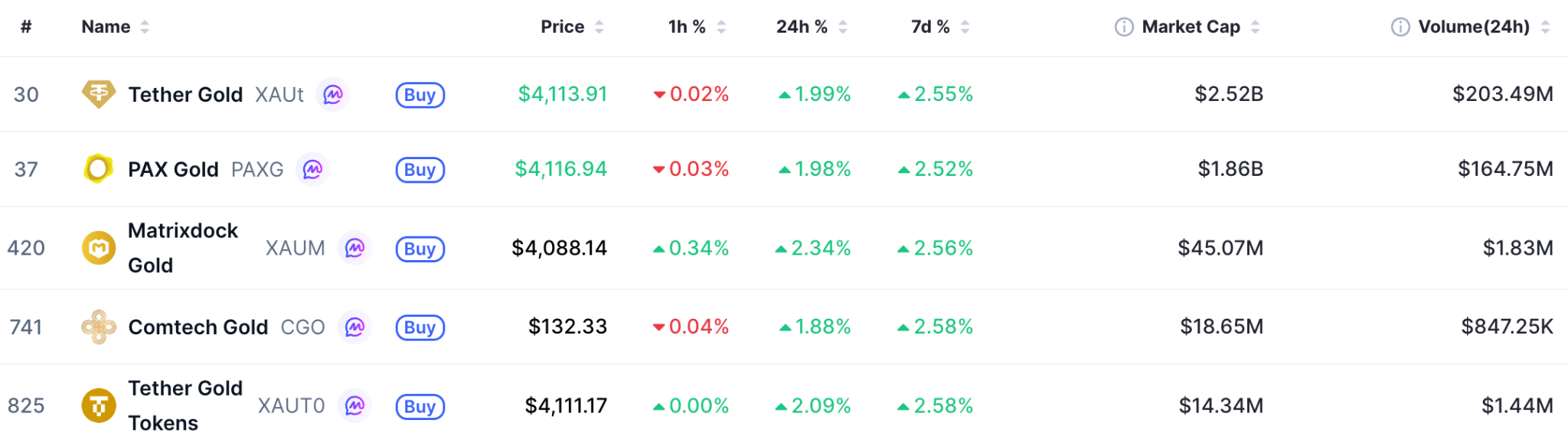
Tokenized gold, such as Pax Gold (PAXG) and Tether Gold (XAUT), respond to the issue of value storage with their five thousand years of history. Issuers have minted approximately $4.4 billion in tokenized gold on the chain, but the two companies control approximately 99% of the market, a structure that reintroduces trusted third parties that Satoshi Nakamoto designed to circumvent.
stablecoin
In terms of cash purposes, the transaction volume of stablecoins far exceeds that of other cryptocurrencies. According to Artemis, stablecoins settled US$33 trillion in 2025, twice Visa's annual transaction volume. However, issuers of the largest stablecoins can freeze addresses on request, exposing them to the same enforcement pressure that led to the end of eCash and Liberty Reserve.
What changes need to be made?
Bitcoin's leadership is based on network effects: it has the deepest liquidity, the largest security budget, and the broadest institutional access channels. Challengers need to find an area where these advantages have less impact, and on-chain surveillance seems to be an obvious candidate. If chain analytics continues to advance and governments take action on Bitcoin's public books-taxing, tracking or blacklisting the currency based on historical records-then Monero's built-in privacy features will shift from a niche preference to a must-have trait for anyone who wants to use digital cash. Even Peter Schiff, who for 15 years has called Bitcoin worthless, now acknowledges the importance of privacy:
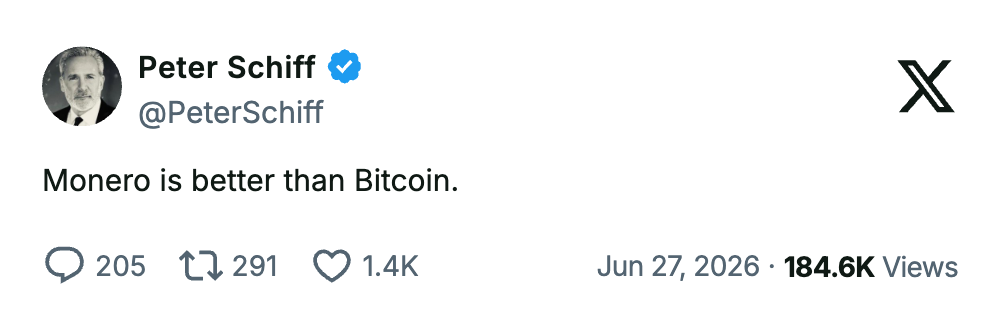
His criticism was directed at Bitcoin's design, not its price. Monero also has its own limitations. Its security budget is only a fraction of Bitcoin's, and liquidity continues to decrease as regulated exchanges exit. TRM Labs found that 48% of the new dark web market will only accept XMR in 2025-a figure cited by regulators in pushing for further removal. Bitcoin Cash once positioned itself as a daily payment currency, but now stablecoins carry most of the transaction volume, and BCH's merchant adoption rate remains limited. Bitcoin itself has not stalled: Lightning Network has achieved the cheap and fast payments promised by forked coins without changing the base layer.
It can be said that every challenger defeated Bitcoin in some way. Monero provides greater privacy, Bitcoin cash has cheaper underlying payments, tokenized gold prices are more stable, and stablecoins have much larger settlement volumes. But every challenger achieves these advantages while sacrificing something, whether it be a security budget, a degree of decentralization, or the ability to resist censorship. Currently, no project has all these features in a single network. Until this is achieved, the question of whether a "better" Bitcoin will someday replace the original cryptocurrency remains open.
























