
 Exchange Ranking
 Top Exchanges
 24h Volume Ranking
 Popularity Ranking
 Exchange BTC Balance
 Proof of Reserves
 Decentralized Exchanges
 Funding Rate
 Funding Heatmap
 Liquidation Data
 Max Pain
 Long/Short Ratio
 Whale L/S Ratio
 Binance/Okex/Huobi L/S
 Bitfinex Margin L/S
 ETF Tracker
 Solana ETF
 XRP ETF
 Hong Kong ETF
 Bitcoin Treasuries
 Crypto Reversal
 Ethereum Reserves
 HyperLiquid Wallet Analysis
 Hyperliquid Whale Watch
 Large Transactions
 On-chain Movement
 Bitcoin ROI
 Stablecoin Market Cap
 Options Analysis
 News
News Articles
 Economic Calendar
 Features
 Wallet
 Contract Calculator


 Security
 Collections
 Watchlist
 Following
 BTC
BTC Bitcoin has been one of the preferred blockchain networks synonymous with security and decentralization for many years. However, with the rapid development of DeFi, NFT and Web3 applications, developers are beginning to need to build the infrastructure for more complex applications on Bitcoin. This demand has spawned new projects aimed at providing more advanced trading capabilities while retaining Bitcoin's core security model. 0xVM (XVM) is one of them. The platform defines itself as an execution layer running on Bitcoin, rather than a new blockchain or Layer 2 network. The goal of the project is to leverage Bitcoin's existing security model while providing developers with a more programmable working environment. The architecture developed through 0xVM aims to allow applications on Bitcoin to support more complex transactions and implement different usage scenarios. By doing so without changing the structure of the Bitcoin consensus mechanism, the project seeks to expand the technical capabilities of the ecosystem.
How does 0xVM work?
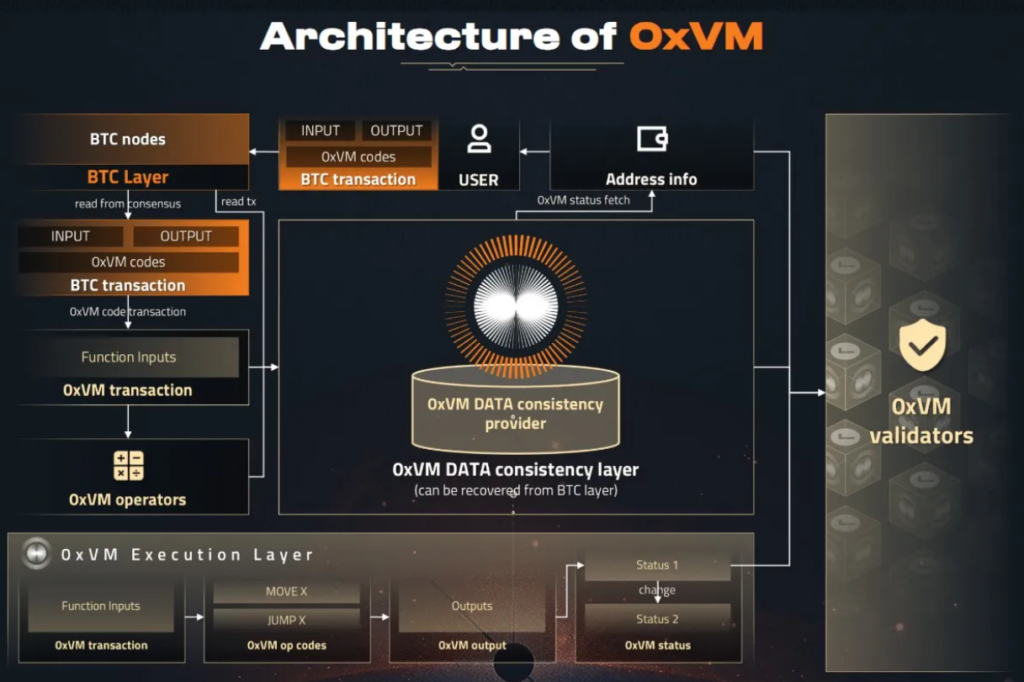
0xVM provides a framework for interpreting transactions running on the Bitcoin network and ensuring that those transactions are executed under specific rules. The project leverages its existing security model without changing the Bitcoin consensus mechanism and adds an additional execution layer.
The architecture defined in thewhite paper consists of three main components:
BTC layer: The fundamental layer where transactions are recorded on the Bitcoin network.
Execution layer: The layer responsible for executing applications and programmable transactions.
Data consistency layer: A data layer designed to maintain and verify the consistency of network records.
With this structure, transactions are recorded on Bitcoin, while the computing processes required to run the application are completed in a separate execution layer.
Different ways to calculate Bitcoin
One of the outstanding features of 0xVM is its unique method of executing transactions. The white paper points out that instead of executing every transaction directly on the blockchain, predictable calculations can be handled in different ways.
The main purpose of this model is to help systems run more efficiently by reducing unnecessary computing burdens. At the same time, the goal is to develop more advanced applications without sacrificing Bitcoin's security model.
Thewhite paper also revealed plans to evaluate GPU and CUDA-based heterogeneous computing support and parallel processing technologies in the future. These efforts aim to contribute to higher transaction processing capabilities in the long term.
Outstanding features of 0xVM
0xVM not only aims to provide a new execution layer, but also hopes to build a more efficient infrastructure for applications developed on Bitcoin.
The main features highlighted in the white paper include:
Utilize Bitcoin's existing security model
Design the execution layer instead of the new blockchain or Layer 2 network
Use a separate data consistency layer to maintain the accuracy of network records
Adopt different transaction sequencing fee models, Aiming to reduce the impact of MEV
Future plans to support parallel processing technology architecture
Aiming to develop more programmable applications on Bitcoin
This approach not only provides developers with a more flexible working environment, but also supports the expansion of the Bitcoin ecosystem into different application areas.
0xVM Verification Node System
In the 0xVM ecosystem, network security is maintained by verification nodes, and transaction verification is also supported by these nodes. According to the white paper, these nodes verify transaction results generated by operators and check the consistency of network records, helping the system operate reliably.
The platform also provides delegated support to include users without technical knowledge into the system. In this way, users can delegate purchased nodes to authorized operators without having to build their own servers to run them.
0xVM's node sales model is also based on specific rules. The initial price for verification nodes is set at $700, and the first 10,000 nodes will remain at this price. After that, for every 10 nodes sold, the price increased by $1. The platform is expected to have a maximum of 50,000 verification nodes.
According to the white paper, node rewards account for 26% of the total token supply. The reward plan is based on a calendar of approximately four years, with daily allocations halved every 180 days. In this way, rewards will gradually decrease over time.
Purpose of XVM Tokens
XVM, as a native token of the 0xVM ecosystem, has multiple uses in different components of the network.
According to the white paper, XVM holders can participate in the governance process and vote on future proposals and updates to the network. Verify node operators receive XVM rewards by contributing to the network.
In addition, XVM tokens are also used to participate in pledge mechanisms, ecosystem activity rewards, specific airdrop plans, early access to new products and services, fee discounts for certain DeFi transactions, etc., becoming the core of the ecosystem.
The white paper also pointed out that in order to support the pledge economy in the future, changes in token supply will be evaluated within the community governance framework.
XVM Token Economy Model
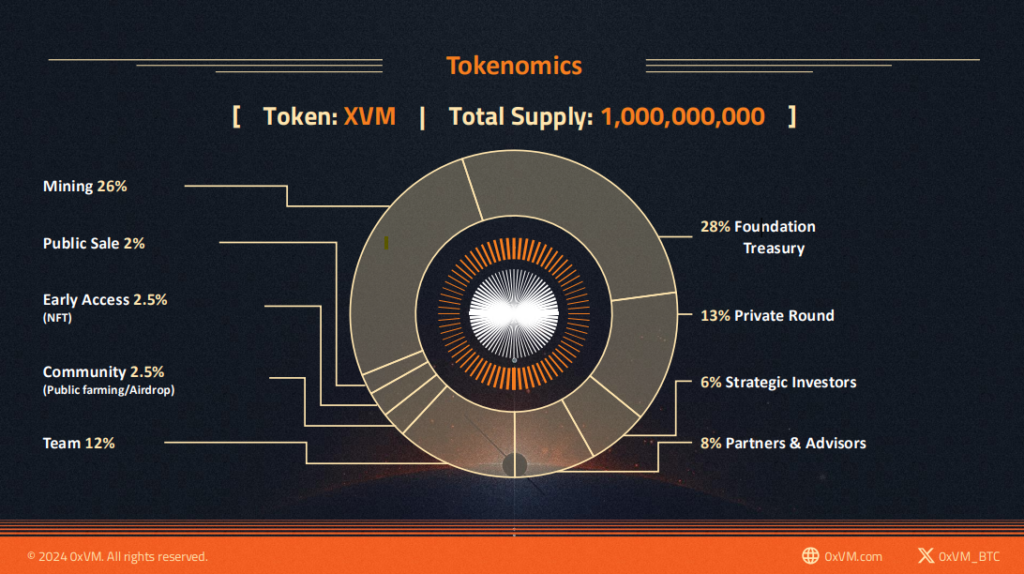
The total supply of 0xVM is limited to 1 billion XVM. The token allocation program is designed to support ecosystem growth, cybersecurity and long-term project development.
Allocation is as follows:
Category Proportion
Foundations 28%
Mining (verification node rewards) 26%
Private equity 13%
Teams 12%
Partners and consultants 8%
Strategic investors 6%
Community 2.5%
Early access NFT 2.5%
Public offering 2%
A portion of the plan allocated by the Foundation is used for research and development, ecosystem growth and operational activities. The mining pool is used to fund verification node rewards.
The white paper states that tokens designated by teams, investors and foundations will enter circulation according to the unlocking schedule. The purpose of this approach is to reduce sudden supply pressures on the market.
Investors and partners
0xVM aims to build an ecosystem of different investors and technology partners during its development process. According to information shared by the projects, there are multiple institutions active in blockchain infrastructure, Web3 development and investment around the platform.
The official website displays the logos of investors and partners, which aim to promote ecosystem growth and improve technological infrastructure.

Conclusion
As the Bitcoin ecosystem evolves, infrastructure projects that go beyond just focusing on value transfer are becoming increasingly important. As one of the projects developed in this field, 0xVM aims to leverage Bitcoin's existing security model while providing developers with a more programmable working environment.
The project features an execution layer architecture, a data consistency layer architecture, and a verification node system, and aims to build the infrastructure for developing more advanced applications on Bitcoin.
The extent to which 0xVM, which is still in development, is achieving its technical goals will be made clearer through future releases, ecosystem growth rates, and developer interest.
























