
 Exchange Ranking
 Top Exchanges
 24h Volume Ranking
 Popularity Ranking
 Exchange BTC Balance
 Proof of Reserves
 Decentralized Exchanges
 Funding Rate
 Funding Heatmap
 Liquidation Data
 Max Pain
 Long/Short Ratio
 Whale L/S Ratio
 Binance/Okex/Huobi L/S
 Bitfinex Margin L/S
 ETF Tracker
 Solana ETF
 XRP ETF
 Hong Kong ETF
 Bitcoin Treasuries
 Crypto Reversal
 Ethereum Reserves
 HyperLiquid Wallet Analysis
 Hyperliquid Whale Watch
 Large Transactions
 On-chain Movement
 Bitcoin ROI
 Stablecoin Market Cap
 Options Analysis
 News
News Articles
 Economic Calendar
 Features
 Wallet
 Contract Calculator


 Security
 Collections
 Watchlist
 Following
 BTC
BTC  ETH
ETH  SOL
SOL  XRP
XRP Key insights
Cryptocurrency ETFs recorded a net outflow of approximately US$250 million on July 31.
Outflows from Bitcoin ETF reached US$265.37 million.
Despite the divestment of Bitcoin, the Ethereum ETF product attracted a net inflow of US$9.03 million.
The net outflow of US-listed cryptocurrency ETFs was approximately US$250 million
On July 31, the US-listed cryptocurrency ETFs recorded a net outflow of approximately US$250 million. Bitcoin products were the main factor behind the decline, while Ethereum, XRP and Solana funds maintained positive inflows.
This divergence shows that institutions 'demand for digital asset products is uneven. The redemption scale of Bitcoin funds exceeded the small inflow of other competing cryptocurrency products.
This day's reversal is noteworthy because Bitcoin funds also attracted US$233.15 million in inflows the previous day. The two-day fluctuations indicate that the allocation of funds during the month-end adjustment stage changes very rapidly.
Bitcoin prices were also hovering around US$63,500 at the time. This weak price makes fund flows more vulnerable to weakening market momentum.
Cryptocurrency ETF reversal: Bitcoin funds lost US$265 million
Data from Farside Investors showed that on July 31, the spot Bitcoin cryptocurrency ETF recorded a net outflow of US$265.37 million. BlackRock's iShares Bitcoin Trust led the way with $122.66 million in redemptions.
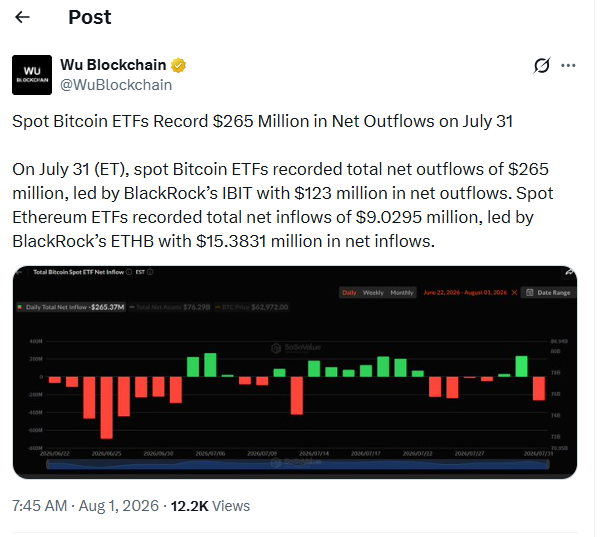 Cryptocurrency ETF: Bitcoin ETF outflows raise concerns
Fidelity's Wise Origin Bitcoin Fund followed closely, withdrawing $54.78 million. Analyst Trader T's dataset showed that gray's Bitcoin trust recorded an outflow of $52.63 million. Bitwise's BitB lost $17.77 million on the day. ARK 21Shares 'ARKB also decreased by $17.54 million.
Six listed Bitcoin funds reported no net changes. These funds include products managed by Invesco, Franklin Templeton, Van Eck and Wisdom Tree.
This result erased $233.15 million in Bitcoin ETF inflows from the previous trading day. Among them, BlackRock's IBIT contributed $183.41 million on July 30.
This sudden reversal suggests that capital flows are a short-term allocation adjustment rather than a steady accumulation. During the last few trading sessions of July, the daily flow of cryptocurrency ETFs remained unstable.
Daily ETF traffic may turn negative when authorized participants redeem fund shares. These redemptions reduce asset size and may trigger the transfer or sale of underlying bitcoins.
But this does not prove that BlackRock made a directional judgment on the Bitcoin market. BlackRock manages the trust structure only for shareholders and authorized participants.
Market expert Crypto Patel estimated on Platform X that these ETFs sold approximately 4,217 bitcoins in July 31 transactions. This amount is equivalent to nearly nine days of new Bitcoin mining supply.
However, ETF flow estimates track cash purchases and redemptions and do not represent the issuer's independent trading decisions.
Cryptocurrency ETF divergence: Ethereum ETF demand remains positive
SoSoValue data shows that the net inflow of spot Ethereum funds is US$9.03 million. BlackRock's Ethereum products led the category with an inflow of $15.38 million.
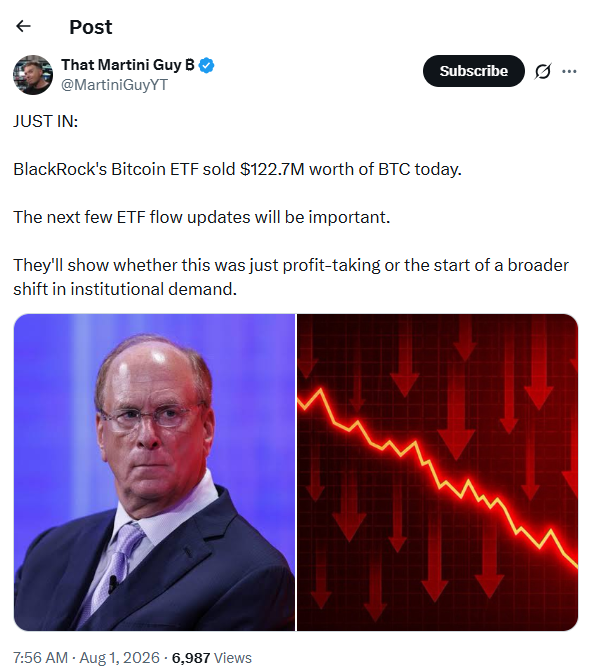 BlackRock Bitcoin ETF becomes focus
Fidelity, Gray and Bitwise's Ethereum cryptocurrency ETFs also received smaller capital allocations. These inflows offset the divestment of other Ethereum products.
The inflow of the Ethereum ETF contrasts with the outflow of the BlackRock Bitcoin Fund. This divergence suggests that investors distinguish between different products in the day's trading.
However, this does not confirm that funds have been permanently diverted from Bitcoin to Ethereum. The evidence provided by a single trading session is limited and insufficient to support broader asset allocation trends.
According to Crypto Patel's dataset, XRP funds increased by approximately $7.69 million. During the same period, Solana products received approximately $395,39 million.
Hyperliquid Fund lost $1.83 million. Products related to several smaller cryptocurrencies reported no net traffic. Taken together, the total daily outflow of U.S. spot cryptocurrency ETFs is approximately US$250 million. Bitcoin products are the main reason for negative values across the category.
Ethereum and other products only reduced the decline. Their inflows are still small compared to the scale of Bitcoin redemptions. This divergence across assets also suggests that a single aggregated data masks different demand patterns. Bitcoin faces concentrated redemptions from five major funds.
Ethereum recorded small, scattered purchases from multiple issuers. XRP and Solana cryptocurrency ETFs also maintained positive daily traffic.
Bitcoin ETF outflows encounter weak price momentum
CoinMarketCap data shows that on August 1, bitcoin prices traded around US$63,650, down about 1.5% in 24 hours. Its market value is close to US$1.27 trillion. During the reporting period, daily trading volume exceeded US$26 billion.
The July 31 traffic reversal occurred as Bitcoin struggled below its 50-day moving average. MarketWatch reported that Bitcoin remained below this trend indicator in late July.
This structure limits evidence that demand for cryptocurrency ETFs has regained broader price momentum. Bitcoin is also still below its July high.
XS.com's Linh Tran previously said that the ETF reversal reflected caution ahead of new monetary policy signals. His comments were reported on July 27.
His assessment occurred before the latest outflows, but was consistent with unstable fund allocation patterns during recent trading sessions.
BlackRock describes IBIT as an exchange-traded product that provides Bitcoin exposure without direct custody. Its product page shows that position data reflects the trust's investment history.
This structure means that investor subscriptions and redemptions determine reported fund flows and distinguishes shareholder activity from BlackRock's corporate balance sheet decisions.
Cryptocurrency ETFs face new demand test in August
The U.S. Securities and Exchange Commission approved spot bitcoin exchange-traded products on January 10, 2024. Former chairman Gary Gensler said the approval covered listings and trading, but added that the decision was not an endorsement of Bitcoin.
This distinction remains relevant when interpreting institutional needs through daily traffic. Redemptions of cryptocurrency ETFs reflect investor activity within regulated products.
Weekly traffic totals will provide a clearer signal of demand than a single-day trading session and can show whether redemptions are expanding among multiple issuers.
The next U.S. trading session will show whether the July 31 divestment extends into August. If another wave of large-scale outflows occurs, it will support the view that demand has been weak in the near term; if it reverses quickly, it will further support the explanation of month-end rebalancing.
























