
 Exchange Ranking
 Top Exchanges
 24h Volume Ranking
 Popularity Ranking
 Exchange BTC Balance
 Proof of Reserves
 Decentralized Exchanges
 Funding Rate
 Funding Heatmap
 Liquidation Data
 Max Pain
 Long/Short Ratio
 Whale L/S Ratio
 Binance/Okex/Huobi L/S
 Bitfinex Margin L/S
 ETF Tracker
 Solana ETF
 XRP ETF
 Hong Kong ETF
 Bitcoin Treasuries
 Crypto Reversal
 Ethereum Reserves
 HyperLiquid Wallet Analysis
 Hyperliquid Whale Watch
 Large Transactions
 On-chain Movement
 Bitcoin ROI
 Stablecoin Market Cap
 Options Analysis
 News
News Articles
 Economic Calendar
 Features
 Wallet
 Contract Calculator


 Security
 Collections
 Watchlist
 Following
 ADA
ADA  ARB
ARB  BTC
BTC  ENA
ENA  ETH
ETH  ONDO
ONDO  SUI
SUI  XLM
XLM The integration stage is the period when positioning is formed. Prices have stopped trending, trading volume has shrunk, retail investors have shifted their attention elsewhere, and assets that will lead the next round of gains are quietly changing hands. This is roughly the current situation of the cryptocurrency market in early August 2026.
Bitcoin traded at US$63,043, down about 28% during the year and squeezed between the US$62,000 support and the downtrend line that has suppressed every rally since July 21. Most large-cap altcoins fell between 32% and 44% during the year. The chart below focuses on tokens with prices below $5, small market capitalizations and large retractions, but the selection is based on clear catalysts rather than simple price weakness. Cheap tokens in and of itself does not constitute investment logic.
Why is the cryptocurrency market in the consolidation stage now?
As of 13:11 UTC on August 2, Bitcoin was trading at US$63,043, a slight increase of 0.12% during the day, and the three-hour chart showed a textbook-style compression pattern.
This structure has four clear boundaries:
Downtrend line resistance: Since hitting a high of $66,803 on July 21, Bitcoin has formed a series of clear downward highs. This trend line has suppressed all attempts to rebound in the past two weeks.
200-cycle EMA ($63,969): This moving average provided support for most of July, but turned into resistance around July 30. Bitcoin has been trading below that moving average since then.
Horizontal resistance level of US$65,000: This level lost ground at the end of July and is currently above the EMA and trend line.
Support level of $62,000: On July 25 and August 1, this level absorbed selling; the more important support level was $58,000, the starting point of gains in early July.
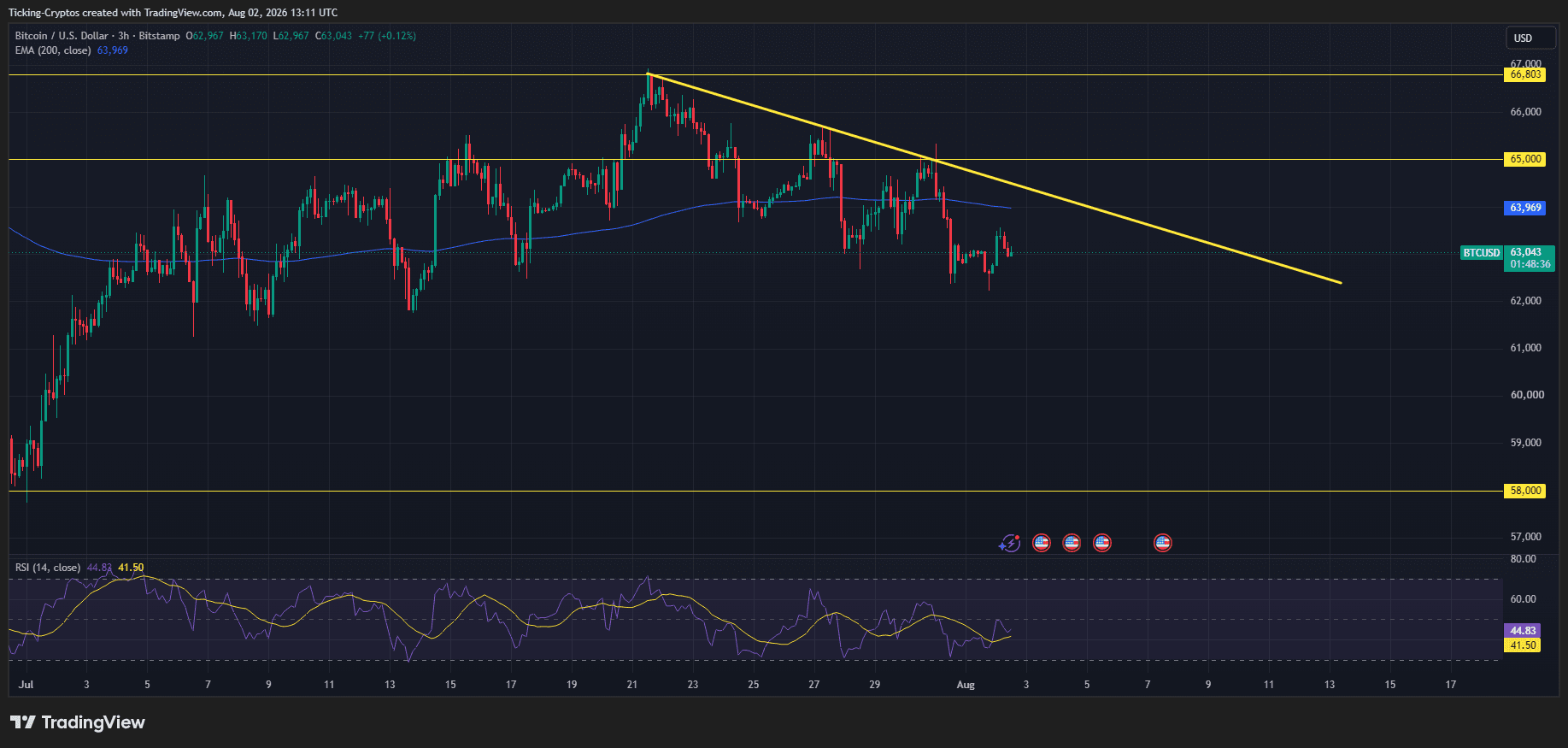 The RSI reading was 44.83, with a mean of 41.50. This is below the neutral 50th line, but is recovering from lows rather than getting worse. Sellers are basically exhausted and buyers are absent-this is the definition of integration.
The important detail is that this range is narrowing. The downtrend line is moving downward towards level support of $62,000, which means the two boundaries will meet in the next two weeks, forcing the market to make a direction choice rather than sideways indefinitely. Breaking through the trend line and the $63,969 EMA will open up $65,000 space and point to the July 21 high of $66,803. If it loses $62,000,$58,000 will come into view, down about 8%, and the altcoins will almost certainly fall even more.
This stage has three characteristics: volatility has been compressed-Bitcoin absorbed the hawkish Federal Reserve, a $70 million wallet loophole, and stagnant regulatory bills in a week, but only fell by about 2%; Institutional capital flows have stabilized but have not yet turned positive-the net inflow of U.S. spot Bitcoin ETF in July was US$172.4 million, ending a two-month outflow, but far less than the pace that had previously driven the rise; Altcoins have become increasingly divided-Cardano rose 12.36% in a week, while Hyperliquid fell 11.02%, indicating that the market is trading based on its own catalysts rather than a one-directional impulse.
The last point is the most important for this article. When correlations collapse, specific developments in the token begin to determine the return.
What macro forces are actually driving altcoin prices?
Monetary policy is the dominant variable. The FOMC kept rates at 3.50% to 3.75% on July 29, but voted 9 - 3, with Beth Hammack, Neel Kashkari and Lorie Logan all voting for a 25 basis point rate hike. This is the most divided committee since September 2016. CME FedWatch currently shows a 61.4% probability of a rate hike in September, up from 50.6% a month ago. Higher real yields compress valuations of long-term risky assets, and altcoins are at the far end of the spectrum.
Geopolitical risks persist, but the market has gradually absorbed them. The Iran-related conflict that escalated at the end of February due to the joint strike between the United States and Israel remains unresolved. Brent crude oil carries a geopolitical risk premium throughout 2026, and its trading price in July is above US$90. The Russia-Ukraine war is entering its fifth year and a sanctions bill is currently being passed to occupy Senate time. The important nuance is that the market has basically adapted. Analysts are increasingly describing cryptocurrencies as a liquidity sponge: expanding when the global money supply and risk appetite rise, contracting when real interest rates rise, and largely unaffected by headlining conflict situations. War headlines trigger violent intra-day fluctuations, but often the average returns; interest rate expectations trend.
Regulatory clarity has been delayed. The CLARITY bill has passed the House and Senate Banking Committees, but a full vote has not yet been scheduled, and Majority Leader John Thune does not expect a vote until the recess is suspended around August 7. The probability of passing in 2026 on Polymarket has dropped from more than 80% in February to about 35%. For altcoins, this is the most influential of the three because the bill would have solved the token classification issue that keeps most regulated agencies away from assets other than Bitcoin and Ethereum.
Security risks have been re-priced. On July 30, an attacker stole 1,082.65 BTC (worth approximately $70.2 million) from 1,196 Coldcard generated addresses, exploiting a firmware vulnerability that allowed offline reconstruction of seed phrases. Blockaid reported that cryptocurrency projects lost more than US$1 billion due to hacking attacks in the first half of 2026. This raises the risk premium across the industry and has a particularly severe impact on agreements that hold large amounts of user money.
Top five altcoins worth paying attention to in August 2026
1. Ondo (ONDO)
Price: approximately US$0.38 to US$0.41| Market value: approximately US$1.9 billion| Down approximately 81% from the all-time high of US$2.14
$Ondo has the most specific institutional pipeline of any token in this list. Its tokenization plan associated with DTCC will be launched in July 2026, involving BlackRock, JPMorgan Chase and Goldman Sachs to tokenize Russell 1000 stocks and treasury bonds. Another cross-border settlement pilot project with JPMorgan Chase's Kinexys platform, MasterCard and Ripple was completed in five seconds. The agreement extends tokenized securities on Solana to enable round-the-clock minting and redemption, and launches Ondo Perps, which provides perpetual contracts linked to stocks and commodities. The total locked position value is close to the historical record of US$3.5 billion, with more than 205,000 holders. A governance vote to permanently destroy 100 million ONDOs (10% of the total supply) ended on July 25.
Risk: Ondo is the clearest example of platform growth in the market that has failed to translate into token performance. TVL hit an all-time high while prices were flat, a documented disconnect. About half of the 10 billion total supply has not yet entered circulation, which means that dilution remains a structural drag regardless of adoption rates.
2. Sui (SUI)
Price: approximately US$0.72 to US$0.78| market value| Well below historical highs
$Sui achieved a true institutional milestone on July 23: Abu Dhabi sovereign wealth fund Mubadala tokenized a $75 million private market fund directly online. The same week, Hashi launched a Sui-based Bitcoin lending test network for institutional BTC backed credit markets. This pattern suggests that the network is targeting regulated financial products rather than retail DeFi activity. The price trend is more positive than the overall altcoin pattern. SUI regained key technical levels at the end of July, and activities on the chain increased simultaneously.
Risk: Technical patterns are attempts to rebound from cyclical lows rather than confirmed trend reversals. Sui also tends to follow overall altcoin liquidity and Bitcoin dominance more closely than its own news, which limits the influence of Mubadala headlines in dull markets.
3. Stellar (XLM)
Price: approximately US$0.18| Down approximately 79% from the 2018 all-time high of US$0.94
$Stellar has built an exceptionally trustworthy collection of institutional validators. MoneyGram, Figure Markets and Range all joined as first-level verifiers in July. Tradable has committed to bringing up to $1 billion in tokenized private credit to the network. Most importantly, DTCC has confirmed plans to connect its tokenized securities platform to Stellar, and $XLM is expected to be used as a settlement asset. The network activated Protocol 27 after the July 8 vote, introduced authentication commissions, and reported issuing more than $2 billion in real-world assets in the first quarter of 2026 alone. The supply of stablecoins online has increased by nearly 300% in two years.
Risk: DTCC's launch target is in the first half of 2027. This is a long wait, and the long-term catalyst is the most serious factor in the market's discount given the 61.4% probability of a September rate hike. XLM also failed to hold the resistance level of $0.20 many times.
4. Arbitrum (ARB)
Price: approximately US$0.08| Market cap: approximately $517 million|
$Arbitrum represents the most significant divergence between network usage and token price in this group. Robinhood Chain launched its mainnet in early July using Arbitrum technology, peaking at more than $500 million in daily trading volume and generating 17 million transactions and 350,000 addresses in its first week. The network surpassed Hyperliquid, ranking eighth in total lock value among all chains at approximately $1.2 billion, and led all Layer 2 networks in Aave v3 lending activity with a TVL of $728 million. During periods of severe token weakness, usage remained strong.
Risk: The reason for this differentiation is dilution and continues. Arbitrum unlocked approximately 92.65 million tokens in mid-July, most of which went to teams, advisers and investors, with further unlocks to be held for the rest of 2026. Continued selling pressure from ownership is the direct cause of poor price performance, and the timetable will not change until the end of the year.
5. Ethena (ENA)
Price: approximately US$0.083| Market value: approximately US$790 million| Down approximately 94% from the all-time high of US$1.52
$Ethena is the riskiest name here, and it is on the list for only one reason: the institutional distribution is real. BlackRock integrated Erena's USDe into its Aladdin risk management platform. Janus Henderson holds an ENA position and plans to use pledged USDe for treasury cash management, adding to existing relationships with Anchorage Digital and Securitize. A potential fee switch activation would transform ENA from a pure governance token to a cash flow-linked asset, directing agreement revenue to pledgers, the single change most likely to re-evaluate the token.
Risk (and considerable): Fundamentals are deteriorating, not improving. In the first quarter of 2026, total agreement revenue fell 32% month-on-month to US$65.06 million. USDe supply has dropped from a peak of $14.5 billion to approximately $5.92 billion. Daily active users dropped to approximately 1,200. Ethena completed the unlocking of 172 million tokens on July 4, with further releases in August, with approximately 40% of the maximum supply of 15 billion still pending allocation. Ethena's model also relies on funding rates, which means that when market sentiment turns negative, its yields compress accurately. This is a speculative position based on whether fee switches and institutional distribution can outpace the contraction agreement, rather than a bet on current performance.
Compare where to trade these tokens?
Fees and spreads are more important in range markets than in trend markets.
What are the risks of purchasing altcoins during integration?
Integration does not guarantee upward breakthroughs. The range breaks in both directions, and a closing price of Bitcoin below $62,500 could drag down every token on this list, regardless of its respective catalysts, as the correlation between altcoins and Bitcoin increases sharply during downturns.
There are three risks that deserve special attention this month. Token unlocking affects three of the five names in this list: ARB, ENA, and ONDO all have active or upcoming dilution plans. The September interest rate decision is a binary event. The market currently has a pricing probability of raising interest rates at 61.4%, and the altcoin is the expression with the highest beta value in this result. Deep retractions do not automatically constitute an entry point, as approximately 94% of major tokens launched since 2024 are now trading at a price lower than the issue price, with a median return of approximately-95.7%. Most assets that have fallen by 90% will continue to fall.
The recent schedule is intensive: U.S. non-farm payrolls data on August 7, Senate recess on the same day, and CPI data on August 12. All of this occurred before any of the above catalysts had time to develop.
























