Exchange Ranking
 Top Exchanges
 24h Volume Ranking
 Popularity Ranking
 Exchange BTC Balance
 Proof of Reserves
 Decentralized Exchanges
 Funding Rate
 Funding Heatmap
 Liquidation Data
 Max Pain
 Long/Short Ratio
 Whale L/S Ratio
 Binance/Okex/Huobi L/S
 Bitfinex Margin L/S
 ETF Tracker
 Solana ETF
 XRP ETF
 Hong Kong ETF
 Bitcoin Treasuries
 Crypto Reversal
 Ethereum Reserves
 HyperLiquid Wallet Analysis
 Hyperliquid Whale Watch
 Large Transactions
 On-chain Movement
 Bitcoin ROI
 Stablecoin Market Cap
 Options Analysis
 News
News Articles
 Economic Calendar
 Features
 Wallet
 Contract Calculator


 Security
 Collections
 Watchlist
 Following
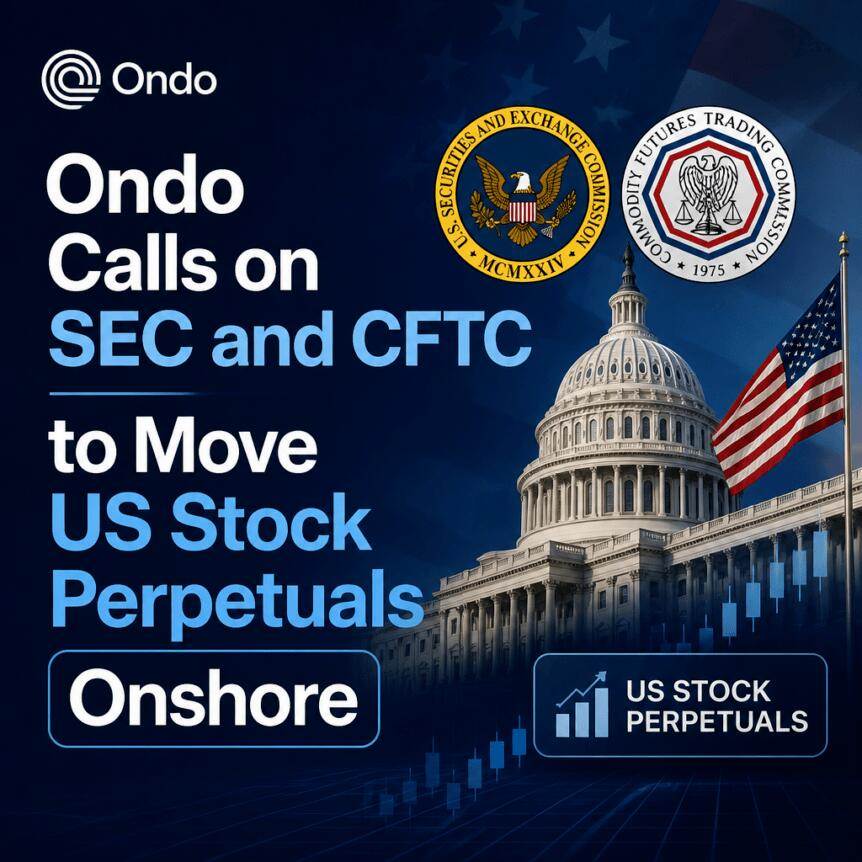
Ondo Finance calls on U.S. regulators to allow the trading of perpetual contracts for individual stocks in China.
Ondo Finance has submitted a request to U.S. regulators to allow the launch of perpetual futures contracts linked to individual stocks in the United States, and maintains that the existing securities and futures framework is sufficient to cover such products and no new rules are needed. The request was made in three comment letters filed August 24 with the Securities and Exchange Commission (SEC) and the Commodity Futures Trading Commission (CFTC).
In a filing, Ondo said that perpetual contracts can track the price of underlying stocks by imitating the maturity and funding logic mechanisms found in traditional futures markets. The company also mentioned its overseas business, pointing out that about six weeks after its launch, its cumulative trading volume of perpetual stock futures had reached US$8 billion as of August 14.
Core Points
Ondo believes that the definition of "securities futures" in the United States does not require a fixed maturity date, so perpetual stock futures can be supported under the existing framework. The company claims that regular capital payments can align the price of the perpetual contract with the price of the underlying stock, and function like an expiration mechanism. Ondo also pointed out that many stocks facing overseas are mainly traded on U.S. exchanges, so regulators should focus on bringing such trading activities into the United States. Ondo cited its sustainable product settled in overseas stablecoins as an example to prove that the product is designed to operate on a large scale, and reported that the cumulative transaction volume as of August 14 had reached US$8 billion.
The push comes as the SEC and CFTC strengthen coordination and cooperation, and the SEC proposes updates to infrastructure rules that affect tokenized securities.
Ondo's argument: Perpetual contracts meet existing definitions of securities futures
Ondo's core position is that perpetual structures are not automatically excluded from the legal definition of securities futures products. In a product classification comment letter, the company stated that "nothing in the legal definition of securities and futures products requires a fixed maturity date," thereby defining perpetual contracts as compatible with existing legal categories.
In addition to legal interpretations, Ondo also responded to the operational questions that regulators typically ask about sustainable products: how to maintain price alignment over time. The company believes that regular capital payments can play the same role as the maturity of traditional futures, by incentivizing perpetual contract prices to remain close to reference stock prices.
These letters also link discussions to modern market mechanisms. Ondo pointed out that modern margin methods and on-chain market data need to be considered-elements common to blockchain-based derivatives markets but may not have been explicitly considered in early derivatives rulemaking.
The importance of overseas operating records and "return"
To strengthen its request, Ondo mentioned existing overseas products. According to the company, its Panama-based affiliates already offer perpetual futures based on U.S. listed stocks settled in stablecoins outside the United States. Ondo said the platform's cumulative transaction volume reached US$8 billion as of August 14 within about six weeks of its launch.
Ondo's letter also emphasized that "bringing such activity back to the United States" should not be an open issue, as many of the underlying stocks are mainly traded on U.S. exchanges. The company recommended that the SEC and CFTC actively seek ways to allow similar products to operate legally in the United States.
For investors and traders, the core issue is regulatory clarity. When derivatives linked to familiar underlying assets flow overseas, it may be more difficult for U.S. regulators to monitor liquidity and price discovery. Ondo's push is actually arguing that regulators can proactively capture these transactions rather than allow them to take place on overseas platforms.
Regulators reassess rules on crypto and tokenized securities
Ondo's proposal comes as the SEC and CFTC re-examine how old market frameworks apply to blockchain-native products, including perpetual futures and tokenized securities. Efforts have also emerged this year to reconcile overlapping jurisdictions. The SEC and CFTC signed a memorandum of understanding in March aimed at coordinating areas of regulatory overlap.
In addition, the SEC has begun updating parts of its transfer agency framework, proposing changes to reflect the growing demand for blockchain-native record-keeping and tokenized securities. The proposal makes clear that rules designed for traditional infrastructure may no longer match the operating realities of modern tokenized markets.
At the same time, public comments from U.S. politicians continue to focus on bringing popular online derivatives trading platforms into U.S. regulation. In August, President Donald Trump said CFTC Chairman Michael Selig was committed to bringing Hyperliquid into the United States "in a fully compliant and legal manner." Hyperliquid is widely associated with on-chain perpetual futures, but neither the CFTC nor Hyperliquid provides details on how to achieve this access in public materials.
Although Ondo's document focuses on perpetual futures linked to U.S. stocks, the broader message for market participants is that regulators are not just observing the crypto market, they are actively adjusting how rules involving tokenized assets and derivatives are interpreted and enforced.
Ondo's broader positioning in the tokenized real-world asset space
Ondo's push in derivatives is also consistent with its position in the tokenized real-world asset space (RWA) space. According to RWA.xyz data cited by the company, as of Wednesday, Ondo ranked fourth among tokenized RWA managers by assigned value, at approximately $2.6 billion.
This background is important because tokenized RWA infrastructure often relies on interactions at multiple stages of the market: transactions, custody/record-keeping, and derivatives or hedging instruments. Establishing a regulatory path for perpetual stock futures could enhance application scenarios for tokenized assets and related financial products, especially if U.S. market participants are allowed to use familiar reference tools and are subject to clearer regulation to hedge risks or express opinions.
At the same time, uncertainty remains as to how regulators will view the specific mechanisms for perpetual contracts-especially the mapping of funding rates, margins and data flows on the chain to existing market regulatory and compliance expectations. Ondo's letter raises legal and structural arguments, but the actual outcome will depend on how the SEC and CFTC respond during the rule-making and enforcement interpretation process.
The most important signal for readers watching next developments will be whether the SEC and CFTC will regard Ondo's position as a sufficient condition for market entry under existing securities and futures rules, or whether they will require additional guidance to define acceptable perpetual contract structures linked to U.S. listed stocks.