Exchange Ranking
 Top Exchanges
 24h Volume Ranking
 Popularity Ranking
 Exchange BTC Balance
 Proof of Reserves
 Decentralized Exchanges
 Funding Rate
 Funding Heatmap
 Liquidation Data
 Max Pain
 Long/Short Ratio
 Whale L/S Ratio
 Binance/Okex/Huobi L/S
 Bitfinex Margin L/S
 ETF Tracker
 Solana ETF
 XRP ETF
 Hong Kong ETF
 Bitcoin Treasuries
 Crypto Reversal
 Ethereum Reserves
 HyperLiquid Wallet Analysis
 Hyperliquid Whale Watch
 Large Transactions
 On-chain Movement
 Bitcoin ROI
 Stablecoin Market Cap
 Options Analysis
 News
 Articles
 Economic Calendar
 Features
 Wallet
 Contract Calculator


 Security
 Collections
 Watchlist
 Following
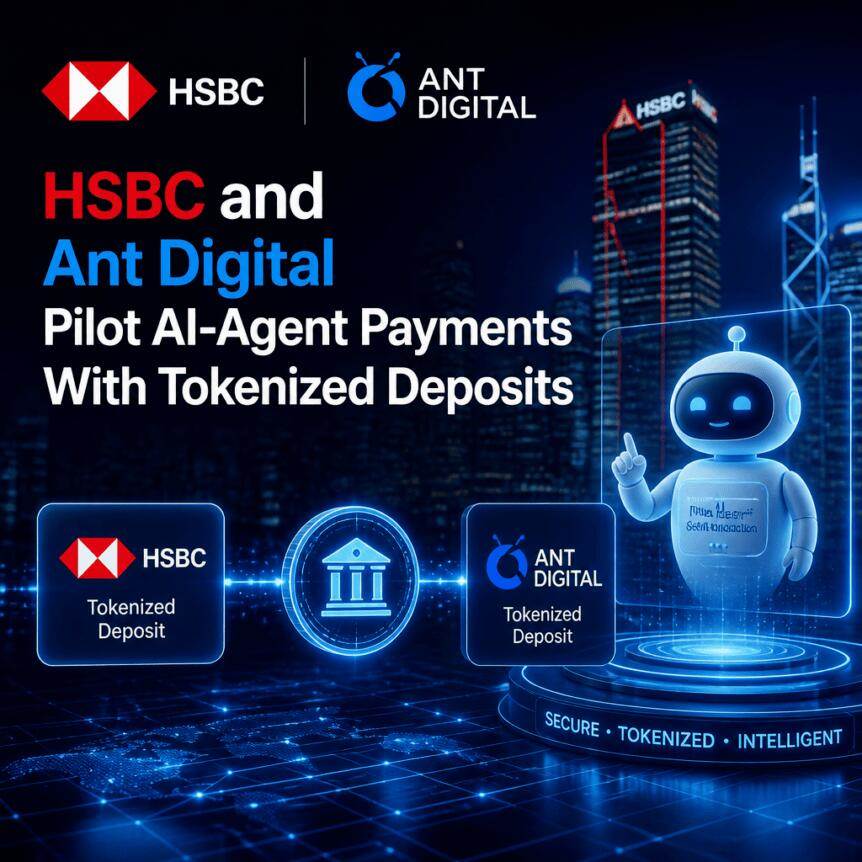
HSBC and Ant Digital Technologies successfully test AI proxy payment process based on tokenized deposits
HSBC and Ant Digital Technologies announced that they have successfully tested an AI proxy payment workflow that utilizes tokenized bank deposits. In this test, settlement was completed in real time in a blockchain testing environment. This demonstration combines HSBC's Tokenised Deposit Service with Ant Digital's "Anvita Flow" network to enable AI-driven service access and payment, and uses Jovay Testnet as a Layer-2 test platform.
During testing, a simulated AI agent selected a digital service and completed the payment. The company describes such payments as "micropayments," which are generally defined as transfers of less than $2. HSBC handles settlement and real-time risk checking, while Antsys 'system coordinates how agents discover services and execute payments.
Key Points
- HSBC and Ant Digital demonstrated AI agent payment processes linked to tokenized deposits and real-time settlement on the blockchain test network.
- The two companies emphasized that the move focuses on technical verification rather than commercial products or official launches to real customers.
- Risk control was part of the demonstration: HSBC integrated real-time risk checks in the settlement process.
- Micropayments are at the core of the experiment, consistent with the use case where AI agents may make small purchases frequently.
- The test is in line with a broader trend in the banking industry, where banks are exploring the use of payment infrastructure and programmable tracks to initiate agent-driven payments.
Details of HSBC and Ant Digital Test
According to an announcement released on Friday, the test aims to verify how AI agents interact with financial services and perform payments without human intervention throughout the process. The architecture combines "service discovery and execution"(via Ant Digital's Anvita Flow) with "tokenized deposit settlement"(via HSBC's tokenized deposit service).
The transaction path relies on Jovay Testnet, a second-level blockchain testing environment that can check settlements under conditions close to a production environment. The companies 'focus on "real-time" settlement suggests that the workflow is designed to mimic how quickly an agent may need to pay when selecting a service-for micropayments, speed and automation are often more important than traditional bulk settlement cycles.
Although the two companies have not positioned this demonstration as a full product deployment, the real-time risk check it includes is worth noting for investors and developers. In agent-driven finance, payment execution must be combined with compliance and control measures, which need to be scalable as transaction frequency increases and occurrence scenarios diversify.
is not a release, only a verification step
HSBC and Ant Digital clearly pointed out that this action is limited to technical verification. The company stated that this does not represent a commercial release or service provided to real customers.
This distinction is crucial for market participants. Bank-linked tokenization and blockchain settlement proposals are usually evaluated from two dimensions: one is whether the transaction can be successfully executed end-to-end, and the other is whether the workflow can be safely run with true risk management and compliance. This test seems to focus mainly on the first dimension-technical feasibility, while emphasizing that risk inspections have been integrated into the settlement stage.
What is unclear is how this approach can be extended beyond controlled demonstrations: whether additional safeguards, audits and operational controls are needed for broader service categories, higher transaction volumes, or more complex customer approval processes.
Broader advancement of payments to AI agents
This HSBC and Ant Digital experiment joins a growing set of banking and payment industry pilot projects that are exploring how AI agents can initiate transactions.
- In March, Santander used Mastercard's Agent Pay infrastructure to complete a controlled end-to-end payment test through its real-time payment system.
- In May, Sygnum reported on its AI agent-driven digital asset transaction testing on the blockchain main network, requiring customers to approve and sign every transaction.
- 同样在5月,CaixaBank利用Visa Intelligent Commerce和现有的商户支付系统,完成了一笔由AI代理发起的卡交易。
综合来看,这些努力突显了通往相似最终目标的不同技术路径:使AI代理能够请求和执行支付,同时保留一定程度的客户同意和机构控制。汇丰银行的测试似乎侧重于代币化存款和区块链结算性能,而其他试点则更多地依赖与代理工具集成的现有支付轨道。
辩论:传统机构能否适应全天候运行的代理?
尽管有多个高调的演示案例,但人们仍然怀疑传统银行能否迅速为核心基础设施适应AI驱动的金融业务。
在接受Cointelegraph采访时,Augustus Bank首席执行官Ferdinand Dabitz认为,传统机构不能简单地重建基于几十年前设计的人类操作工作流的系统,而不是为自动化、全天候的交易处理而设计的系统。他指出,清算和结算基础设施最初并非为软件代理驱动的连续执行而构建。
据报道,Augustus正在开发一种以稳定币和AI驱动运营为导向的美国银行模式——这种方法实际上假设,通往原生代理金融的最快路径可能需要专门建设的轨道,而不是对现有系统的改造。
This tension-the conflict between incremental piloting in existing banking structures and promoting a new "agent-first" architecture-may be a decisive theme in the next stage of adoption. HSBC's demonstration showed that banks can experiment with tokenization and risk checking in parallel with agent workflows, but this does not solve the question of whether these systems can be efficiently scaled to meet fully automated payment needs.
Why programmable payments may be critical to blockchain adoption
In addition to banking experiments, an investment research perspective recently highlighted the connection between AI agents and infrastructure that needs to be continuously running and executing logic programmatically.
In an October 8 report titled "Breaking The Wall," Citrini Research argued that autonomous agencies could expand the need for programmable financial systems. The company's core argument is that traditional financial settings built mainly around human users may need to evolve as agents increasingly manage transactions between applications. The report points out that blockchain networks can provide a round-the-clock track for moving funds and financial assets.
Citrini wrote: "It is logical that AI agents run programmatically 24/7 across applications, so funds and financial assets will eventually do the same."
汇丰银行与蚂蚁数科的测试从实际角度契合了这一叙事:它中心聚焦于与代币化存款挂钩的实时结算以及由AI代理控制的支付执行。然而,从技术演示到广泛采用的道路不仅取决于结算速度——它还取决于运营整合、客户体验、合规性以及管理不同类型交易风险的能力。
接下来,投资者和用户应关注这些实验是否进展为更广泛的试点,其中包括更复杂的服务类别、更清晰的客户同意机制以及在更高交易量下的可衡量性能——特别是如果银行旨在支持AI代理所暗示的“全天候”支付节奏的话。