
 Exchange Ranking
 Top Exchanges
 24h Volume Ranking
 Popularity Ranking
 Exchange BTC Balance
 Proof of Reserves
 Decentralized Exchanges
 Funding Rate
 Funding Heatmap
 Liquidation Data
 Max Pain
 Long/Short Ratio
 Whale L/S Ratio
 Binance/Okex/Huobi L/S
 Bitfinex Margin L/S
 ETF Tracker
 Solana ETF
 XRP ETF
 Hong Kong ETF
 Bitcoin Treasuries
 Crypto Reversal
 Ethereum Reserves
 HyperLiquid Wallet Analysis
 Hyperliquid Whale Watch
 Large Transactions
 On-chain Movement
 Bitcoin ROI
 Stablecoin Market Cap
 Options Analysis
 News
News Articles
 Economic Calendar
 Features
 Wallet
 Contract Calculator


 Security
 Collections
 Watchlist
 Following
 BTC
BTC Executive Summary: Catalyst
The U.S. emergency oil reserves fell to their lowest level in more than 40 years, while the cryptocurrency market remained almost indifferent. As of mid-July, only 316.5 million barrels of strategic oil reserves were left. The last time this low was in April 1983, but reserves were being replenished rather than depleted. The direct reason for this situation was that the government ordered the emergency release of 172 million barrels of oil on March 11 to replace the supply lost after shipping in the Strait of Hormuz was interrupted due to the US-Iran conflict.
Why should Bitcoin holders care about crude oil stored in the salt caves of Texas? Because this reserve is the closest thing in the economy to the inflation balloon, and it is deflated at the worst time. Washi's Fed has turned hawkish. Almost overnight, the market shifted from betting on interest rate cuts to pricing interest rates. Bitcoin is already scarred. As of this writing, BTC is trading close to $64,200, about $53,000 lower than a year ago, while spot bitcoin ETFs have outflowed $5.8 billion so far this year. [TAG[5][6] So suffering is real. But note what actually happened: Oil hovered near $80 while the Middle East conflict continued, and the market shrugged. Two years ago, such a combination would have destroyed all risky assets. But not this time, which is worth noting. The scale of capital funding the construction of artificial intelligence, quantum, robots and blockchain is too huge for an energy scare to derail it. We view this decline as an opportunity to accumulate rather than a signal to sell.
Data interpretation
That 316.5 million barrels account for only about 44% of total reserve capacity. Since January 2021, reserves have been slowly lost, consuming about 45% of inventory and now reaching a low. At this level of consumption, the buffer space basically disappears. The next oil shock will hit consumer prices directly, with no cushion underneath. 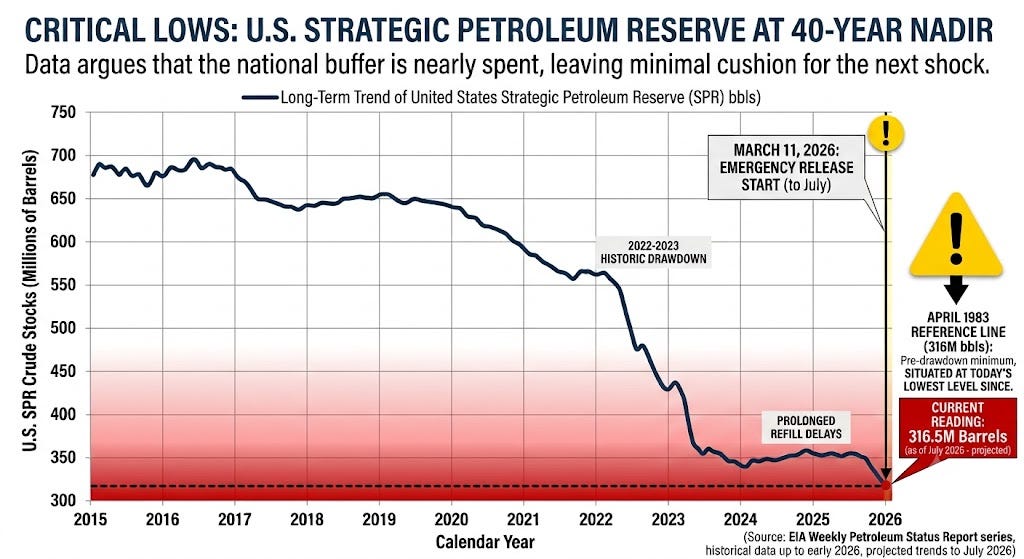
This dilemma is why it is difficult for the Fed to exit easily. Walsh made no secret of being "too high" and the committee currently expects the federal funds rate to be 3.8% in 2026, up from the 3.4% proposed in March. When interest rates remain high, funds chase yields, flow directly into treasury bonds and flow out of any speculative assets. Cryptocurrencies are usually the first to bear the brunt. 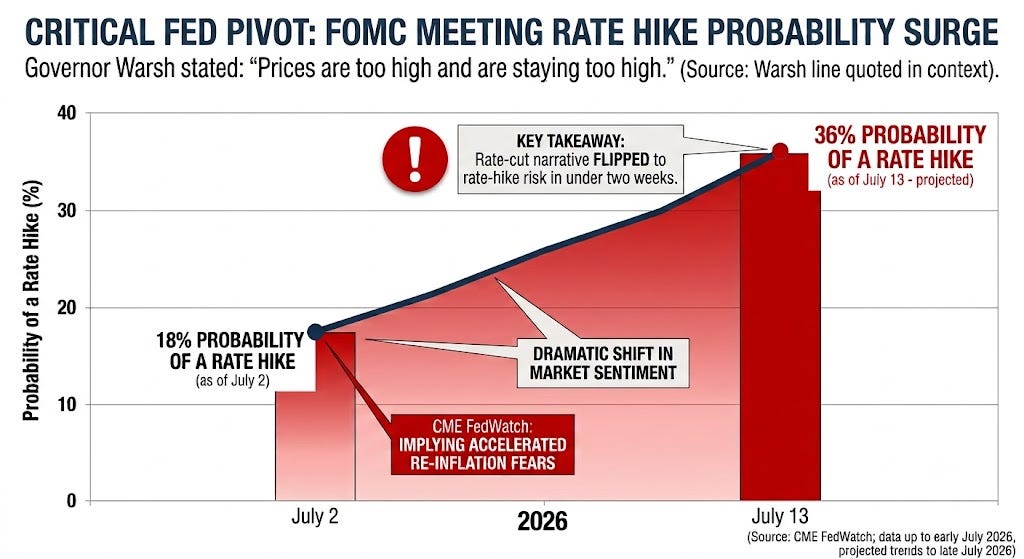
ETF data shows this in real numbers. About $4.5 billion flowed out in June, the worst month since the launch of the spot bitcoin fund. The situation was even worse on July 13: a one-day outflow of $424.66 million. These funds now dominate a large part of Bitcoin's weekly volatility, so a day of low institutional sentiment almost immediately turns into a day of low prices.
However, look at Bitcoin's actual performance. It still hovers in the price range of $58,000 to $64,000. Those same ETFs turned into net inflows for four consecutive days July 14 - 17. This refusal to back down is the most striking sign in the whole chart.
Long-term strategic impact
We keep coming back to the same point that was elaborated last week. The market is ignoring macro noise because it can already see the scale being built. Transformation in the fields of artificial intelligence, quantum, robotics and blockchain is being funded through sufficiently large-scale debt and equity issues, which in itself marks its importance. Half-empty oil reserves will not change this trajectory. But it does offer a discount to patient configurators.
If the pullback deepens further, we will not wait and wait to speculate on precise lows. We will enter the market in batches according to the structural support levels marked in recent charts. Here are our position configurations: 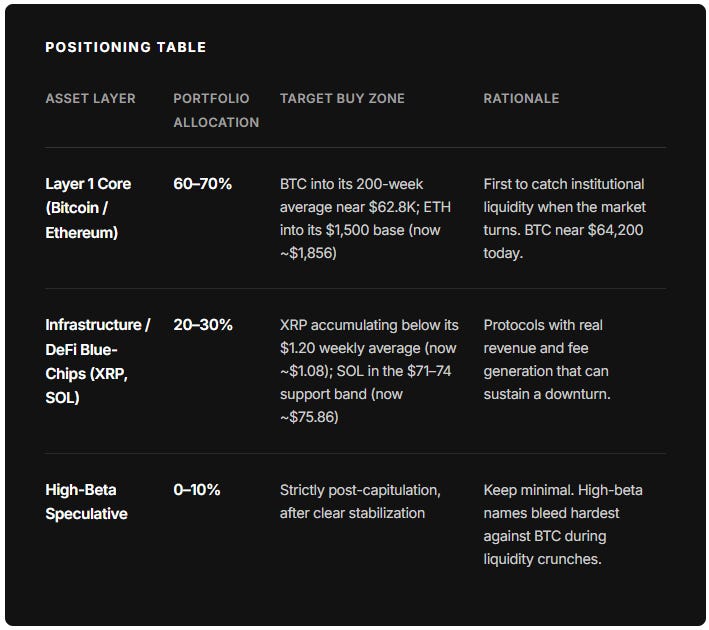
None of these means that the short is wrong. Suppose Wash does raise interest rates at a time when the economy is slowing. The chain we have just traced from oil to the Federal Reserve to liquidity could drag this decline well below current support levels. ETF flows remain negative this year, whether or not they rebound. While these flows drive nearly half of weekly price movements, a new round of institutional selling will come quickly. Accumulating is only effective if you can keep funds unused during difficult times, so allocate at this scale, keep some ammunition, and let macro factors come to you.
Stay tuned. We will continue to track the evolution of oil to liquidity tightening.
























