Exchange Ranking
 Top Exchanges
 24h Volume Ranking
 Popularity Ranking
 Exchange BTC Balance
 Proof of Reserves
 Decentralized Exchanges
 Funding Rate
 Funding Heatmap
 Liquidation Data
 Max Pain
 Long/Short Ratio
 Whale L/S Ratio
 Binance/Okex/Huobi L/S
 Bitfinex Margin L/S
 ETF Tracker
 Solana ETF
 XRP ETF
 Hong Kong ETF
 Bitcoin Treasuries
 Crypto Reversal
 Ethereum Reserves
 HyperLiquid Wallet Analysis
 Hyperliquid Whale Watch
 Large Transactions
 On-chain Movement
 Bitcoin ROI
 Stablecoin Market Cap
 Options Analysis
 News
News Articles
 Economic Calendar
 Features
 Wallet
 Contract Calculator


 Security
 Collections
 Watchlist
 Following
 BTC
BTC Why Wall Street chose ETFs instead of directly holding Bitcoin
How institutional funds are reshaping the structure of the Bitcoin market
The U.S. spot Bitcoin ETF holds approximately US$180 billion in assets, a significant increase since its approval in 2024. ETF positions were close to 1.38 million bitcoins and are currently stable at about 1.2 million bitcoins. Even when Bitcoin prices were trading in the recent range of $115,000 to $125,000, the inflow of funds continued. Japan's Bitcoin ETF may attract new capital inflows of 1.5 trillion to 3 trillion yen.
Wall Street's growing appetite for Bitcoin ETFs is reshaping the way institutions handle digital assets. Since January 2024, large financial companies have transformed from cautious observers to active buyers.
Regulated ETF structures now allow banks, pension funds and asset management companies to easily gain exposure. This wave of institutions marks a fundamental change in Bitcoin's ownership base and market behavior.
Why Wall Street chose ETFs rather than directly holding Bitcoin
Directly holding Bitcoin has posed major challenges to traditional financial institutions. Private key management, custody arrangements, audit requirements and compliance controls create huge operational obstacles. Few companies have the infrastructure to securely hold digital assets. Bitcoin ETFs solve this problem by providing exposure to standard brokerage accounts.
This convenience explains much of Wall Street's enthusiasm for Bitcoin ETFs today. Financial institutions can now leverage existing trading systems and custody relationships to purchase Bitcoin exposure without the need for dedicated cryptographic infrastructure or private key processing. This convenience removes the biggest obstacle to institutional participation.
By 2026, the asset size of the U.S. spot Bitcoin ETF has grown to approximately US$180 billion. Shortly after approval, total Bitcoin holdings began to rise from approximately 620,000. 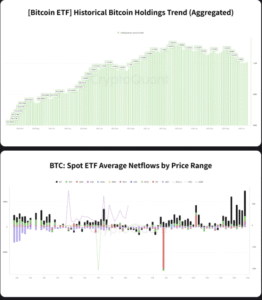 Subsequently, during strong buying activity, the number of open positions was close to 1.38 million. Despite the market correction, ETF positions remained at about 1.2 million.
Wall Street purchases continue even though bitcoin prices are high. When Bitcoin was recently traded in the range of US$115,000 to US$125,000, capital inflows still existed. This model suggests that institutions are not just waiting for a lower entry point, but are viewing Bitcoin as a long-term portfolio allocation decision.
How institutional funds reshape the Bitcoin market
The investor base behind Bitcoin ETFs has far exceeded early adopters. Asset managers, hedge funds and registered investment advisers are now tied with banks and endowments. Corporate and pension-related investors have also recently entered this space. This diversity suggests that Bitcoin's acceptance in mainstream finance is expanding.
The scale of potential institutional demand in global portfolios remains huge. Even a 1% allocation in a $1 trillion portfolio is equivalent to $10 billion. This example shows that small allocation changes can have a significant impact on the market value of Bitcoin. Growing institutional interest suggests that this demand curve may continue to rise.
Traders continue to pay attention to the bitcoin price cycle while also paying attention to this institutional buying trend. An analyst named Crypflow described recurring patterns in previous market recoveries.
$BTC(1W)-Breakout that ends every bear market. _39]
Each cycle tells the same story.
After the top of each Bitcoin cycle...
→ Prices fall, forming lower highs.
→ A downward trend is formed.
→ This downward trend was finally broken.
And when it is broken through...
A new bull market follows.
The commentary pointed out that the downward trend after the price peak will eventually be broken before a new rally begins. Such observations reflect the market's continued focus on Bitcoin's next big trend.
Bitcoin ETFs do more than just drive short-term price increases for holders. They have built a regulated financial infrastructure that connects Wall Street directly to digital asset markets. This infrastructure allows long-term global capital to enter the Bitcoin market more efficiently than before. Regulatory clarity continues to enhance institutions 'confidence in this asset class.
Japan may soon see similar institutional developments at home. Capturing just 0.5% to 1% of Japan's approximately 300 trillion yen investment assets could bring a large amount of capital inflows. Under this scenario, potential capital inflows could reach approximately 1.5 trillion to 3 trillion yen. Wall Street's ETF script may increasingly become a global template.