Exchange Ranking
 Top Exchanges
 24h Volume Ranking
 Popularity Ranking
 Exchange BTC Balance
 Proof of Reserves
 Decentralized Exchanges
 Funding Rate
 Funding Heatmap
 Liquidation Data
 Max Pain
 Long/Short Ratio
 Whale L/S Ratio
 Binance/Okex/Huobi L/S
 Bitfinex Margin L/S
 ETF Tracker
 Solana ETF
 XRP ETF
 Hong Kong ETF
 Bitcoin Treasuries
 Crypto Reversal
 Ethereum Reserves
 HyperLiquid Wallet Analysis
 Hyperliquid Whale Watch
 Large Transactions
 On-chain Movement
 Bitcoin ROI
 Stablecoin Market Cap
 Options Analysis
 News
News Articles
 Economic Calendar
 Features
 Wallet
 Contract Calculator


 Security
 Collections
 Watchlist
 Following
Key Insights
EU encryption regulations prohibit white Russia from controlling European encryption service providers. The restrictions cover exchanges, transfers, consulting and portfolio management. Affected companies must implement the expanded ban from August 25. The European Union expanded the scope of crypto regulation on July 23, targeting White Russian ownership of regulated crypto companies. Council Decision 2026/1847 (Common Foreign and Security Policy) extended the restrictions to the entire EU from August 25. The measure expands the scope of previous bans on wallets, accounts and custody service providers to now cover all other crypto services as defined in the Cryptographic Asset Markets Regulation. The significance of this expansion is that sanctions review now directly overlaps with the MiCA licensing system. European companies face broader scrutiny, involving ownership, control and appointments to governance bodies.
Crypto Regulation Expands Belarus Russia Ownership Restrictions
Council Decision 2026/1847 (CFSP) revised the EU sanctions framework against Belarus Russia on July 23. The Council linked these measures to Belarus Russia participation in Russia war against Ukraine. 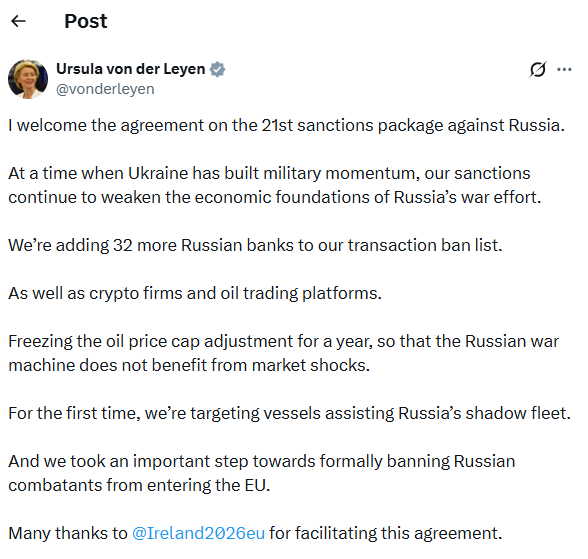 Source: X The decision bans Belarus Russia Nationals and residents who own or control covered European entities are also prohibited from holding positions in these corporate governance bodies. The revised text covers entities providing services as defined in Regulation (EU) No 2023/1114. The regulation establishes the Crypto Asset Markets Framework, commonly known as the MiCA regulation. Covered activities include operating trading platforms, converting crypto-assets into fiat currencies or other tokens, as well as order execution, transmission, placement, transfer, consulting and portfolio management. The decision will take effect after being announced in the official gazette on July 24. However, the expanded ownership and management ban came into effect on August 25.
Legal mechanisms link crypto regulation and sanctions
The Council adopted the decision through the EU Common Foreign and Security Policy Framework, amending Decision 2012/642/CFSP, the EU's core sanctions instrument against Belarus Russia . Council Regulation (EU) No 2026/1846 translates policy decisions into directly applicable economic restrictions. The regulation brings financial measures related to Belarus Russia into line with broader restrictions on Russia . The Finnish Ministry of Foreign Affairs said the package coordinated Belarus Russia Sectoral and financial sanctions. In a statement on July 24, it pointed out that the decision and regulations are the main legal documents. The measure expands narrower rules that previously only covered wallets, accounts and custody services. The original distinction excludes other regulated activities from ownership and governance bans. Under the revised wording, the ban now follows MiCA's broader definition of services. This approach directly links sanctions compliance to European licensing categories.
Crypto regulation follows MiCA's transition period deadline
The European Securities and Markets Authority said MiCA's transition period ended on July 1. Unlicensed providers must then cease operating in the EU and implement an orderly exit plan. MiCA allows qualified companies operating before December 30, 2024 to continue to operate on a temporary basis. Article 143 sets July 1, 2026 as the final grandfather clause deadline. This time point puts Belarus Russia relevant measures in a stricter licensing environment. European companies now face a single authorization framework while also assuming independent sanctions review obligations. The European Commission said MiCA has developed organizational, operational and prudential standards for crypto service providers and incorporated them into the EU Anti-Money Laundering Framework. For regulated companies, the ban affects ownership reviews, governance appointments and control assessments. Companies must identify indirect control relationships before approving director or ownership structures. The measure does not prohibit White Russian users from holding crypto assets, but it targets the ownership, control and management of covered service providers within the EU.
The EU's crypto regulation targets third-country platforms
White Russia related decisions were introduced simultaneously with the EU's 21st sanctions package against Russia . The Council extended the trading ban to 14 crypto-related platforms outside the EU. The Council confirmed platforms from six jurisdictions, including Belarus Russia and Panama. At the same time, it has also established a broader third-country encryption restriction mechanism. The mechanism allows a transaction ban on foreign service providers used to circumvent Russian sanctions. EU operators will face direct restrictions. EU foreign policy chief Kaya Karas said the package targeted banks and crypto operators and linked sanctions to pressure on Russia 's ability to continue the war. The UK implemented relevant measures against Huobi Global S.A. on May 26. Its sanctions notice stated that the platform involves services from sanctioned entities A7 and Garantex. The next verifiable milestone date for the EU is August 25. Covered companies must implement expanded ownership and governance restrictions from that date.