
 Exchange Ranking
 Top Exchanges
 24h Volume Ranking
 Popularity Ranking
 Exchange BTC Balance
 Proof of Reserves
 Decentralized Exchanges
 Funding Rate
 Funding Heatmap
 Liquidation Data
 Max Pain
 Long/Short Ratio
 Whale L/S Ratio
 Binance/Okex/Huobi L/S
 Bitfinex Margin L/S
 ETF Tracker
 Solana ETF
 XRP ETF
 Hong Kong ETF
 Bitcoin Treasuries
 Crypto Reversal
 Ethereum Reserves
 HyperLiquid Wallet Analysis
 Hyperliquid Whale Watch
 Large Transactions
 On-chain Movement
 Bitcoin ROI
 Stablecoin Market Cap
 Options Analysis
 News
News Articles
 Economic Calendar
 Features
 Wallet
 Contract Calculator


 Security
 Collections
 Watchlist
 Following
 AAVE
AAVE Aave is gradually closing multiple chains: Insider on Six Network Exit Plan
Aave is gradually closing multiple chains, its largest reserve cleanup to date. Aave founder Stani Kulechov confirmed on July 30 that after a comprehensive review, the agreement will phase out 50 low-adoption asset reserves in multiple deployments and orderly and completely withdraw six blockchains: Sonic, Scroll, zkSync, Metis, Soneium and Aptos. Overall, these changes affected $98.1 million in supply assets and $15.6 million in outstanding obligations. 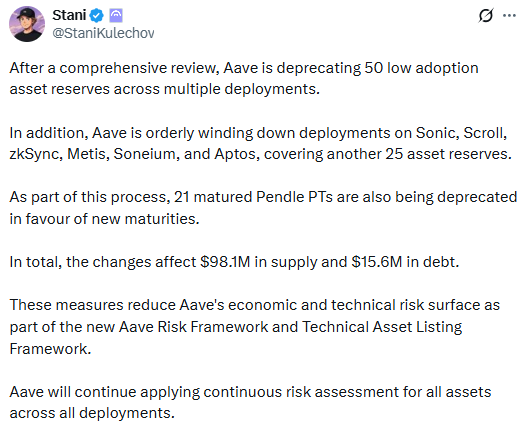
Aave gradually closes multiple chains: Proposal coverage
Based on governance proposals prepared by risk consultant LlamaRisk under Aave's newly established risk framework and technology asset listing framework, the cleanup is divided into two tracks. The first track involves the removal of 50 separate reserves, as well as 21 expired Pendle principal tokens distributed among 11 Aave V3 deployments, which together hold approximately $85.3 million in supply and $11.5 million in debt. The second track is the complete shutdown of six smaller deployments-Sonic, Scroll, zkSync, Metis, Soneium and Aptos-involving an additional 25 reserves, supplying approximately $12.8 million and borrowing approximately $4.1 million.
Kulechov described the move as reducing the economic and technical risk profile of Aave and said the agreement will continue to conduct ongoing risk assessments for all deployments. The proposal has not yet become the final DAO decision-it still needs to go through Aave's governance process to take effect.
Economic considerations behind decisions
The numbers behind decisions are very clear. Under LlamaRisk's proposal, each of the six affected chains generates less than $5000 in revenue from the agreement per quarter, of which Metis, Soneium and Aptos each generate less than $1000-far from enough to cover the operating costs of maintaining price feeds, clearing systems and ongoing monitoring for each market. In comparison, Aave's Ethereum mainnet deployment generates more than $142 million per year, while Base generates approximately $4.7 million.
Deposits along these six chains have fallen sharply over the past six months: Soneium fell 95%, Aptos liquidity fell 94%, zkSync fell 88% to about $844,000, Scroll fell 86% to about $2.2 million, Metis fell 79%, and Sonic (the largest of them) fell 74% to just under $8 million. According to DefiLlama, the six chains together hold about $13 million, while Aave's total assets in the 23 chains are about $14 billion-less than 1% of the total agreement size.
This timing is consistent with Aave's overall income profile. Gross revenue fell from US$198 million in the first quarter of 2026 to US$156 million in the second quarter, and third-quarter data is reportedly still below this level. According to DefiLlama data, Aave itself retains about 13% of the interest paid by borrowers and returns the rest to depositors-an allocation that makes a chain that generates only a few hundred dollars per quarter for the agreement actually unworth investing in operating expenses.
Practical operation process
Existing positions in the affected chain will not be forcibly closed. Instead, under the proposal, the market would freeze new deposits, loans and collateral use, supply and lending caps would be reduced to a single token, 99% of borrower interest would flow to Aave's vaults, and a base borrowing rate of 5% would be introduced-a structure designed to keep the cost of staying on the chain high enough to encourage remaining users to exit themselves over time.
The proposal builds on the signal Aave issued months ago. In December 2025, the Aave Chan Initiative first proposed specifically withdrawing zkSync, Metis and Soneium, saying they had "proven to lack product market fit" and promoted a rule requiring any future deployment to commit at least $2 million in annual revenue. Today's broader six-chain proposal is seen as a logical extension of earlier push.
AAVE, the agreement's governance token, traded at approximately US$99.54 today, up 4.58% in the past week, with a market value of nearly US$1.53 billion and a total locked value of approximately US$14.59 billion.
Conclusion
Aave is shutting down chains that are no longer mathematically viable-six deployments add up to several thousand dollars per quarter, and the agreement earns more than $142 million annually on Ethereum alone. The proposal still needs to go through Aave's governance process, but it marks a clear shift from expansion to centralization.
Disclaimer
This article is for information only and does not constitute financial or investment advice. All details are based on Aave's official governance proposals, statements by founder Stani Kulechov, and public DefiLlama data as of July 31, 2026. The proposal has not yet been finalized through Aave's governance process and may change. Be sure to conduct independent research before making any investment decisions.
























