
 Exchange Ranking
 Top Exchanges
 24h Volume Ranking
 Popularity Ranking
 Exchange BTC Balance
 Proof of Reserves
 Decentralized Exchanges
 Funding Rate
 Funding Heatmap
 Liquidation Data
 Max Pain
 Long/Short Ratio
 Whale L/S Ratio
 Binance/Okex/Huobi L/S
 Bitfinex Margin L/S
 ETF Tracker
 Solana ETF
 XRP ETF
 Hong Kong ETF
 Bitcoin Treasuries
 Crypto Reversal
 Ethereum Reserves
 HyperLiquid Wallet Analysis
 Hyperliquid Whale Watch
 Large Transactions
 On-chain Movement
 Bitcoin ROI
 Stablecoin Market Cap
 Options Analysis
 News
News Articles
 Economic Calendar
 Features
 Wallet
 Contract Calculator


 Security
 Collections
 Watchlist
 Following
 ADA
ADA Cardano prices have steadily climbed since July 28, even as its ecosystem continues to face several major problems. ADA rose from around $0.15 and hit a high of $0.199 today, making it one of the stronger performing currencies in the struggling altcoin market.
The price rebound paints an unusual picture: Thousands of holders have left Cardano, multiple native projects have closed, and network revenue remains sluggish. However, ADA can still outperform many competing currencies. Sanitation's latest data helps explain why these seemingly contradictory developments may be closely linked.
Cardano prices began their latest round of recovery on July 28 from approximately US$0.15. Buyers continued to push the ADA higher until the token hit approximately $0.199 today. This increase is nearly 33% higher than the July 28 level. Sanitation Intelligence reported that the ADA hit $0.195 for the first time since July 4. Cardano's market value has increased by 24% in the past week, making ADA one of the clearest performing currencies in the disappointing altcoin market.
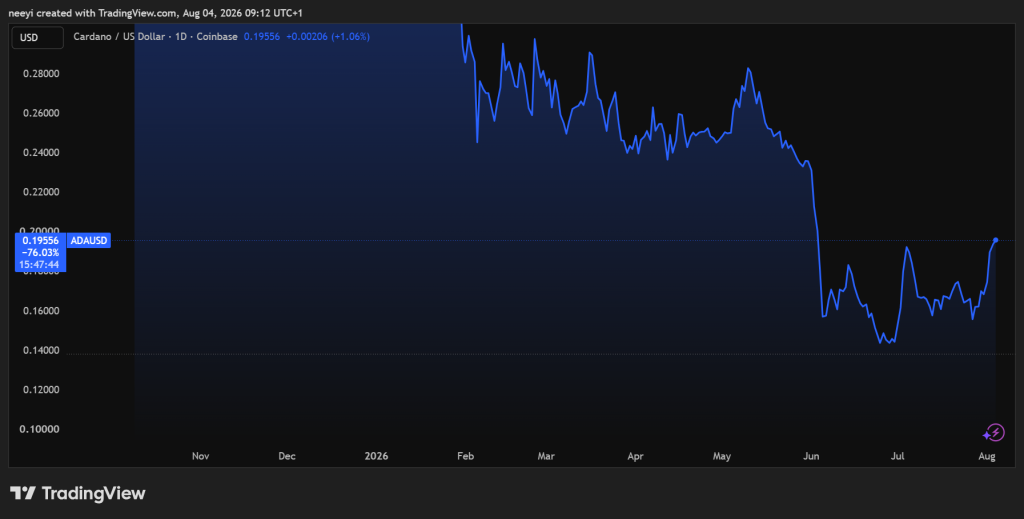
This rally is even more eye-catching considering Cardano's recent difficulties. Although it is difficult to establish a clear recovery trend for multiple cryptocurrencies, ADA continues to climb amid weak retail confidence and doubts about online business progress.
Declining wallets may be helping Cardano prices recover
Sanitation data shows that in the past two months, Cardano has lost 7070 non-empty wallets. Many retail holders appear to have liquidated their ADA holdings after suffering significant financial losses and repeated ecosystem setbacks.
ADA is still down about 95% from previous historical highs. Such a deep decline has left many long-term holders facing huge unrealized losses. Some holders may have decided that waiting for a full recovery is no longer worth it. The following data reveals this unusual situation:
·In the past two months, Cardano has lost 7070 non-empty wallets.
·In the past week, ADA's market value has increased by 24%.
·Since July 28, Cardano prices have risen from approximately US$0.15 to nearly US$0.199.
·Large holders continue to absorb ADAs sold by outbound retail investors.
A decline in the number of wallets does not automatically mean that the price of Cardano will inevitably fall. Sanitation explained that during periods of extreme panic, market values may rebound as stronger buyers absorb supply released by departing holders. As retail wallets disappear, large holders have been increasing their holdings in ADA recently. These purchases provide demand for tokens sold by frustrated investors. Therefore, as long as large buyers buy enough supply, Cardano prices can rise even if the total number of holders declines.
$ADA hit US$0.195 for the first time since July 4. Its market value has risen 24% in the past week, making Cardano one of the clearest bright spots in the already disappointing and volatile altcoin market.
Cardano ecosystem issues continue to push retail holders away
The decline in the number of Cardano wallets has been accompanied by several problems on the Internet. Recent difficulties include:
· TapTools and JPG Store closed due to low traffic, weak revenue and high operating costs.
·Governance fatigue and community divisions have reduced the participation of some delegated representatives.
·The community rejected a US$2 million treasury proposal for the 2026 Singapore Cardano Summit.
·Organizers canceled the Cardano Summit after requested treasury funds were not approved.
· Cardano only generates thousands of dollars in revenue per week from transaction fees.
· Solana, Avalanche and other Layer 1 networks are currently recording higher activity.
·Complex DeFi applications and limited mobile-friendly options create difficulties for ordinary users.
· Cardano lacks large spot exchange-traded funds to provide broader channels of institutional access.
Cardano is also struggling to secure a larger share of real-world asset tokenization. Competitive networks are now processing more transactions and attracting more funds in several important cryptocurrency areas. False reports that Charles Hoskinson had left Cardano created additional uncertainty, although he himself had denied these claims. Taken together, these questions help explain why thousands of small holders have closed their wallets despite the recent rebound in ADA prices.
Cardano development provides practical support for ADA recovery
Recent ecosystem developments provide a more positive explanation for the rebound in Cardano prices. Sanitation points to a number of developments that may help boost buyer confidence:
· Leios testnet was developed to improve Cardano's transaction processing capabilities.
· Hydra's progress supports faster activities through its extended framework.
· Mithril upgrades continue to strengthen Cardano's technical infrastructure.
· Pyth integration allows Cardano applications to access external market data.
·New Catalyst funding may support developers and future Cardano apps.
These advances address important parts of Cardano's technical foundation. Technological progress alone cannot fix the problem of low revenue or weak user activity, but it provides a clearer reason for buyers to increase their holdings in ADA during a period of widespread pessimism.
Retail confidence has not recovered at the same rate as Cardano prices. This difference means that the current recovery relies more on determined buyers than on broad participation from small wallets.
Cardano prices are rising because large buyers seem to be absorbing ADA sold by outbound retail holders. Advances in Leios, Hydra, Mithril, Pyth and Catalyst have provided further support for this recovery. The decline in the number of wallets still deserves close attention. If demand from large households weakens before retail confidence returns, sustained growth may become difficult. Issues such as ecosystem failure, governance disputes, low transaction revenue and limited institutional access also remain unresolved.
FAQs
How much is a Cardano worth in 2030? [TAG
Projections for Cardano (ADA) prices in 2030 vary by source, ranging from conservative lows of about $0.15 to optimistic highs of $5.00. Mainstream algorithmic models and market analysts predict average transaction prices between $0.23 and $2.50, depending largely on the success of the network adoption and its enterprise roadmap. [TAG
Can Cardano hit $2 by 2026?
Is the ADA price of $2 in this cycle realistic? Most estimates do not consider US$2 as the benchmark scenario for 2026, and forecasts are below this level. In the most bullish scenarios, strong multi-year expansion will continue into 2028 and 2030.
























