
 Exchange Ranking
 Top Exchanges
 24h Volume Ranking
 Popularity Ranking
 Exchange BTC Balance
 Proof of Reserves
 Decentralized Exchanges
 Funding Rate
 Funding Heatmap
 Liquidation Data
 Max Pain
 Long/Short Ratio
 Whale L/S Ratio
 Binance/Okex/Huobi L/S
 Bitfinex Margin L/S
 ETF Tracker
 Solana ETF
 XRP ETF
 Hong Kong ETF
 Bitcoin Treasuries
 Crypto Reversal
 Ethereum Reserves
 HyperLiquid Wallet Analysis
 Hyperliquid Whale Watch
 Large Transactions
 On-chain Movement
 Bitcoin ROI
 Stablecoin Market Cap
 Options Analysis
 News
News Articles
 Economic Calendar
 Features
 Wallet
 Contract Calculator


 Security
 Collections
 Watchlist
 Following
Project Overview
The project describes itself with a simple analogy: It aims to do for AI infrastructure what Airbnb and Uber do for idle rooms and cars. It brings together idle GPUs, disks, and domain-specific models from around the world into an open network that anyone can call or join.
What is YeBlock
Today, AI computing, model hosting, and fine-tuning are mostly run through a few centralized platforms. This setup concentrates pricing power, custody risk and monetization in the hands of a few people. YeBlock is a project that aims to change this structure. According to its white paper, YeBlock LIM integrates decentralized computing, decentralized storage, and decentralized AI with LoRA granularity into one open protocol. Idle GPUs contribute computing power, idle hard drives contribute storage space, and LoRA creators earn on-chain income every time their work is used.
YeBlock's latest news: The app is online
According to the official announcement on July 17, 2026, the YeBlock app is now available on iOS, Android and the web. The project says this allows users to view node status, revenue and community updates with one click from any device, rather than being limited to a single platform. The app is available through the official download page.
Vision of the YeBlock Project
The project company claims that its core belief is: "DeFi makes money flow, and YeBlock makes intelligence flow." The project defines its mission as returning AI calculations, models, and economic incentives to contributors rather than concentrating them on a centralized platform. The project's public commitments include open sourcing its core protocols and SDK under the Apache 2.0 license, and transferring governance rights to the DAO starting in the second quarter of 2027.
Why was created
According to the white paper, the project aims to solve three structural problems in the AI industry: centralized cloud service providers 'gross margins exceed 60%, excluding small AI startups; model hosting relies on centralized platforms such as Hugging Face, which may delete models without prior notice; Long-tail LoRA finers create real value but have no way to monetize it. The protocol aims to solve these three problems simultaneously by routing idle computing, storage and specialized AI skills through an on-chain revenue-sharing protocol.
How YeBlock works
The protocol is built around five parallel pillars. The first three constitute the so-called "capability layer" of the project, which determines what the network can do; the last two constitute the "trust layer and time layer", which determine who the network can serve and for how long.
Decentralized computing
Idle GPUs around the world are aggregated into a rentable computing network for AI reasoning.
Decentralized storage
Model weights and LoRA files are distributed across the network and therefore are not deleted by a single platform.
The decentralized AI
protocol operates at LoRA granularity, so each fine-tuning skill (rather than the full model) carries on-chain authorship and revenue is settled on a per call.
Privacy protocol
Encryption mechanism and a higher level of Trusted Execution Environment (TEE) isolation ensure that inference data is not visible to node operators.
Post-quantum protocol
Communication channels and signatures will be migrated to NIST approved post-quantum algorithms to protect long-standing AI assets.
Project owners say removing any pillar would degenerate the agreement into something else that already exists, such as a centralized model market or a universal computing cloud.
Core architecture and main characteristics
On top of the five pillars, the project defines the so-called "liquidity economy layer", consisting of three components.
YeBlock LIME
allows creators to cast an idea into an encrypted, chain-verified asset that network AI can directly execute.
YeBlock LEM (Liquidity Energy Grid)
Allow energy providers to convert surplus or cheap electricity into calculated revenue locally rather than selling electricity directly.
YeBlock LIP (Liquidity Smart Payment)
A payment channel specially designed for machine-to-machine settlement, suitable for typical high-frequency and low-value transactions in AI inference calls.
Several features of the protocol described in thewhite paper run through:
LoRA-granular revenue sharing allows a single spinner to be paid on the chain for each call, rather than getting nothing after a public upload. Model weight persistence based on IPFS-anchored is designed to prevent unilateral removal. Multiple LoRA pooled inference nodes, allowing one basic model to serve multiple specialized LoRAs at the same time. A NIST post-quantum roadmap has been released covering hybrid key exchanges and post-quantum digital signatures.
The technology behind YeBlock
The inference layer is built based on vLLM and SGLang, and the project owner stated that these tools now support serving multiple LoRAs simultaneously on a shared underlying model. Storage adopts IPFS-style content addressing, combining fragmentation and redundant encoding. In terms of privacy, the project lists TLS 1.3 with client encryption as the default level and provides Intel TDX, AMD SEV-SNP and NVIDIA confidential computing for enterprise TEE channels. In terms of post-quantum protection, the project refers to NIST standardized ML-KEM, ML-DSA and SLH-DSA algorithms, and migrates in stages starting from the TLS mixed key exchange at the MVP stage.
Purpose of YBT tokens
YBT is a native token to the network. According to the white paper, it is used for network incentives, call fee settlement, pledge of node operators and LoRA creators, and future DAO governance rights. The project party said 40% of the agreement ecosystem's net revenue was used to purchase YBT on the open market and permanently destroy it, which is intended to be a deflationary mechanism linked to network usage rather than inflation.
Note: At the same time, the agreement is still in the pre-launch stage on the main network, its tokens have not yet been issued, and the identity of the founding team has not been disclosed. Readers should view early participation as high-risk and check details directly on yeblock.com.
Token economics of YBT
The total supply of YBT is fixed at 121,000,000 pieces. According to the allocation plan published in the white paper and official website information:
Allocation plan| Number of Tokens| Proportion
Distributed recommended mining| 30,000,000 |24.9%
TGE (token generation event)| 21,000,000 |17.4%
VC (Venture Capital)| 14,520,000 |12.00%
YeBlock Foundation| 15,730,000 |13.00%
nodes| 14,000,000 |11.6%
Pledge mining| 12,000,000 |9.9%
contributes mining| 9,000,000 |7.4%
Partners, funding, growth| 4,750,000 | 3.9%
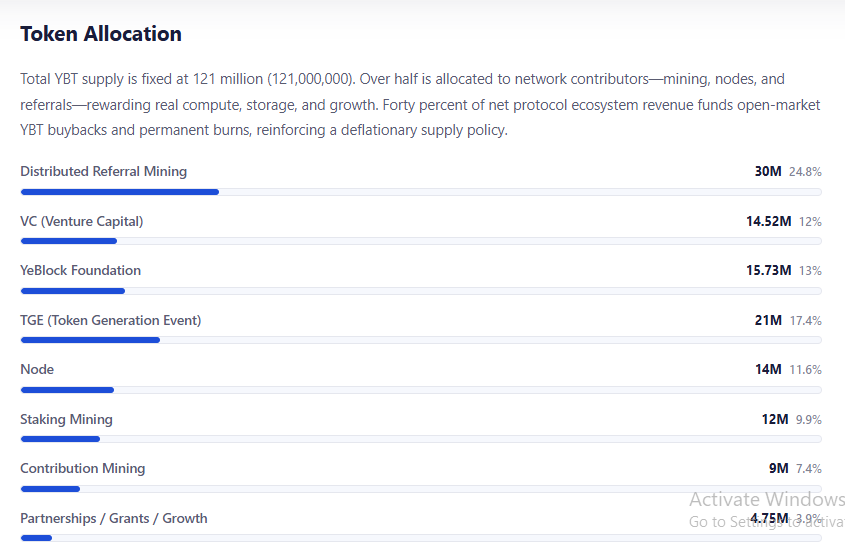
Foundation allocations (13%) and VC allocations (12%) are both unlocked linearly over a three-year period, with a one-year lockup period. The white paper points out that unlocked team tokens are expected to be re-pledged. If they are not re-pledged, the DAO vote can destroy some team YBT.
Note: As of the writing of this article, the token has not yet been issued, and the project has not been launched on the main network.
Roadmap
The published roadmap is broken down by quarterly milestones. Q3 2026 goals: five seed nodes, a workable single LoRA inference loop, and open source core protocol code under the Apache 2.0 license. Target for the first quarter of 2027: Publicly testing the TEE channel for privacy protocols. Targets for the second quarter of 2027: more than 1 million monthly calls, at least five TEE nodes, and the first phase of DAO governance is launched. Target for the fourth quarter of 2027: The white paper sets a specific accountability indicator-within 18 months after the main network is launched, the real USDC call fee revenue must reach at least 50% of the total node revenue.
As of this writing, the main network has not yet been launched. The web application on yelock.com has been launched, the project white paper will be released on July 15, 2026, and the application will be launched on July 17, 2026 on iOS, Android and the web.
Note: All information comes directly from its official white paper and recent announcements. Because the field is changing rapidly, be sure to keep an eye on yeblock.com and its X account to verify any future updates.
Ecosystem
YeBlock describes six ways to participate in the network, ranging from non-technical users to professional developers: computing providers, storage providers, LoRA creators, LoRA liquidity providers, AI users or developers, and ecosystem ambassadors.
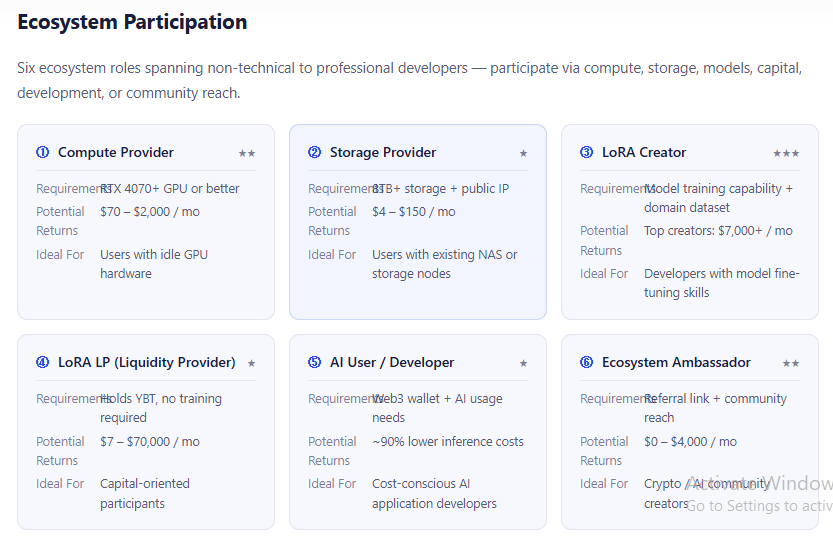
The white paper clearly states that all revenue figures associated with these roles are targeted designs rather than guarantees, and the final parameters will be determined by DAO governance. At the same time, early actual data are likely to be well below optimistic estimates in the first 6 to 12 months. No third-party partners or design partners have been officially confirmed. The white paper notes that pre-seed financing is planned based on the appeal of yeblock.com, and the current funding comes from the founding team and an unnamed top Web3 venture fund.
Advantages
Five-pillar design integrates computing, storage and AI with privacy and post-quantum protection into one protocol. LoRA creators receive a revenue share for each call on the chain, solving the monetization gap on platforms such as Hugging Face. A quarterly roadmap has been published with specific verifiable milestones. A clear 18-month accountability indicator links token issuance to actual call fee income. Six clearly defined participation roles covering users of different technical levels.
Main issues and risks
The white paper itself reveals several unresolved issues. Computational verification is not completely collusion-resistant because nodes can theoretically falsify inference results. Projects rely on sampling, pledge and forfeiture to make cheating economically unattractive rather than eliminating it altogether. The first token delay between distributed nodes is between 200 and 2000 milliseconds, and the project party stated that it is currently not suitable for real-time chat or voice usage scenarios. Projects also face cold start issues common in bilateral markets and multi-regional regulatory risks posed by combining DePIN infrastructure, AI and tokens in one project. The identity of the founding team is confidential and plans to be disclosed only 10 days before the main online launch. No tokens have been issued yet, and the main network has not yet been launched.
Future Outlook
The next verifiable milestone for the project is the test online launch in the first quarter of 2027, and the commitment of "real call fee revenue must reach 50% of node revenue" in the fourth quarter of 2027. Whether the project achieves meaningful calls, attracts corporate customers through the TEE privacy channel, and conducts quantum migration as planned will determine whether the five-pillar model works as described.
Summary
YeBlock integrates multiple DePIN and AI trends-decentralized computing, decentralized storage, LoRA-level monetization, hierarchical privacy, and post-quantum cryptography-into one protocol rather than processing them separately. The project has announced detailed token economics, quarterly roadmap and specific accountability indicators for the first 18 months.
Expert Opinion
Projects that publish specific, verifiable accountability indicators, such as YeBlock's 18-month call fee revenue target, generally show more rigorous planning than projects that publish only optimistic forecasts. The project's white paper also lists its own unresolved engineering challenges extremely directly, rather than avoiding them. At the same time, the fact that the founding team was not disclosed and the main network and tokens were not online were common risk signs of early projects and were not unique to the project. This combination of ambition and disclosure gaps emerged in many early DePIN and AI infrastructure projects.
Disclaimer : This article is for educational and information purposes only and does not constitute financial or investment advice. Please be sure to study it yourself.
























