
 Exchange Ranking
 Top Exchanges
 24h Volume Ranking
 Popularity Ranking
 Exchange BTC Balance
 Proof of Reserves
 Decentralized Exchanges
 Funding Rate
 Funding Heatmap
 Liquidation Data
 Max Pain
 Long/Short Ratio
 Whale L/S Ratio
 Binance/Okex/Huobi L/S
 Bitfinex Margin L/S
 ETF Tracker
 Solana ETF
 XRP ETF
 Hong Kong ETF
 Bitcoin Treasuries
 Crypto Reversal
 Ethereum Reserves
 HyperLiquid Wallet Analysis
 Hyperliquid Whale Watch
 Large Transactions
 On-chain Movement
 Bitcoin ROI
 Stablecoin Market Cap
 Options Analysis
 News
News Articles
 Economic Calendar
 Features
 Wallet
 Contract Calculator


 Security
 Collections
 Watchlist
 Following
 DEXE
DEXE The AI governance token DeXe (DEXE) suffers one of the worst crashes of the 2026 cycle
DeXe (DEXE) has just experienced one of the most violent crashes of the 2026 cycle. After hitting a record high of $48.89 on July 13, the token plummeted into the $4 to $5 range, evaporating about 85% of its market value and losing billions of dollars in nominal value. Within 24 hours, DEXE plunged 84.73% to US$5.27, performing extremely poorly against the backdrop of a slight increase in the overall market. The plunge was mainly triggered by large-scale internal selling and there was no clear external catalyst. Such a rapid decline has caused the crypto community to explode, and everyone is asking the same question: Is this a "carpet" scam?
What happened to DeXe?
DEXE experienced a parabolic rally from early to mid-July, and then collapsed rapidly. On July 13, 2026, the token hit a record high of US$48.89. This four-day surge began with the exchange launch announcement on July 9. That historical high was the culmination of a fierce short-term rally, catalyzed by the launch of the exchange and turned into a short market.
Since then, the token price has continued to fall in stages-first by 10%, then by 30%, and then by 58%-before falling to single digits amid panic selling. DeXe (DEXE) plunged 58.13% today, a sharp reversal from its recent historical high, with heavy selling pressure throughout the day, although its continued role as a DeXe network governance and social trading token still attracts attention. After the dust settled, the chart showed prices falling almost vertically from more than $30 to the $4 mark.
Why did DeXe collapse?
There are no confirmed records of hacking or protocol vulnerabilities. Analysts pointed out that the main reason is that concentrated selling occurs in markets with thin liquidity and over-expansion. Extreme declines appear to stem from concentrated selling pressure and are likely to come from large households or panic flight. No specific hacking, partnership cancellations or negative news were found in the data to explain the crash.
The market structure was already fragile long before the crash. Traders began to open short orders on platform X (formerly Twitter) when Dexe did not specify the maximum future token supply. This round of rally itself is based on trading mechanisms rather than fundamentals: recent price changes are mainly driven by catalysts on online exchanges and short market conditions, so fundamentals and parabolic trends are two different things, and traders should not confuse them.
Skeptics have also issued warnings during the rally. Some people pointed out that the white paper and GitHub codebase have not been updated for many years, and one analyst even characterized DEXE as an old project from the previous cycle and has been heavily hyped in this cycle-this is typically a market that ends in a sudden washout.
Is DeXe a carpet scam?
Strictly speaking, a "carpet pulling scam" means that the team drains liquidity or sells supply and abandons the project. The current known situation is more like a concentrated selling collapse after a parabolic peak than a flight of confirmed developers-but the price trend is exactly in line with pulling the carpet. One community member described its performance as being pulled on a carpet, falling from $49 to around $6, pointing to the outdated white paper and GitHub as red flags. As of now, there is no publicly confirmed evidence of liquidity withdrawal on the chain, and the team has not issued a clear statement. Traders should view the carpet scam as an accusation rather than a fait accompli.
DeXe Crash-Chart Analysis
The accompanying daily chart clearly shows the entire process. DEXE started in the $8 range in April, gradually climbed along a step-by-step upward trend, and accelerated to a near vertical surge in July, hitting an all-time high of about $48. The last K-line was a fatal blow: a physical long negative line opened at about US$36, reaching as low as US$4.487, and also closed at US$4.487. The day's decline was 27.49%, and directly penetrated all medium-term support levels.
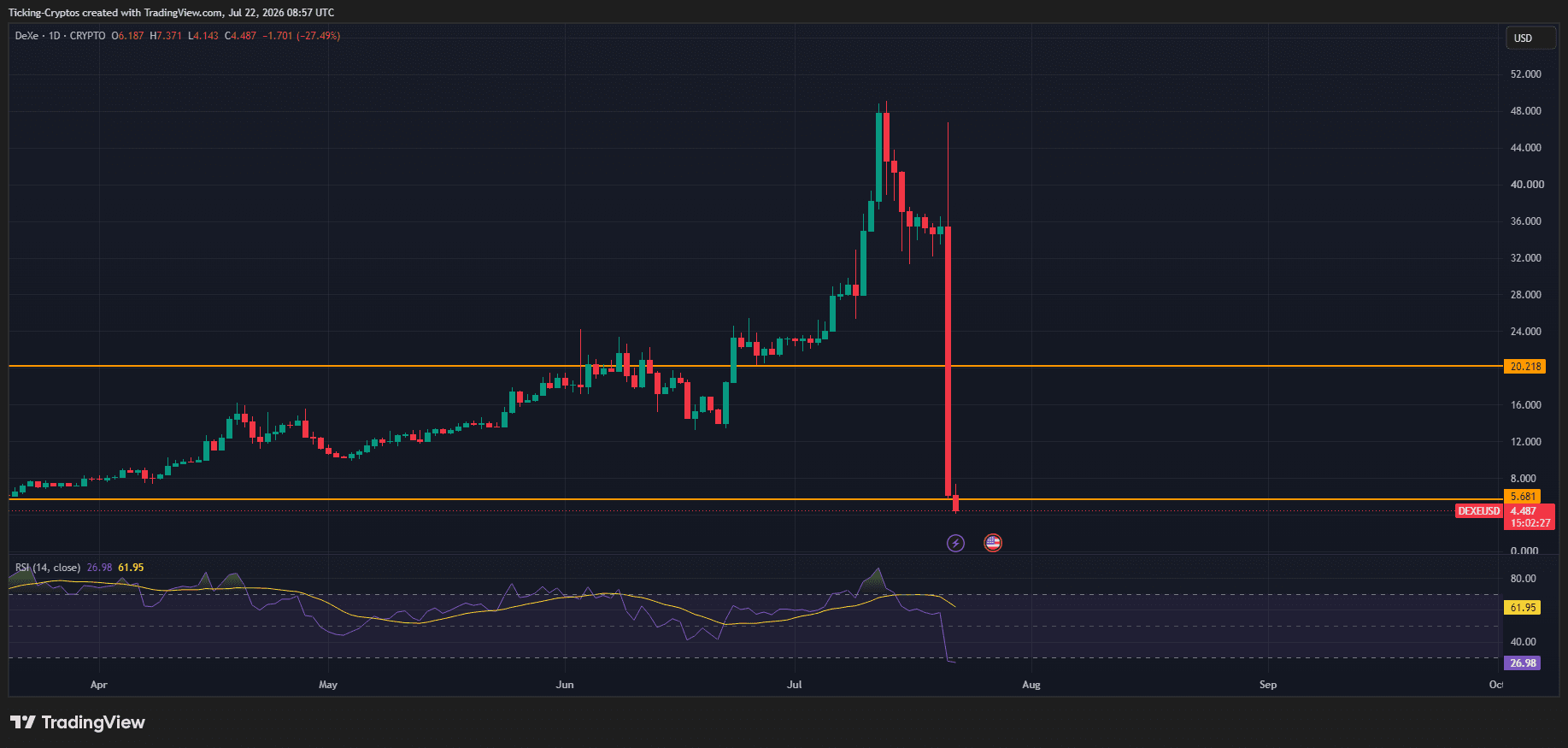 Two levels are now crucial. The $20.218 line (the old June consolidation platform) provided no support during the decline-the price broke through directly with just a long shadow line, a typical feature of a liquidity vacuum rather than an orderly selling. $5.681 is the last visible structural support level; if the daily close falls below this level, the space below will open to a low of $4 or even lower.
RSI (14) confirmed kinetic energy depletion: After the yellow signal line remained high throughout the rising period, the RSI plunged to 26.98, entering a deeply oversold area. Oversold does not mean a bottom-in a post-peak crash, the RSI may continue to hover near the low. Any rally from $5.68 or $4.50 is more likely to be a brief respite rather than a trend reversal unless prices recover and settle into a higher structure.
Conclusion
DEXE has evolved from an 18-fold parabolic market driven by a round of short-selling to an 85% plunge in a few days, backed by heavy selling and no confirmed exploits. Whether it is technically a carpet scam or a classic case of pulling up shipments and then collapsing, the outcome will be the same for subsequent buyers. Extreme caution is required.
























