
 Exchange Ranking
 Top Exchanges
 24h Volume Ranking
 Popularity Ranking
 Exchange BTC Balance
 Proof of Reserves
 Decentralized Exchanges
 Funding Rate
 Funding Heatmap
 Liquidation Data
 Max Pain
 Long/Short Ratio
 Whale L/S Ratio
 Binance/Okex/Huobi L/S
 Bitfinex Margin L/S
 ETF Tracker
 Solana ETF
 XRP ETF
 Hong Kong ETF
 Bitcoin Treasuries
 Crypto Reversal
 Ethereum Reserves
 HyperLiquid Wallet Analysis
 Hyperliquid Whale Watch
 Large Transactions
 On-chain Movement
 Bitcoin ROI
 Stablecoin Market Cap
 Options Analysis
 News
News Articles
 Economic Calendar
 Features
 Wallet
 Contract Calculator


 Security
 Collections
 Watchlist
 Following
 ETH
ETH  SOL
SOL 2026 vs. 2025 Cryptocurrency Hacks: Changes in Trends, Affected Chains, and Patterns
2026 Cryptocurrency Hacks begin with a grim set of data. Chain security company Blockaid confirmed 212 attacks between January and June 2026, with a total loss of US$1.1 billion, making the first half of 2026 the busiest six months on record for Blockaid. 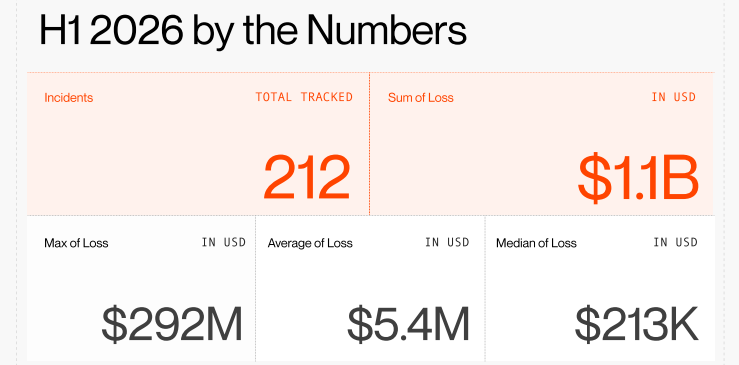 The number of incidents in this cryptocurrency hacking news shows that the number is 3.4 times the number of attacks tracked in 2025, a surge that Blockaid believes is related to continued pressure from AI-assisted attackers and North Korean hackers. Data shows that North Korea-related attacks, cross-chain bridge vulnerabilities, and theft of private keys have once again become the biggest losses in cryptocurrency hacking attacks in 2026.
2026 Cryptocurrency Hack Report: Major Findings from Blockaid Data
Four incidents that caused most of the damage
KelpDAO -$292 million.
Fake cross-chain verifier messages depleted the protocol's custody funds on Ethereum without any contract vulnerabilities.
Drift Protocol -US$285 million.
After weeks of social engineering attacks targeting multisigners, the attacker gained administrator control of the largest perpetual contract DEX on Solana in less than 12 minutes.
Resolv -US$80 million was minted and approximately US$25 million was withdrawn.
A compromised key minted unsecured stablecoin, and the token price collapsed.
CowSwap -$50.4 million.
An institutional trader approved a single malicious signature, the only one of the four major incidents caused by user error.
The combined losses from these four incidents were approximately US$707 million, accounting for 64% of the total losses in the first half of the year. This concentration is almost the same as in 2025, when just three incidents accounted for 72% of the total losses.
North Korea's role in the 2026 cryptocurrency hacking attack
North Korean hacking groups associated with TraderTraitor, a division of the Lazarus Group, planned the two largest attacks. The two largest incidents, Drift and KelpDAO, were both attributed to TraderTraitor, a division of the Lazarus Group.
Together with the US$32 million lost by Humanity Protocol, the damage to the North Korea-related attack cluster reaches approximately US$609 million, accounting for approximately 55% of the total losses in the first half of 2026.
Cross-chain bridges, monthly trends and new attack techniques
Cross-chain bridges created the largest single loss in the first half of the year. There were seven cross-chain bridge incidents, led by KelpDAO, where attackers used social engineering to steal the login credentials of LayerZero developers.
April was the deadliest month to date: losses reached $635 million, compared with $112 million in January,$21 million in February,$140 million in March,$76 million in May, and $68 million in June.
New attack techniques emerged for the first time: in January, the first EIP-7702 wallet delegation authority exhaustion attack occurred on Arbitrum; in June, Aztec suffered two zero-knowledge proof boundary exploits; and in May, an AI agent in Bankr lost $216,000 due to a prompt injection attack.
Money recovery varies for reasons: code flaws usually allow partial recovery, such as Verus, which recovered $8.5 million; funds stolen through private keys are rarely recovered and are usually transferred through a money mixer within hours. 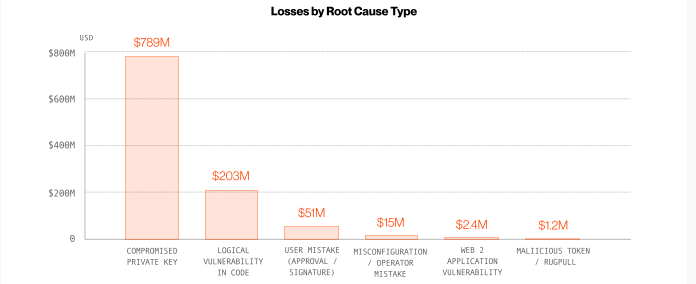
Main root causes
Cryptocurrency hacking attacks by chain: The blockchains with the most serious losses and their capital losses
Ethereum: Leading losses in the EVM network, mainly due to the high-value DeFi and stablecoin protocols.
Solana: Almost all of the losses came from stolen private keys, with Drift and Step Finance accounting for more than 98% of the chain's total losses.
Cross-chain Bridge: The total loss is close to US$330 million, the most serious exposure in any category of China-US yuan.
EVM Layer-2 (Arbitrum, Aztec, etc.): The total dollar losses are small, but they carry almost all new attack methods during the 2026 cryptocurrency hacking attacks, making it a leading indicator for predicting the next wave of large-scale attacks. 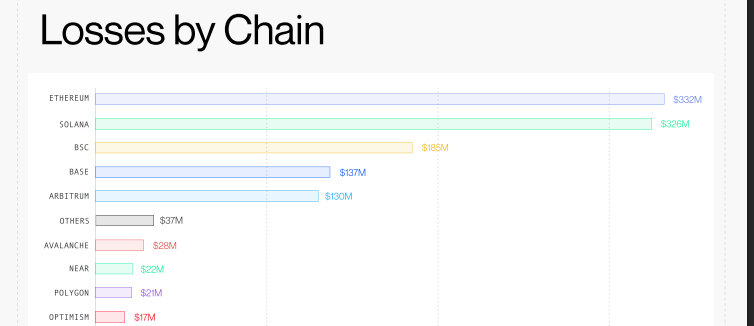
2026 vs 2025 Cryptocurrency Hacking Trends: Year-to-Date Comparison
The "2025 Cryptocurrency Crime Report" released by Chainalysis covering the entire year of 2024 found that the total amount of stolen funds on the platform in 2024 was US$2.2 billion, an increase of 21.07% from 2023, with a total of 303 incidents occurring. North Korean hackers stole 61%($1.34 billion) of the annual total.
2026 cryptocurrency hacking vs. Chainalysis 2024 baseline data
This pattern remains stable compared to data reported in 2026 cryptocurrency hacking.
Root cause: Private key leakage caused US$789 million in losses in cryptocurrency hacking attacks in 2026, accounting for 74.3% of the total losses, which is much higher than 43.8% in 2024. Theft of private keys rather than code vulnerabilities has now become the dominant cause for both periods.
North Korea's share: North Korean hackers stole 55% of lost funds in the first half of 2026, close to its 61% share for the whole of 2024. The same actor continues to cause the largest single losses year after year.
Number of incidents: In the first half of 2026 alone, 3.4 times the number of attacks tracked by Blockaid occurred throughout 2025, a rate far exceeding the total of 303 incidents recorded by Chainalysis in 2024.
Total dollar losses: In terms of dollar amounts, the actual losses in the first half of 2025 are higher than in the first half of 2026 simply because no incident in 2026 can compare to the US$1.5 billion Bybit lost due to the invasion in February 2025.
The clearest interpretation of the 2026 vs. 2025 cryptocurrency theft trend is that the number of incidents and North Korea's participation continue to rise, but there has been no single major hacking incident comparable to Bybit's scale in 2026, so despite the surge in the number of attacks, the total loss seems to be smaller.
User Safety Guide 2026: Simple steps to reduce real-chain risk
Use hardware signers and multi-party approval mechanisms for wallets holding real funds.
treats unexpected job offers or urgent credential requests as red flags; this is a common method of intrusion by North Korean hackers.
Read the EIP-7702 delegation prompt carefully before approving; a wrong upgrade can hand over control of an entire wallet.
Avoid using deprecated or "old" versions of the contract, even if old funds are still stored there.
Compare each signature request with the exact transaction expected to be executed; a faulty signature cost CowSwap $50.4 million.
Confirm before approving any transactions recommended by the AI agent.
What does the 2026 cryptocurrency hacking data really mean
There are two points worth noting. Code Audit's status as a primary defense is declining: three out of every four dollars stolen in cryptocurrency are due to private key leaks rather than contract vulnerabilities, and both Drift and KelpDAO incidents began when someone was deceived. Second, every new attack technique that has emerged this year-wallet commission abuse, AI prompt injection, off-chain bridge verification-has touched the boundaries of unaudited 2025. Attackers have shifted from breaking code to breaking trust between the system and its operators, a shift that may continue to affect cryptocurrency hacking news in the second half of this year.
Blockaid expects that losses related to EIP-7702 will reach seven digits in the second half of 2026, while cross-chain bridge exploits will continue to occur as many projects use the same single validator design as KelpDAO. These situations do not require new defenses, just faster application of existing effective methods: multi-party signatures, real-time screening, and equivalent monitoring of old code that no one shuts down.
Disclaimer : This article is for information purposes only and does not constitute financial or investment advice. There are significant risks in the cryptocurrency market. Before making any investment decisions, be sure to study for yourself.
























