
 Exchange Ranking
 Top Exchanges
 24h Volume Ranking
 Popularity Ranking
 Exchange BTC Balance
 Proof of Reserves
 Decentralized Exchanges
 Funding Rate
 Funding Heatmap
 Liquidation Data
 Max Pain
 Long/Short Ratio
 Whale L/S Ratio
 Binance/Okex/Huobi L/S
 Bitfinex Margin L/S
 ETF Tracker
 Solana ETF
 XRP ETF
 Hong Kong ETF
 Bitcoin Treasuries
 Crypto Reversal
 Ethereum Reserves
 HyperLiquid Wallet Analysis
 Hyperliquid Whale Watch
 Large Transactions
 On-chain Movement
 Bitcoin ROI
 Stablecoin Market Cap
 Options Analysis
 News
News Articles
 Economic Calendar
 Features
 Wallet
 Contract Calculator


 Security
 Collections
 Watchlist
 Following
 ETH
ETH Key insights:
Ethereum (ETH) prices are still below $2000, despite network activity reaching a new high on the second-layer network.
Ethereum applications generated US$1.79 billion in expenses, but the base layer only captured 4.9% of the value.
Analysts are focusing on tokenized assets and institutional demand as potential drivers of future ETH price growth.
Ethereum prices remain the focus of the market, with token prices still below the US$2000 level despite the network continuing to handle more activity. The latest data has sparked renewed discussions about whether Ethereum's growing adoption is enough to support ETH prices, even as more projects and users continue to build on the web.
At the same time, any price forecasts or technical indicators mentioned in this article are based on chart patterns and market indicators and cannot accurately predict future price trends.
This article should not be regarded as financial or investment advice. Given the inherent volatility of digital assets, readers are advised to conduct their own due diligence and seek guidance from licensed professionals.
Ethereum prices lag behind network growth
Ethereum prices fail to keep up with network growth. This is a concern raised by market commentator Tanaka on Platform X, pointing out that Ethereum is expanding faster than ever before, but token prices are still trading below $2000.
The DeFi Report shows that data shared in the second quarter showed that the Ethereum base layer generated real economic value of US$88.4 million. That was a 7% increase from the previous quarter, but still 68% lower than the same period last year.
At the same time, apps running on Ethereum generated approximately $1.79 billion in fees. The network processes more activities, but only a small part of the value flows back to the main chain.
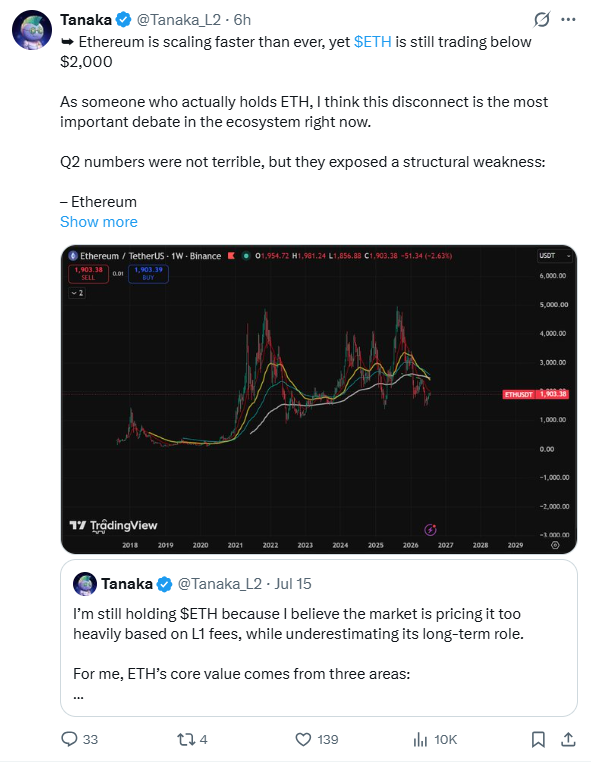
Ethereum Scalability and Price Outlook| Source: Tanaka
Data shows that the Ethereum base layer only captured approximately 4.9% of the value created by applications during the quarter. For many investors, this has become one of the biggest questions surrounding Ethereum (ETH) prices.
Recent activity also shows how much the network has changed. Rollup processes approximately 1270 user actions per second, while the Ethereum main network processes approximately 20.4 times per second. This means that Rollup handles more than 40 times the amount of activity than the base layer.
Robinhood Chain also showed strong activity. It handles approximately 96.2 user operations per second, which is almost five times the level recorded by the Ethereum main network.
These numbers show that Ethereum can support more activities than ever before. Still, many holders wonder whether this growth will ultimately increase demand for ETH, or whether most of the value will remain outside the base.
Lower ETH fees change the story
Ethereum's shift to cheaper transactions has helped Rollup grow rapidly and made the network easier to use. On the downside, lower costs reduce the amount of ETH that is destroyed.
Current data shows that the total supply of ETH is approximately 121.88 million units. About 41.1 million ETH are locked in the beacon chain, which means that about one-third of the total supply is used to ensure network security.
The current pledge yield is about 2.6%, and the annual supply growth rate is close to 0.85%. In the past seven days, only approximately 0.22 ETH was destroyed by Blob fees.
Tanaka said this does not mean Ethereum prices and networks are failing. Instead, the network is experiencing a period where cheaper transactions reduce revenue at the base layer while helping the broader ecosystem grow.
In the past, many investors believed that more users would always lead to higher Gas fees and more ETH destruction. This idea is being tested as more activity migrates to the second-layer network.
Real-world assets may help Ethereum prices
As of July 28, Ethereum had approximately US$17.2 billion in tokenized real-world assets. The stablecoin market (which also has a strong presence on Ethereum) is valued at approximately $299.4 billion.
Analyst Tanaka believes that if more institutions use Ethereum for settlement, collateral and reserve holding, these areas may create stronger demand for ETH over time.
Currently, he is looking at whether demand for second-tier services will increase the value of Blob space; whether stablecoins and tokenized assets are used regularly rather than idle; and whether institutions continue to add ETH to their balance sheets.
Ali Martinez, another market analyst, said that the TD Sequential indicator recently sent a sell signal after it accurately sent a buy signal around $1500, and ETH rose 31.5%. With ETH trading around $1980, the analyst said some traders may decide to take profits.
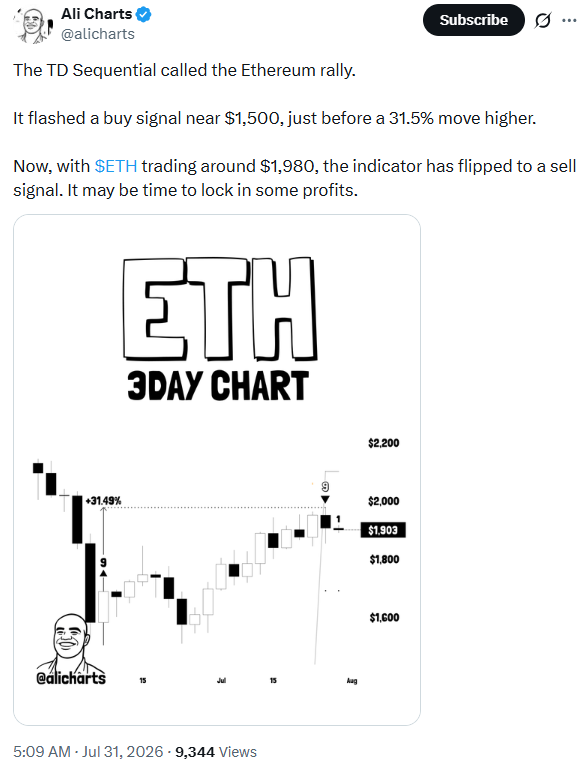
Ethereum (ETH) price rebound forecast| Source: Ali Martinez, X
However, Cryptollica believes that the current chart still looks similar to the pattern that emerged before Ethereum's major gains in 2018 and 2020. The analyst said history may be repeating itself, which has many investors watching closely to see whether Ethereum (ETH) prices can finally catch up with the network's steady growth.
























