
 Exchange Ranking
 Top Exchanges
 24h Volume Ranking
 Popularity Ranking
 Exchange BTC Balance
 Proof of Reserves
 Decentralized Exchanges
 Funding Rate
 Funding Heatmap
 Liquidation Data
 Max Pain
 Long/Short Ratio
 Whale L/S Ratio
 Binance/Okex/Huobi L/S
 Bitfinex Margin L/S
 ETF Tracker
 Solana ETF
 XRP ETF
 Hong Kong ETF
 Bitcoin Treasuries
 Crypto Reversal
 Ethereum Reserves
 HyperLiquid Wallet Analysis
 Hyperliquid Whale Watch
 Large Transactions
 On-chain Movement
 Bitcoin ROI
 Stablecoin Market Cap
 Options Analysis
 News
News Articles
 Economic Calendar
 Features
 Wallet
 Contract Calculator


 Security
 Collections
 Watchlist
 Following
 HYPE
HYPE Hyperliquid's results markets framework HIP-4 this week allowed anyone to pledge HYPE and deploy their own forecast markets on the test web, with entry barriers far lower than Hyperliquid's requirements for a formal environment.
According to Hyperliquid's own developer documentation and the Telegram announcement on its API channel, the testnet implementation has been launched, and the pledge requirement of the resulting deployer is set to 100HYPE. This is the actual number released. Three weeks ago, on July 20, Hyperliquid proposed a preliminary framework for unlicensed deployment of the main network, requiring a pledge of 500,000 HYPE for six months, valued at approximately US$30 million at the time. The test net requirement is only 1/5000 of this number.
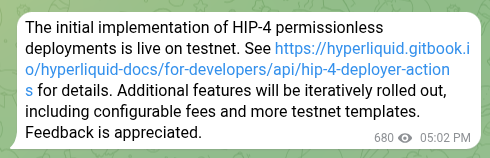
Hyperliquid API Announcement
100 HYPE vs. 500,000 HYPE: The test network (online) pledge requires 100 HYPE, locked for at least 183 days, and the status is released (according to official documents); the main network (proposed on July 20) pledge requires 500,000 HYPE, locked for 6 months, and the status is a preliminary plan, clarifying that may change.
The July 20 announcement was characterized as a preliminary plan from the beginning. The team said that further updates will be released once the unlicensed deployment is actually launched on the test network. This is the update, but it hasn't yet touched the numbers on the main network. The gap between the two numbers is the clearest signal yet that Hyperliquid has considerable leeway before finalizing its pledge requirements.
HIP-4 template internal: What is needed for actual deployment
The deployment market is not unlimited. Under HIP-4, validators first vote on the result templates: these templates are fixed structures that define display text, option names, and a set of typed keywords that deployers can fill in. Rather than writing markets from scratch, deployers instantiate one of three template types: stand-alone results (a single yes/no market), questions (a container of multiple related results), or question results (a named result nested under a specific question). Values filled in templates are limited to 100 characters and cannot contain curly braces or vertical characters because these characters are reserved for system internal formats.
What limits deployers is a hard upper limit: a maximum of 10 active results at a time and a maximum of 50 deployments per day, both numbers for the test net. Hyperliquid only said that other features (configurable fees and more market templates) would be rolled out gradually, and did not say that these specific caps would change. Settlement occurs through two operations: settleOutcome for individual markets, and the newer settleQuestion2, which resolves all named results under a question in one transaction, replacing the earlier settleQuestion operation that is now marked as deactivated in the document.
Timeline for Hyperliquid HIP-4 launch
This week's release is the fourth stage of the eight-month construction process, rather than an independent event:
February 2026: According to reports at the time, Hyperliquid first showed HIP-4 on the test website in early February, describing the result that the contract was fully mortgaged and could be settled without leverage or clearing.
May 2, 2026: HIP-4 is moved to the main network as a curatorial form, and deployment is controlled by verifiers rather than the public. Hyperliquid said the curatorial version generated approximately US$100 million in transaction volume in the first month.
July 20, 2026: Hyperliquid proposes to open deployment to anyone, provided that the 500,000 HYPE threshold is met, modelled on the same pledge structure that already manages HIP-3 (its permissionless perpetual contract framework).
July 31, 2026: The above test network will be launched, and the pledge requirement is 100 HYPE instead of 500,000 HYPE three weeks ago.
The figure of 500,000 HYPE has not changed
According to this week's announcement, configurable fees and additional market templates are still pending, and no main-network dates are attached. Before Hyperliquid released the pledge terms update, the numbers on which developers built on the test web could still change 5000 times before the same features reach the main network, while the proposed model continues to follow the pledge approach introduced through Hyperliquid HIP-3.
























