
 Exchange Ranking
 Top Exchanges
 24h Volume Ranking
 Popularity Ranking
 Exchange BTC Balance
 Proof of Reserves
 Decentralized Exchanges
 Funding Rate
 Funding Heatmap
 Liquidation Data
 Max Pain
 Long/Short Ratio
 Whale L/S Ratio
 Binance/Okex/Huobi L/S
 Bitfinex Margin L/S
 ETF Tracker
 Solana ETF
 XRP ETF
 Hong Kong ETF
 Bitcoin Treasuries
 Crypto Reversal
 Ethereum Reserves
 HyperLiquid Wallet Analysis
 Hyperliquid Whale Watch
 Large Transactions
 On-chain Movement
 Bitcoin ROI
 Stablecoin Market Cap
 Options Analysis
 News
News Articles
 Economic Calendar
 Features
 Wallet
 Contract Calculator


 Security
 Collections
 Watchlist
 Following
 BTC
BTC  ETH
ETH  SOL
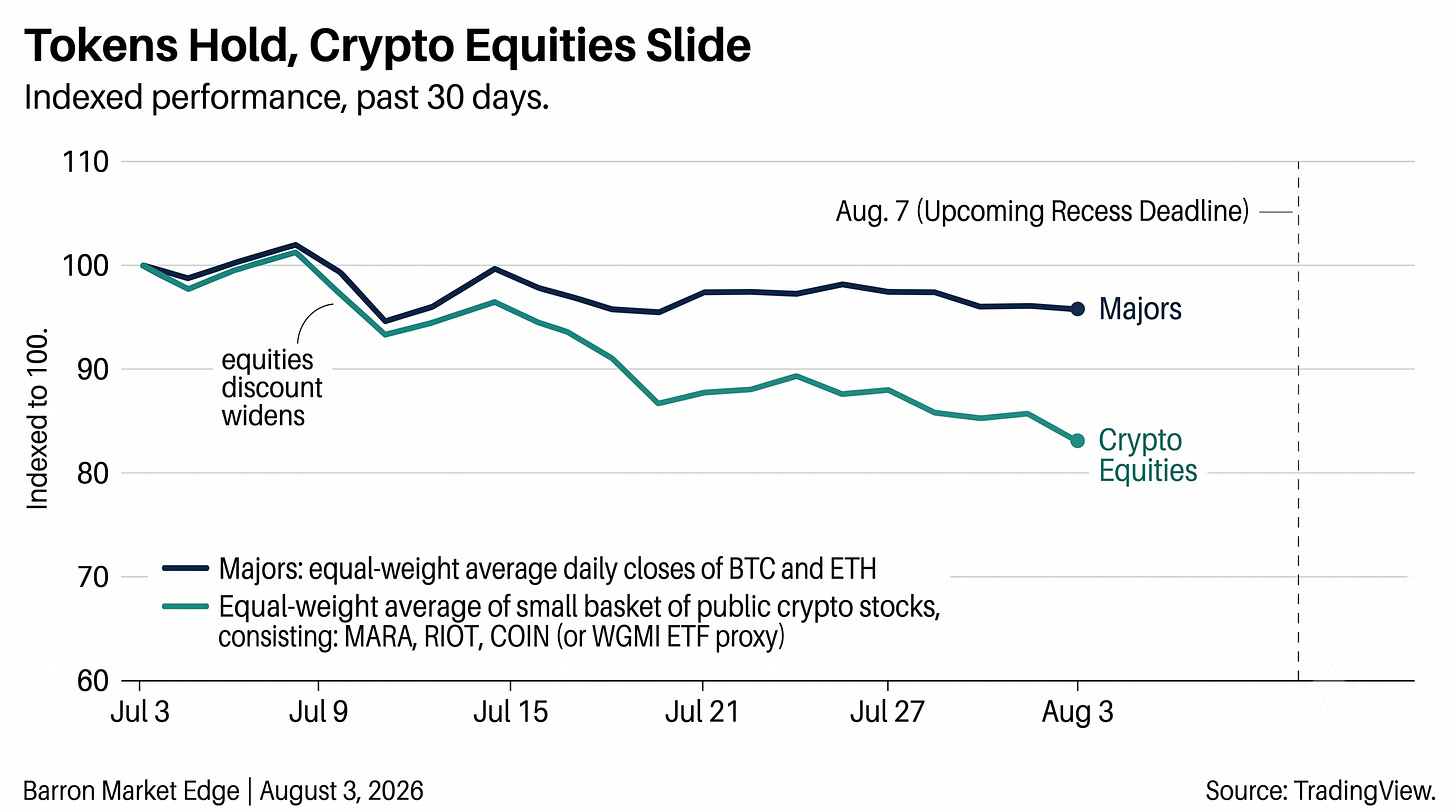
SOL The Senate has only a few days before its summer recess, and the chances of passage of the CLARITY bill have dropped to 26% on the Polymarket. If the bill fails to pass, the entire market will not fall simultaneously. Bitcoin and Ethereum already have sufficient regulatory foundation under the definition of existing institutions to be able to hold their ground. Listed crypto stocks-mining companies, exchanges and custodians-will be sold off during periods of uncertainty. Companies building tokenization and real-world asset (RWA) tracks continue to expand into Europe, the UK, Singapore and United Arab Emirates, where clear rule books are in place. Due to Congress's failure to legislate, the SEC and CFTC will effectively default to dominate the formulation of crypto policy.
Distinctions worthy of attention
Bernstein made this clear this week. Failure to vote will hit the crypto market first and hit bottom at the end of the third or early fourth quarter, putting the low ahead of the November midterm elections. Any investor who buys during this period is effectively betting on where the bottom will fall.
This is the node of market differentiation, and it shows a hierarchical division:
Bitcoin and Ethereum remain strong. The SEC and CFTC have agreed on its nature, so funds can remain liquid even if the headlines are negative.
Mid-range tokens and DeFi become blurred. Utility tokens and the DeFi protocol will lose the clarity that federal law could otherwise give.
stablecoin issuers return to state supervision. Without federal rules, they have to rely on scattered regulations in places such as New York.
Listed crypto stocks suffered the most severe blow. Valuations for mining companies or exchanges are based on forward earnings that are difficult to model when Washington is reluctant to clarify rules.
 Where construction flows?
The following parts cannot be influenced by any single vote. Whether or not the CLARITY bill is passed, the work of putting real-world assets on the chain-tokenized treasury bonds, tokenized funds, and perpetual contracts associated with these assets-continues to advance. Bernstein specifically pointed to continued regulatory support for these tracks. The open question is which country will lead the construction. The EU has the MiCA framework, and the UK, Singapore and United Arab Emirates each have effective working systems. Every month that the United States does not have its own framework, another piece of infrastructure is built elsewhere, and part of it will not be able to return.
The political wedge of the mid-term election
There is another political factor here. If the CLARITY bill is blocked, Republicans will gain a ready point of attack on the eve of the midterm elections. They will claim that Democratic leadership killed a bipartisan encryption bill because Democrats oppose innovation. The message will be sent to voters who are particularly concerned about crypto issues, founders who have moved companies overseas, and investors who have watched Washington delay for more than a year. It doesn't need to be fair, it just needs to be effective. For crypto stocks, this means miners and exchanges will continue to be influenced by political headlines until voters actually make a decision in November.
Regulatory Strategy Manual
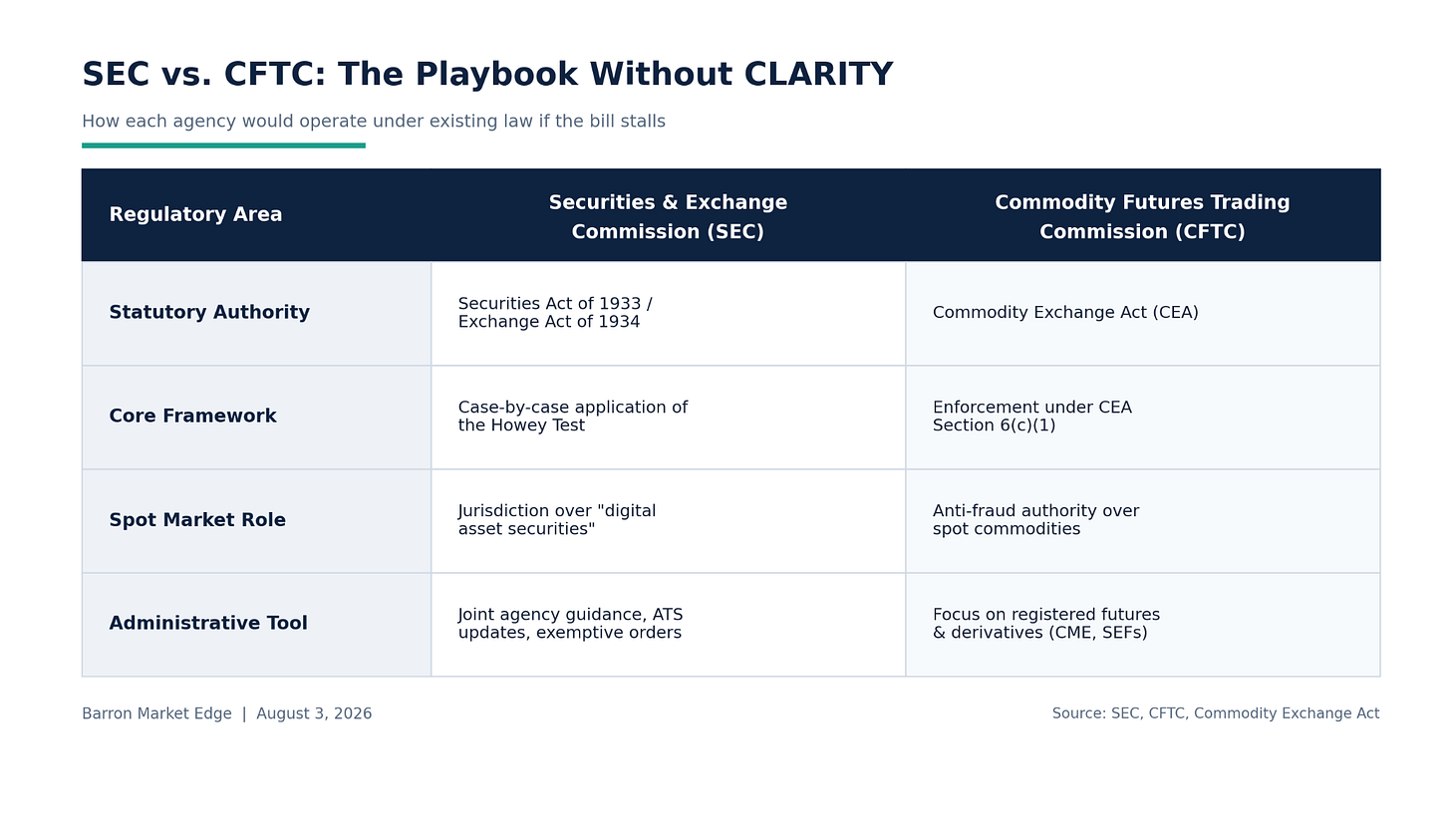
If the bill fails, neither agency will gain new powers, so they will have to use existing regulations to work. The effort now has a name: Project Crypto, a plan launched by SEC Chairman Paul Atkins in July 2025 and expanded into a joint SEC and CFTC project in the fall of that year.
The SEC will not receive new authorization, so it will continue to do so. Each token sale or pledge will be subject to Howey's test to determine whether it constitutes a security. This is where an innovation exemption clause is needed, which allows new tokens to operate for a period of time before facing the issue.
The CFTC has anti-fraud authority over the spot markets of Bitcoin, Ethereum and Solana and will use it to track manipulation, while focusing its main efforts on regulated futures. But it cannot force registration of spot exchanges without congressional authorization, so a comprehensive regulatory system for spot encryption remains impossible. CFTC Chairman Michael Selig warned that if Congress does not take action, regulators will "ultimately write all the rules for crypto."
 What the next 12 months mean
If the CLARITY bill fails, the key venues will become the SEC, the CFTC and ultimately the Federal Court. Congress will take a back seat until the election is over. The bill is deadlocked on two fronts: the ethics clause that the Tills-Gallego compromise seeks to address, and the stablecoin yield rule that banks strongly oppose.
In terms of layout, the actual risks are as follows:
Bitcoin and Ethereum are secure terminals. Their legal status will not change, so they can remain stable despite all the swings around them.
Crypto stocks bear a risk premium. The movements of mining companies or exchanges depend on the headlines and will remain volatile until Washington sorts out the issues.
The election is the countdown. Bernstein's forecast for a bottom between the end of the third quarter and the beginning of the fourth quarter coincides with when lawmakers expect the bill to be reconsidered. It can be assumed that the discount will continue until then.
Strangely enough, there is room for uplink here as well. Bernstein believes the bill's failure may actually prompt agencies to act faster. Once there is no longer a need to wait for Congress, the SEC and CFTC can issue clearer guidance on token classification and self-custody based on their own timetables, even faster than the stalled bill. This is the true bull logic of failure: you can get actionable rules without a vote.
Our interpretation also has downside risks. If the bottom at the end of the third quarter never occurs, crypto stocks will continue to be downgraded, and some companies that have left will not return.
Stay tuned. We will continue to track the evolution of this regulatory game.
























