
 Exchange Ranking
 Top Exchanges
 24h Volume Ranking
 Popularity Ranking
 Exchange BTC Balance
 Proof of Reserves
 Decentralized Exchanges
 Funding Rate
 Funding Heatmap
 Liquidation Data
 Max Pain
 Long/Short Ratio
 Whale L/S Ratio
 Binance/Okex/Huobi L/S
 Bitfinex Margin L/S
 ETF Tracker
 Solana ETF
 XRP ETF
 Hong Kong ETF
 Bitcoin Treasuries
 Crypto Reversal
 Ethereum Reserves
 HyperLiquid Wallet Analysis
 Hyperliquid Whale Watch
 Large Transactions
 On-chain Movement
 Bitcoin ROI
 Stablecoin Market Cap
 Options Analysis
 News
News Articles
 Economic Calendar
 Features
 Wallet
 Contract Calculator


 Security
 Collections
 Watchlist
 Following
 ETH
ETH Ethereum researchers propose to significantly reduce pledge rewards, sparking community controversy.
Six Ethereum researchers and developers, including Justin Drake of the Ethereum Foundation, have proposed amending the network's issuance policy. As the proportion of pledged ETH increases, verifier rewards will be reduced more significantly. The draft, called "Conical Issue Burning"(currently tentatively numbered EIP-8363), proposes to burn more and more parts of the verifier consensus reward until a 100% deduction is reached when the number of ETH pledged approaches a fixed threshold of 60.25 million pieces (approximately 50% of the current ETH supply). These changes will be phased in over 18 months.
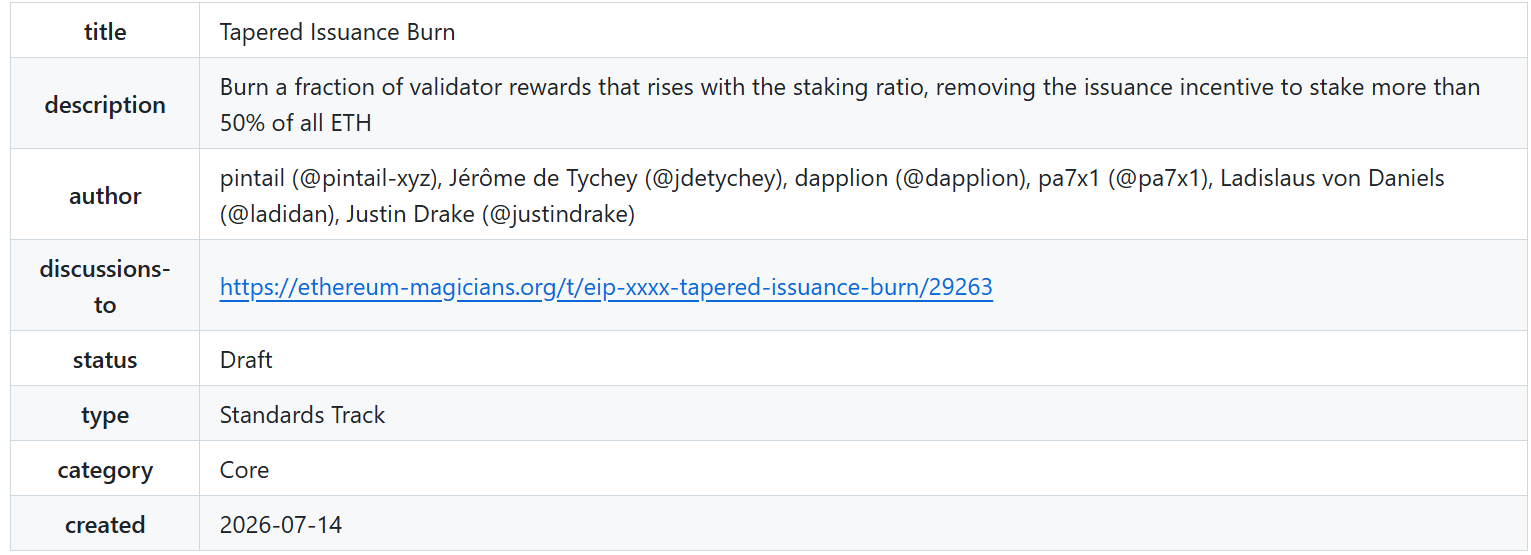 Conical release burning Ethereum improvement proposal. Source: Github
The proposal has sparked strong opposition from developers, pledgers and DeFi founders, who have warned that reward cuts could force independent validators to exit before large institutions are affected, weakening institutional demand for ETH and disrupting the DeFi market built around pledge proceeds. Jerome de Téchet, one of the authors of the proposal, said the changes were to address the rising proportion of Ethereum pledged, which exceeded 33% in April. The authors believe that continued growth in pledge behavior may lead to the concentration of ETH in the hands of large custodians and liquidity pledge providers, while out-of-control issuance will erode Ethereum's status as a neutral, trustless store of value.
"Growing issues are a dilution tax on each holder: either pledged or diluted. At high pledge ratios, liquid pledged tokens (LSTs) and other pledged derivatives will replace the original ETH as circulating currency in the ecosystem, replacing the most neutral and untrustworthy assets with intermediated claims to the issuer." he said.
Although EIP-8363 is still in the early draft stage, its release time is only two days away from the deadline for the Ethereum Hegotá upgrade proposal, which also raises concerns about whether it will have enough time to evaluate the economic impact on the Ethereum token.
EIP-8363 authors 'arguments on reducing issuance
Proposal authors believe that under the current curve, even if all ETH are pledged, the pledge yield has never fallen below 1.5%. De Teicher said: "The incentive for pledge has never been turned off. Where will it stop? It won't." He said that if no changes are made, the worst-case scenario could be that more than 55% of Ethereum's supply will be locked in collateral before 2028.
"Maximum neutrality and minimum dilution: These are the two cornerstones of value storage. This EIP not only strengthens these two points, but also sets standards that other blockchains cannot surpass."
The proposed policy will allow circulation to reach 0.5% of the annual ETH supply at its peak (approximately 20% of ETH is pledged), and when Ethereum's pledge ratio reaches the threshold of 60.25 million ETH, circulation will drop to zero.
De Teshet said: "ETH supply growth will be limited and more predictable. Combined with EIP-1559 and the Blob combustion mechanism, supplies will be reduced more frequently. As the most mature of all protocols, Ethereum has a sustainable security budget, and will be the least diluted of all protocols."
The overall direction of the proposal is also supported by Gray Investment. In May, Zach Pandel, director of research at Grayscale, said limiting pledge incentives was "positive for ether prices in the long run." [TAG
Critics call this a punishment for Ethereum's growth
Aave founder Stani Kuletchoff said that lowering pledge rewards would weaken institutional demand for ETH and lending activity in DeFi, arguing that the proposal "does not achieve what it is trying to achieve, but is harmful to Ethereum." Another argument is that the proposal will affect independent validators because their relative costs are generally higher and they are more sensitive to reward changes, resulting in a more concentrated validator set.
Ether.Fi CEO Mike Siragadze said: "This will obviously crowd out independent pledgers who are not subsidized by the Ethereum Foundation or other institutions." "This will basically ensure that only large centralized entities with zero capital costs can pledge, and users can only passively hold their ETH." De Teicher disputed this, telling the Ethereum Mage Forum that users of large pledge providers must pay fees, making these services less attractive when rewards fall, although he admitted that research in this area remains controversial.
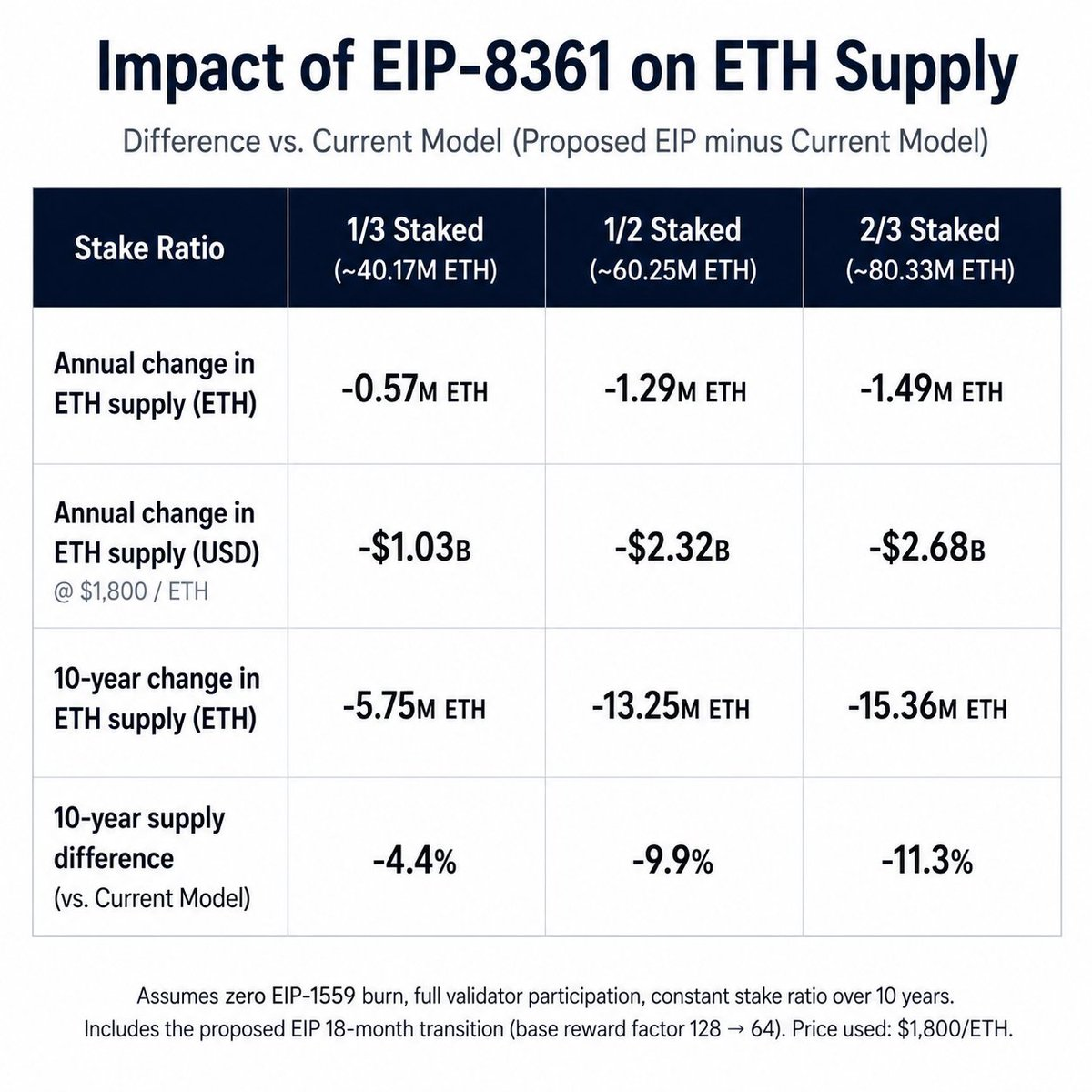 The proposed network update will reduce ETH circulation and inflation. Source: Zach Pandl
Others pointed out that the timetable for considering the proposal seemed too hasty, although this appeared to be due to a misunderstanding of the upcoming August 6 deadline. "This clearly did not allow enough time for the community to review such a significant monetary policy change," said Greg Kumusos, co-author of EIP-8148 and EIP-8205.
Current status of the proposal
The "Cone-release Burn" proposal has not yet been approved, scheduled, or included in the Hegotá upgrade. Although there is a deadline on August 6 related to the proposal, the deadline is a pull request for additional EIP for the Hegotá upgrade, not a deadline for deciding which proposals will be included. Ethereum community organizer Trent Van Epps said the selection process may last until November 8, and the Hegotá upgrade is likely to be launched on the main network in the second quarter of 2027.
























