
 Exchange Ranking
 Top Exchanges
 24h Volume Ranking
 Popularity Ranking
 Exchange BTC Balance
 Proof of Reserves
 Decentralized Exchanges
 Funding Rate
 Funding Heatmap
 Liquidation Data
 Max Pain
 Long/Short Ratio
 Whale L/S Ratio
 Binance/Okex/Huobi L/S
 Bitfinex Margin L/S
 ETF Tracker
 Solana ETF
 XRP ETF
 Hong Kong ETF
 Bitcoin Treasuries
 Crypto Reversal
 Ethereum Reserves
 HyperLiquid Wallet Analysis
 Hyperliquid Whale Watch
 Large Transactions
 On-chain Movement
 Bitcoin ROI
 Stablecoin Market Cap
 Options Analysis
 News
News Articles
 Economic Calendar
 Features
 Wallet
 Contract Calculator


 Security
 Collections
 Watchlist
 Following
 SOL
SOL Solana was trading at US$75.91, and the chart showed the market in a tug-of-war between bulls holding on to US$75 and short limits rebounding to US$77 - 78.
SOL prices have rebounded from a low of around US$71.20 in early August, but the rebound has not yet broken through resistance above US$77. If we break through US$78 decisively, it may open the door to US$80. The next major resistance area is US$82 - 84. On the downside, a loss of $75 would bring the $73 - 72 range back into view, followed by an August low of around $71.20.
This makes the current trend attractive to investors focusing on opportunities beyond the next few days. But what if we extended the problem to 2030? We asked ChatGPT, Claude, and DeepSeek two questions: where the SOL price might fall, and how much the $10,000 invested today would become.
We asked three AI models: What might Solana prices reach by 2030?
These three AI models yielded very different results. ChatGPT gives a bearish SOL price of $150 - 250, a benchmark scenario of $400 - 600, and a bullish scenario of $1,000 - 1,500. The core argument is that Solana will capture more activity from DeFi, tokenized assets, payments, institutional markets, and ETFs. 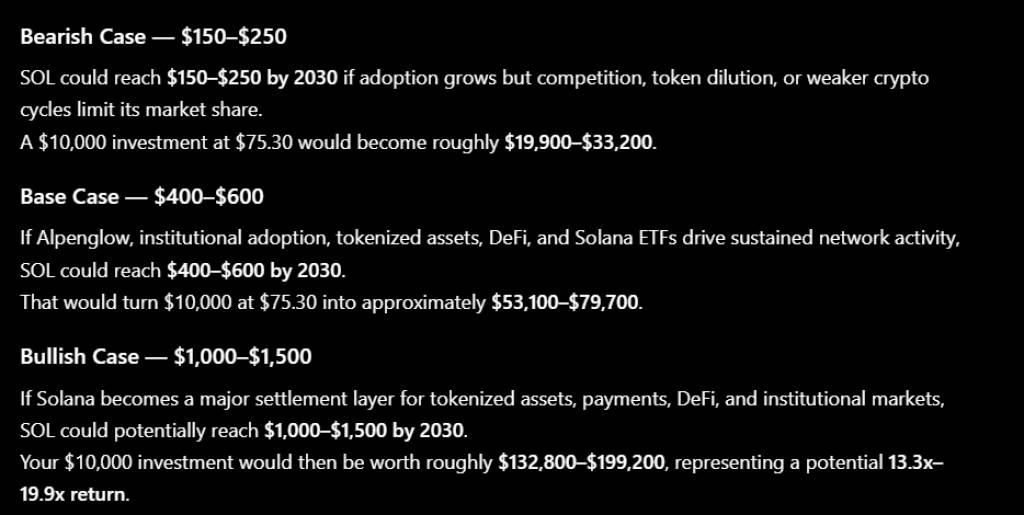
Claude is more conservative. Its bearish scenario sets the SOL price at US$40 - 60, the benchmark scenario is US$150 - 300, and the bullish scenario is US$500 - 1,000+. Its downside assumptions include delayed or disappointing upgrades, stronger competition from other Layer 1 networks, weak ETF flows, and repeated liquidation events. 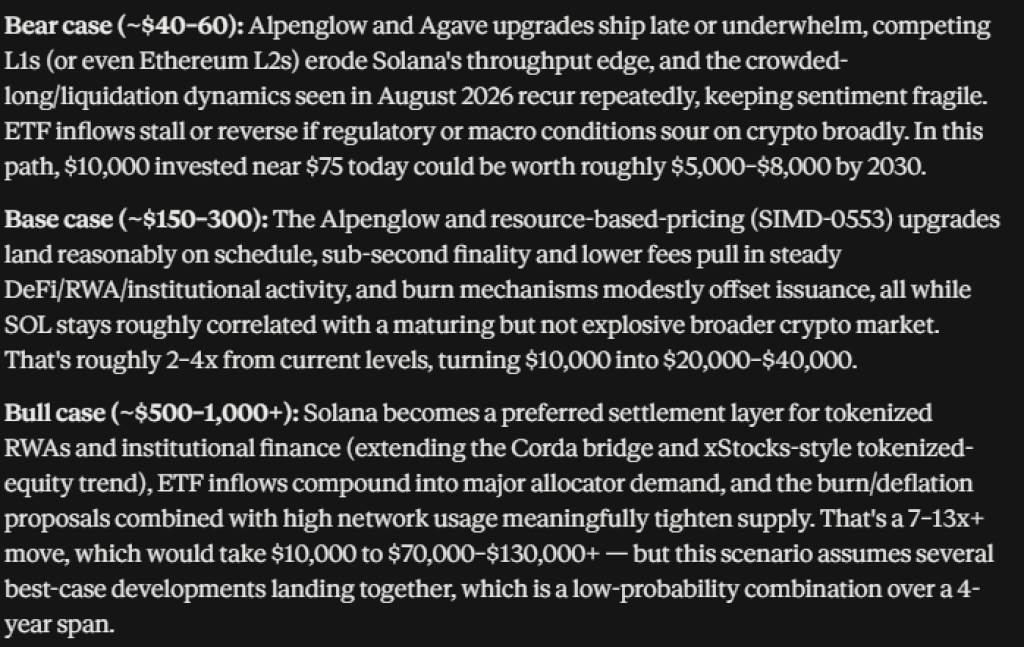
DeepSeek gave the most radical prediction. Its moderate bullish scenario sets SOL at $800 - 1,000 in 2030, a bullish scenario at $1,500, and an extremely bullish scenario at $2,000. The model links these goals to potential changes in Alpenglow, institutional adoption, tokenization of real-world assets, stablecoin growth, and SOL supply dynamics. 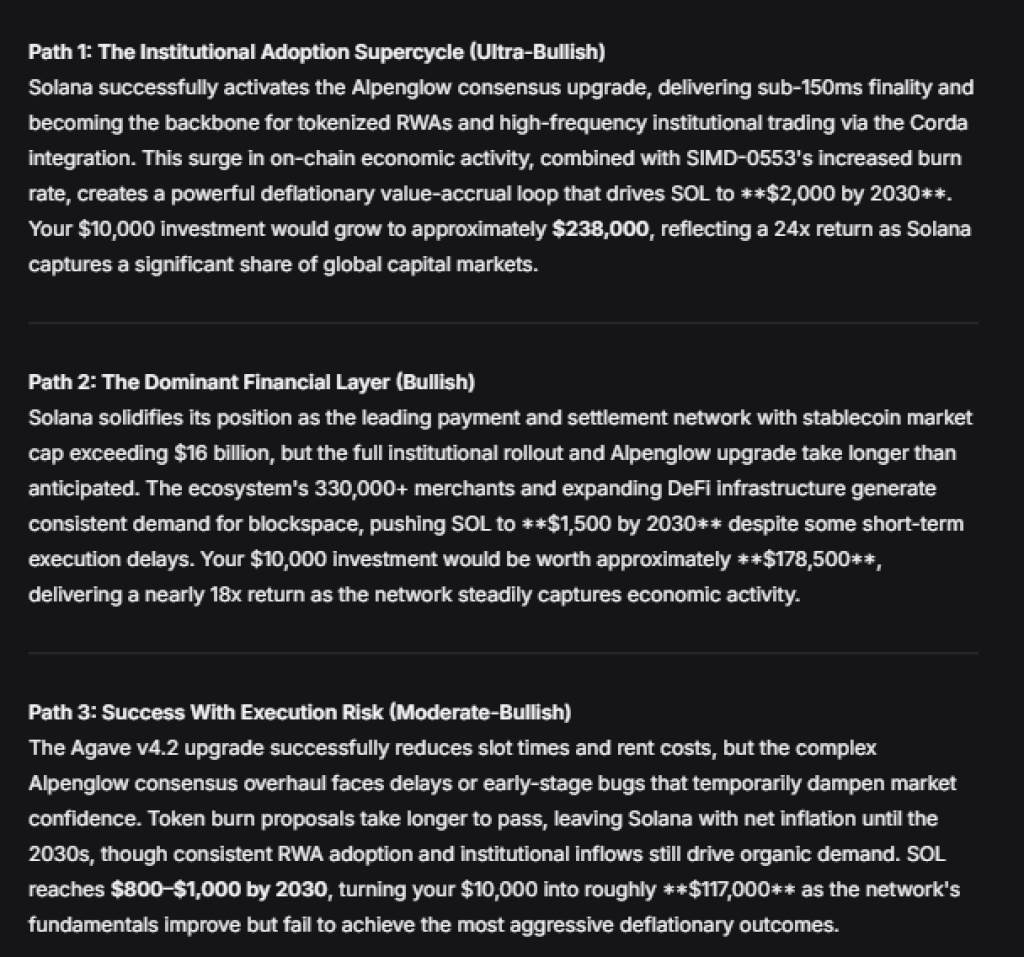
What a US$10,000 investment in Solana might turn into by 2030?
At a SOL price of US$75.91, US$10,000 can buy 131.7 SOLs (excluding fees and taxes). Under the most pessimistic US$40 - 60 scenario in the AI model, the value of this position will be approximately US$5,269 - 7,904 by 2030. In the US$150 - 300 scenario, the same investment will grow to approximately US$19,760 - 39,521.
The middle interval is much more interesting. When SOL prices reach $400 - 600,$10,000 will become $52,686 - 79,042. If the SOL price reaches US$800 - 1,000, the value of the position is approximately US$105,374 - 131,736. At the most optimistic end, when SOL prices reach $1,500, the investment will be close to $197,604, with a return of approximately 19.8 times. When it reached US$2,000, it was US$263,473, about 26.3 times.
Why AI models disagree on Solana price targets
The biggest disagreement lies in how each model weighs Solana's future network adoption and execution risks and competition risks. ChatGPT values institutional adoption, tokenized assets, DeFi and ETFs. Claude places more emphasis on upgrade execution, competition chain, macro environment and the possibility of weak demand. DeepSeek places more emphasis on the successful launch of Alpenglow and Solana becoming the main settlement network for institutional finance. Its $2,000 target requires multiple favorable factors to occur simultaneously, including faster finalization, stronger RWA activity, and stronger SOL economic demand.
This leads to AI predictions ranging as wide as $40 - 2,000, rather than a single consensus goal.
Can Solana really reach these prices by 2030?
The level of adoption required for a US$150 - 300 SOL price is much lower than the US$1,000 - 2,000 scenario. At $300, Solana still needs continued ecosystem growth, but the required market valuation is well below the most aggressive forecasts. The $400 - 1,000 range is feasible as Solana translates technology upgrades into higher trading activity, DeFi usage, tokenized assets and institutional demand. A price of $1,000 represents an increase of approximately 13.2 times from $75.91.
The $1,500 - 2,000 scenario requires greater execution. Solana needs to become the main financial settlement network, attract large amounts of institutional capital, and maintain strong network demand until 2030. Competition, regulation, market cycles and upgrade delays remain major risks. As a result, the AI model does not give a single answer, but provides a spectrum: $40 - 60 for a deep bearish scenario,$150 - 600 for several moderate outcomes, and up to $1,000 - 2,000 if Solana prices achieve their most ambitious growth theory. For a $10,000 investment, this means that by 2030, the results could be between approximately $5,300 and $263,500.
FAQs
Can Solana reach US$1,000 by 2030? Yes, AI forecasts list $1,000 as a possible target, assuming Solana expands in DeFi, tokenized assets, payments and institutional finance.
What might a $10,000 investment in Solana be worth by 2030? At the current SOL price of US$75.91, US$10,000 is worth approximately US$52,700 at US$400, approximately US$131,700 at US$1,000, and approximately US$263,500 at US$2,000.
What are the biggest risks to Solana in achieving these goals? Competition from other Layer 1 networks, upgrade delays, weak institutional demand, unfavorable market conditions, and SOL supply dynamics may limit price upside.
























