Exchange Ranking
 Top Exchanges
 24h Volume Ranking
 Popularity Ranking
 Exchange BTC Balance
 Proof of Reserves
 Decentralized Exchanges
 Funding Rate
 Funding Heatmap
 Liquidation Data
 Max Pain
 Long/Short Ratio
 Whale L/S Ratio
 Binance/Okex/Huobi L/S
 Bitfinex Margin L/S
 ETF Tracker
 Solana ETF
 XRP ETF
 Hong Kong ETF
 Bitcoin Treasuries
 Crypto Reversal
 Ethereum Reserves
 HyperLiquid Wallet Analysis
 Hyperliquid Whale Watch
 Large Transactions
 On-chain Movement
 Bitcoin ROI
 Stablecoin Market Cap
 Options Analysis
 News
 Articles
 Economic Calendar
 Features
 Wallet
 Contract Calculator


 Security
 Collections
 Watchlist
 Following
Former New York Governor Kumo accused competitors of exerting pressure to block the issuance of OKXICE coined shares.
Andrew Cuomo, former Governor of New York State and Co-Chair of OkXICE, claimed that some of the competitive trading platforms had prompted some issuers to prevent or delay their inclusion in the joint venture’s monetized shares. His statement coincided with OKXICE’s official turn-in on Monday, when it allowed eligible American investors to trade all-weather monetized securities.
OKXICE is a partnership between the cryptocurrency Exchange, OKX, and the Intercontinental Exchange Group (ICE), the New York Stock Exchange's operator. The platform's first entry consists of six tokenized securities, with plans to expand more assets in phases, but the wave of opposition from multiple companies complicates the roll-out.
Core elements
- OKXICE online:OKXICE was officially launched on Monday to open up tokenized stock transactions to eligible United States investors.
- Kumo's allegations:Kumo indicated that competitors urged firms to opt out in order to buy time for these competitors to start their respective competition systems.
- Number of objections:According to OKXICE documentation, 67 companies objected during the 30-day notice period for the United States Securities and Exchange Commission (SEC) innovation exemption.
- Size of assets:OKXICE reported that six securities were initially available and that a further 107 assets had been identified for phased roll-out.
- Technical assessment:Kumo suggests that some issuers may simply need more time to assess technology and consult with legal advisers.
OKXICE is on the line - tokenization stocks are entering a new phase of competition
OKXICE deals at the beginning of the week, positioning itself as a bridge between the traditional capital market infrastructure and the implementation system based on blockchain. According to the publication, monetized shares use the blockchain token to represent ownership or rights in the underlying asset, so that they can be traded outside the time of the conventional market transaction.
This uplink also highlights a broader shift in this area: Native encryption infrastructure is increasingly challenging established market sites by providing a continuum of transactions and new clearing lines. With ICE as a partner, OKXICE aims to introduce this model into the mainstream securities workflow in the United States, rather than reserving tokenized assets only overseas or in small places.
Kumo accused the competitor of trying to delay the approval.
On Monday, in a press briefing, Kumo attributed at least part of the delay to the pressure that his alleged competitors put on the issuer. He claimed that competitors encouraged companies to opt out of the OKXICE promotion, because they wanted the issuer to wait for their own system to go online.
“Remember that we also have competitors who urge companies to opt out... because they want companies to wait for their systems to be ready.”
In his statement, Kumo did not name specific competitors, nor did he provide evidence in the briefing to support his claims. Nevertheless, his comments highlighted the growing tension between traditional exchanges, brokers and the cryptocurrency platform, which became more apparent with the increase in proposals for monetization of stocks.
This kind of rivalry is not limited to OKXICE. Previous industry reports point out that there is friction within the industry as listed companies weigh the issues associated with decorativeization. A broader pattern includes that many companies are developing or introducing token trading services, reflecting interest in the product and uncertainty as to how it can be integrated into the existing investor protection framework.
Reasons for the objection and future changes
Kumo’s comments also stress that the objection does not arise entirely from an objection to the monetization itself. Under the provisional innovation exemption clause of the United States Securities and Exchange Commission (SEC), the issuer may oppose the monetization of its shares by unrelated third parties within a 30-day notice period.
According to Kumo, the timetable was too tight for some issuers. He said that the notice period gave some companies insufficient time to understand technology and coordinate internal decision-making to fully communicate with the legal team and the board. He added that OkXICE had received calls from a number of issuers who had initially planned to opt out, but were interested in learning more before taking a final position.
“The simplest decision is no, but many people are actually saying, “I need time, I want to discuss it.”
OkXICE states that 67 companies have objected, including Morgan Chase, McDonald’s, SpaceX and Coca-Cola. The list appears in the OKXICE public notification document, which is linked to the promotion report.
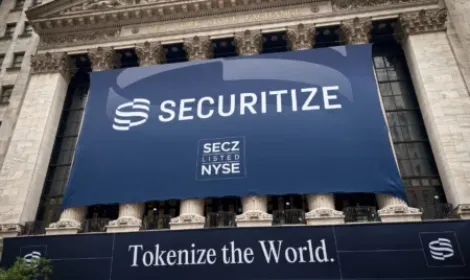
At the same time, the platform announced the first roll-out of six securities — Coinbase, Circle, Robinhod, Strategy, Bitgo and Securitize — and indicated that 107 additional assets had been confirmed to be phased out, which meant that while some issuers continued to resist tokenization through innovative exemption processes, the scope of transactions could be expanded in the near future.
What is it that token stock competition means for investors and markets?
For investors, the most practical difference lies in the continuity of transactions and the potential for faster access to liquidity around the clock when individual securities are activated on various platforms. However, the issuer’s objections also suggest that business involvement is not automatic and that compliance and governance issues remain active.
With the spread of monetized securities, the key question for market participants is whether monetization will become a standardized part of securities market operations, or will continue to be divided into specific products and venues. Kumo’s remarks about competitors trying to slow their opponents down also point to a competition for adoption – not just for technology, but for distribution, comfort and operational readiness.
The next stage is likely to depend on which companies move from “opt-out” decisions to late or reconsidered participation. Kumo’s statements suggest that some issuers have not completely rejected tokenization; they may simply wait for a clearer internal assessment, additional assurances, or more information on how the platform actually works.
Readers should closely follow the further updating of OkXICE in a phased roll-out and the re-examination of early objections by distributors, as well as the continuing signals from other platforms aimed at introducing tokenization stock exchanges in the United States market, which are operating under the evolving interpretation of regulation.