
 Exchange Ranking
 Top Exchanges
 24h Volume Ranking
 Popularity Ranking
 Exchange BTC Balance
 Proof of Reserves
 Decentralized Exchanges
 Funding Rate
 Funding Heatmap
 Liquidation Data
 Max Pain
 Long/Short Ratio
 Whale L/S Ratio
 Binance/Okex/Huobi L/S
 Bitfinex Margin L/S
 ETF Tracker
 Solana ETF
 XRP ETF
 Hong Kong ETF
 Bitcoin Treasuries
 Crypto Reversal
 Ethereum Reserves
 HyperLiquid Wallet Analysis
 Hyperliquid Whale Watch
 Large Transactions
 On-chain Movement
 Bitcoin ROI
 Stablecoin Market Cap
 Options Analysis
 News
News Articles
 Economic Calendar
 Features
 Wallet
 Contract Calculator


 Security
 Collections
 Watchlist
 Following
 SOL
SOL DeFITuna exploit incident: Solana agreement suffers a $580,000 bad debt crisis
On July 16, a exploit attack against DeFITuna attacked leverage agreements in the Solana ecosystem, taking approximately $580,000 from its lending infrastructure. According to the 2026 cryptocurrency standards, this number will hardly even make headlines.
But the loss itself did not cause much uproar compared to the source of the stolen funds.
According to the agreement, the attacker used a vulnerability in its lending pool to cause a deficit of $580,000 in DeFITuna's USDC pool. The team said that the attack vector has been identified and repaired, the investigation is still in progress, and recovery work is progressing.
But what is not yet clear is whether users will receive compensation if recovery efforts fail.
What does the USDC deficit mean for users?
Cryptocurrency protocols often declare that funds are "lost" or "drained." The word "deficit" is more specific.
In the DeFiTuna exploit, debt owed to USDC depositors now exceeds the remaining assets in the pool.
The $580,000 stolen did not come from company treasury accounts or reserve funds. It comes from liquidity provided by users who deposit into the USDC in the expectation of earning income through lending activities.
This creates bad debts.
As long as the withdrawal request remains within the controllable range, the system can still operate normally.
Problems arise when depositors flock to withdraw cash at the same time, because eventually someone will face an empty pool.
In traditional financial terms, this is called a bank run.
The open question is: Does DeFITuna plan to use treasury funds, insurance reserves, future income or external financing to fill the gap?
As of now, the agreement only promises to recover stolen assets. If recovery efforts fail, it does not promise to make up for user losses.
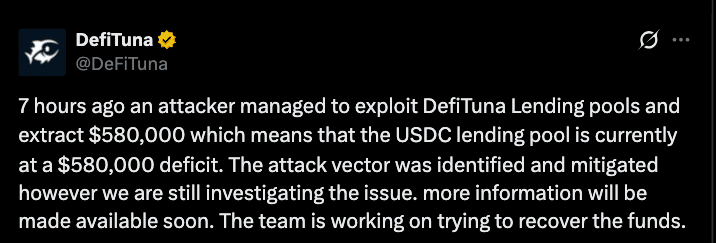
DeFITuna exploit: The intersection of efficiency and complexity
DeFITuna has built its reputation by integrating multiple services that many protocols tend to provide separately.
The platform provides centralized liquidity supply, lending markets, leveraged trading positions and borrowing functions similar to Uniswap v3 in a single ecosystem. Users can establish long, short or Delta-neutral positions with leverage up to five times the value of the collateral, while lenders provide funds to support these strategies.
This model improves capital efficiency, but also increases technical complexity.
Attackers may not need to individually breach lending engines or automated market makers. Vulnerability often occurs where differences arise when multiple systems interact and each calculate the value of an asset.
DeFITunna has not released a post-mortem analysis or technical note to explain the details of the vulnerability, making it impossible for security researchers to determine whether the problem involves pricing logic, collateral accounting or leverage calculations.
Before the report was released, speculation had no practical significance. However, users need transparency.
Solana ecosystem faces security credibility crisis
Since the beginning of this year, the security of decentralized finance has been troubling.
According to data from DefiLlama, more than 140 exploit incidents have been recorded in the DeFi field in 2026, with global losses exceeding US$1 billion. The second quarter alone became the most attacked quarter on record for the platform, with a total of 99 independent incidents. CertiK's latest Hack3D report estimates that 344 incidents caused more than $1.31 billion in losses in the first half of this year.
The Solana Network is still recovering from an approximately $285 million Drift Protocol exploit earlier this year, while other projects within the ecosystem are also facing treasury breaches and protocol failures.
DeFitune exploit events are much smaller, but smaller attacks tend to reveal more accountability issues because the financial risks are lower and users can be protected from loss if the agreement is willing.
History shows that recovery rates after DeFi exploits remain low, and reputation losses often exceed the stolen value. DefiLlama research found that within thirty days of the incident, the total locked volume (TVL) of most attacked protocols dropped to less than 10% of the pre-attack level, regardless of the amount of damage.
The next few days are more important than the attack itself
The exploit itself is basically over, but the response phase has just begun.
Users still don't know: whether depositors will be compensated; whether an insurance mechanism exists; whether treasury funds will cover the deficit; whether attackers can be identified; whether third-party security companies have verified the investigation results; and whether there are other undiscovered vulnerabilities.
The answers to these questions will determine whether DeFITunica can survive this incident or join the list of agreements that have never restored user confidence after the exploit.
Conclusion
DeFiTuna exploit is unlikely to threaten Solana's overall DeFi ecosystem and will not affect the network's mobility. In a market locked in billions of dollars in assets, a loss of $580,000 is manageable. The bigger issue is accountability.
If the agreement distributes revenue to token holders during profitable periods, then when problems occur, users will naturally expect losses to be borne by others rather than being covered by customer deposits.
DeFitune's response in the coming days may ultimately be more important than the exploit itself.
Glossary
DeFITuna: Solana-based protocol that provides leveraged liquidity supply, lending and trading products.
USDC: A dollar-anchored stablecoin issued by Circle, widely used in decentralized financial applications.
Bad debts: In a lending agreement, the excess of a liability over available assets.
TVL (Total Locked Volume): The total value of assets deposited in a decentralized financial agreement.
Concentrated liquidity: A liquidity model that allows providers to allocate capital within a selected price range to improve efficiency.
Frequently asked questions about DeFiTuna vulnerability
Has the DeFiTuna vulnerability been fixed? The protocol said the attack vector was identified and mitigated shortly after the vulnerability was discovered, and the investigation is still ongoing.
Did the attacker steal treasury funds? No. According to the agreement, the deficit affects the USDC loan pool funded by depositors.
Can users get back their funds? DeFiTunta has not announced whether it will have a compensation plan if the recovery fails.
How big is the exploit? The attackers withdrew approximately $580,000, creating an equivalent deficit in the USDC pool.
Does this DeFitune exploit threaten Solana DeFi? The vulnerability is too small to pose a systemic risk to Solana, but it exacerbates widespread concerns about application-level security within the ecosystem.
























