
 Exchange Ranking
 Top Exchanges
 24h Volume Ranking
 Popularity Ranking
 Exchange BTC Balance
 Proof of Reserves
 Decentralized Exchanges
 Funding Rate
 Funding Heatmap
 Liquidation Data
 Max Pain
 Long/Short Ratio
 Whale L/S Ratio
 Binance/Okex/Huobi L/S
 Bitfinex Margin L/S
 ETF Tracker
 Solana ETF
 XRP ETF
 Hong Kong ETF
 Bitcoin Treasuries
 Crypto Reversal
 Ethereum Reserves
 HyperLiquid Wallet Analysis
 Hyperliquid Whale Watch
 Large Transactions
 On-chain Movement
 Bitcoin ROI
 Stablecoin Market Cap
 Options Analysis
 News
News Articles
 Economic Calendar
 Features
 Wallet
 Contract Calculator


 Security
 Collections
 Watchlist
 Following
More than 1 dollar for every 10 dollars of global tokenized U.S. Treasury bonds is issued by a company registered in The British Virgin Islands. According to BVI Finance, this makes the small Caribbean island country the key jurisdiction behind the United States in this fast-growing asset class.
The Destination Digital report released by BVI Finance in June showed that as of June 1, the global tokenized U.S. Treasury bond market was US$14.98 billion, of which BVI entities accounted for approximately US$1.5 billion.
A growing number of digital asset companies are now registering in The British Virgin Islands, including Kraken's parent company Payward, Bitstamp (recently acquired by Robinhood), 1inch and Bitfinex.
The region has a market value of approximately US$1.2 billion in stablecoin held at BVI-related addresses and has approximately 28,000 stablecoin asset holders.
More than 25 virtual asset service providers have been approved under the BVI's VASP system. According to Bernstein Research, 305 tokenized securities are held on these islands, the largest number of any single jurisdiction in the RWA.xyz dataset.
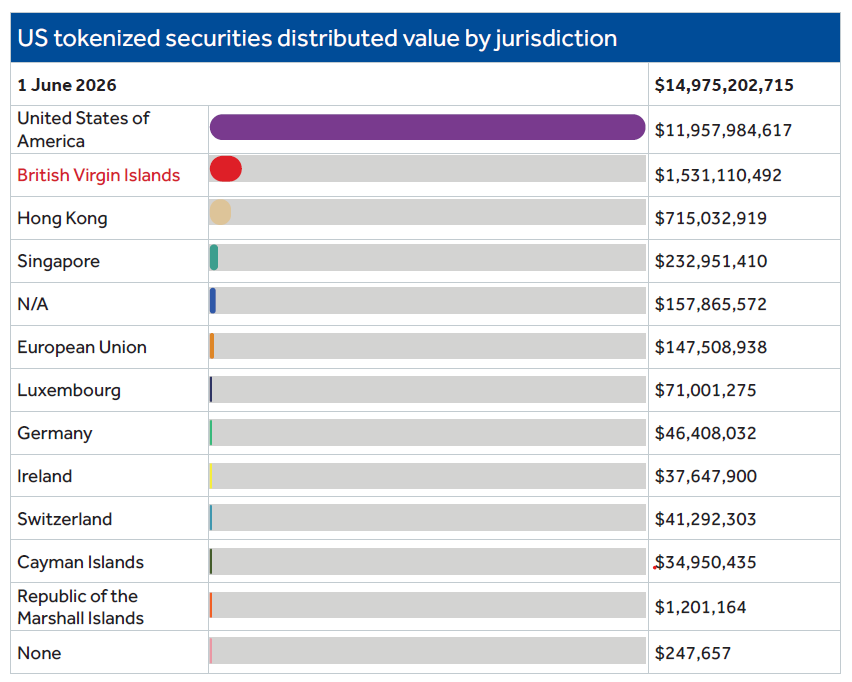
Value distribution of U.S. tokenized securities by jurisdiction. Source: Destination Digital
These data show that The British Virgin Islands has become one of the hottest cryptocurrency hotspots in the world, but the actual situation is more complicated. Tokenized assets are designed to be borderless, and crypto projects can often choose which offshore jurisdiction to register in. In most cases, digital asset companies have not actually relocated to The British Virgin Islands, but instead use registered legal entities in the region, such as token issuers, financial instruments, holding companies or special purpose vehicles.
Crypto companies did not choose BVI solely for tax reasons
Andrew Jowett, a partner at Appleby (BVI) Ltd, who provides corporate structure advice for the digital asset business, told Cointelegraph that clients studying BVI typically compare multiple jurisdictions, such as the Cayman Islands, United Arab Emirates, Singapore and Switzerland. Although the Caribbean offshore has long been considered a tax haven, tax neutrality is no longer the main driver.
Jowett said: "The primary factor in choosing a BVI is digital asset regulation, not taxation." This British overseas territory does have an attractive tax policy and does not impose corporate income tax or capital gains tax on BVI companies. But all leading crypto centers now have preferential crypto tax policies, which means tax is no longer the deciding factor. The Cayman Islands do not impose corporate income tax or capital gains tax, and the United Arab Emirates exempt eligible free zone entities from personal income tax or federal corporate income tax.
"Tax neutrality is just a ticket to entry," said Saeed Al-Marri, CEO of Ethra, a digital asset infrastructure company registered with the BVI. He added that the BVI provides legal certainty and clarity, factors he believes will determine which jurisdictions will survive institutional adoption.
LTP is an institutional digital asset infrastructure provider operating regulated entities in BVI, Hong Kong, Australia and United Arab Emirates. Jack Yang, its founder and CEO, told Cointelegraph that while preferential taxation is important for cross-border structures, legal and regulatory certainty is more important than taxation as tokenization moves deeper into institutional finance. "A tax-neutral structure that cannot pass review by banks, custodians, auditors, investment committees or regulators has limited real value."
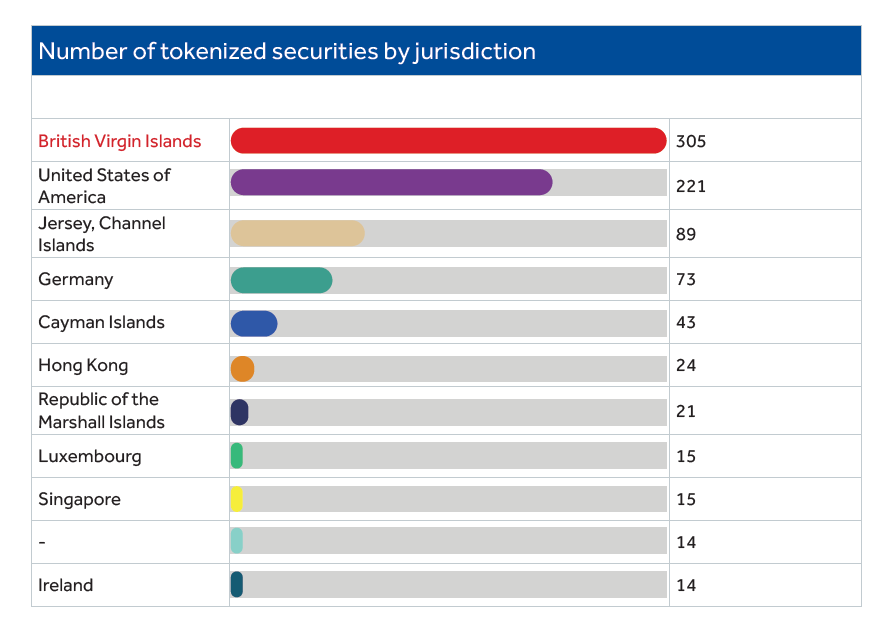
Number of tokenized securities by jurisdiction. Source: Destination Digital
Orest Gavryliak, chief legal officer of 1inch, a BVI-registered decentralized exchange aggregator, said that more and more decentralized financial agreements are choosing jurisdictions that provide predictable rules, rather than just those with the lowest tax burden. "Jurisdictions have not become irrelevant, but their role is changing," Gavryliak told Cointelegraph. "The agreement increasingly focuses on factors such as regulation, institutional credibility and long-term sustainability."
Crypto centers now compete on legal infrastructure
Jurisdictions such as Singapore and the United Arab Emirates that are vying for status as "crypto centers" are increasingly competing through favorable legal infrastructures and licensing regimes, such as Singapore's Payment Services Act and the Dubai Virtual Assets Authority's rulebook. The BVI introduced the Commercial Law for the Provision of Virtual Asset Services in 2023, which is regulated by the BVI Financial Services Committee. Compared to many larger financial centers, the BVI provides fast turnaround, responds to VASP applications within six weeks, and aims to complete the review process within six months, according to BVI Finance and FSC guidelines.
Jowett said that in addition to the favorable tax regime, customers also prioritize "start-up convenience" and efficient corporate structures, which have long been the attraction of BVI. Companies can be established quickly, legal frameworks are flexible, and ongoing reporting requirements are often more lenient than in onshore jurisdictions.
The British Virgin Islands have also historically been favored for providing higher corporate confidentiality than many larger financial centers. Although BVI companies still have to comply with anti-money laundering and know-your-customer requirements, beneficial ownership information is held by registered agents rather than publicly registered, reducing disclosure requirements.
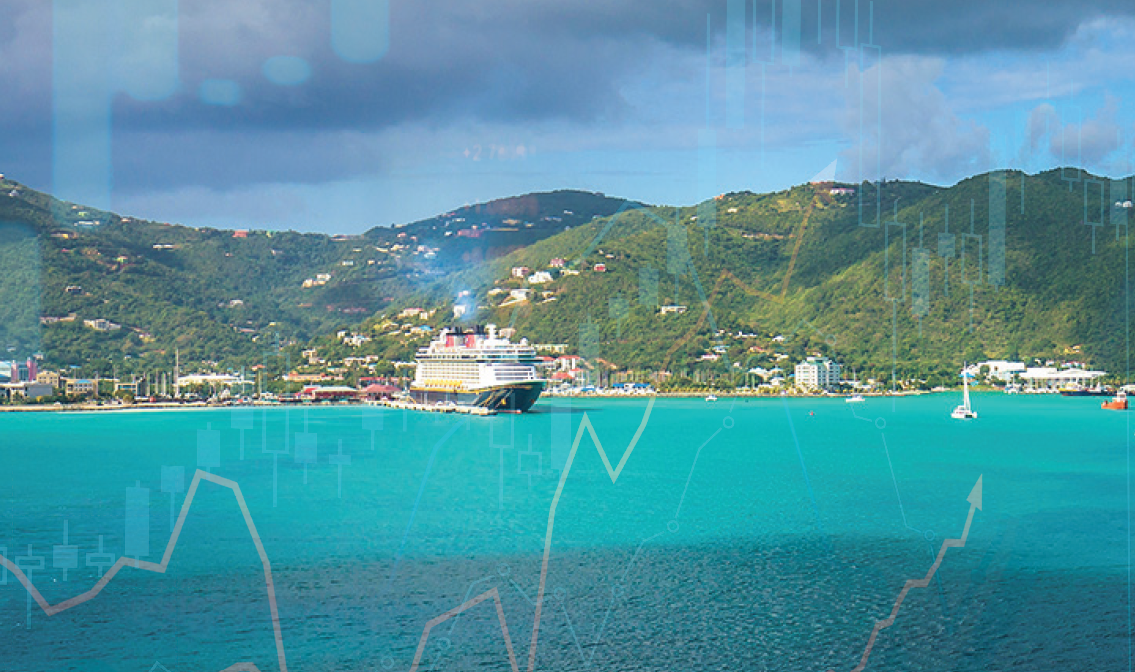
The British Virgin Islands. Source: Destination Digital
However, none of the companies Cointelegraph interviewed viewed tax neutrality or higher corporate confidentiality as determining factors in registering with the BVI, pointing instead to legal certainty, regulatory clarity and corporate flexibility.
Registration in The British Virgin Islands, Not Actual Relocation
Yang told Cointelegraph that LTP has no full-time employees "locally". Instead, the entity is overseen by a board of directors and supported by employees elsewhere in the LTP Group. The same differences can be seen in other parts of the industry. Kraken's parent company Payward is registered with BVI, but the exchange operates mainly in the United States; 1inch's team and operations are spread across multiple jurisdictions. BVI did not win the competition to attract shiny headquarters or large engineering teams. Instead, it has become the legal home for many digital asset businesses, while most of the work is done elsewhere. That may be enough for jurisdictions vying to attract the industry.
























