
 Exchange Ranking
 Top Exchanges
 24h Volume Ranking
 Popularity Ranking
 Exchange BTC Balance
 Proof of Reserves
 Decentralized Exchanges
 Funding Rate
 Funding Heatmap
 Liquidation Data
 Max Pain
 Long/Short Ratio
 Whale L/S Ratio
 Binance/Okex/Huobi L/S
 Bitfinex Margin L/S
 ETF Tracker
 Solana ETF
 XRP ETF
 Hong Kong ETF
 Bitcoin Treasuries
 Crypto Reversal
 Ethereum Reserves
 HyperLiquid Wallet Analysis
 Hyperliquid Whale Watch
 Large Transactions
 On-chain Movement
 Bitcoin ROI
 Stablecoin Market Cap
 Options Analysis
 News
News Articles
 Economic Calendar
 Features
 Wallet
 Contract Calculator


 Security
 Collections
 Watchlist
 Following
 ETH
ETH The accumulation of Ethereum's giant whale has recently returned to the spotlight. On-chain data shows that although Ethereum prices are still below key resistance levels, large investors continue to participate. The latest blockchain dynamics show that institutional participants are still actively deploying as the market looks for clearer directional momentum.
Ethereum's current trading price is approximately US$1,829.10, down 4.74% in the past 24 hours, and its market value reaches US$220.75 billion. The 24-hour trading volume is US$12.43 billion, and the volume to market value ratio is 5.71%. Recent transactions provide important context for Ethereum's market structure, although investors are still assessing the dynamics of the chain by combining technical indicators and the overall market environment.
What signals does the accumulation of Ethereum's giant whale reveal of recent market activity?
The accumulation of Ethereum's giant whale reflects a series of important transactions involving large holders, with buying interest continuing to surge below the US$2,000 mark. Recently, Lookonchain reported that a wallet labeled by the platform as related to Arthur Hayes purchased 1,293 ETH units worth approximately $2.48 million. It should be noted that address tags are based on blockchain heuristics and should not be regarded as absolutely accurate identification.
During the same period, approximately 21,300 ETH (worth nearly $40.95 million) were transferred from an address labeled Fidelity Custody to a newly built online wallet. Similarly, blockchain address tags are based on on-chain heuristics and should not be regarded as confirmed company ownership. The transfer indicates that the assets were transferred from the institutional custody address rather than to the exchange, implying that it may be direct custody or on-chain deployment rather than an immediate sell-off.
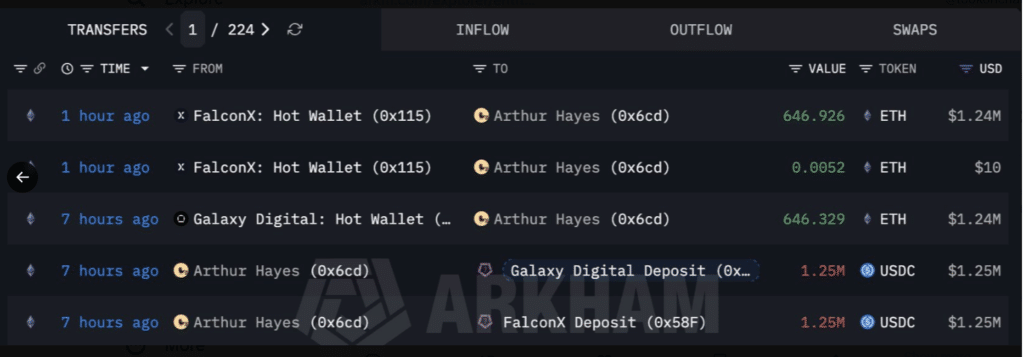
After Arthur Hayes purchased US$2.48 million in ETH, the accumulation of Ethereum's giant whale surged (4)
Changes in large wallets tend to attract attention because they can reflect the position layout of professional investors. However, analysts have repeatedly pointed out that such transactions may also be related to portfolio management, pledges, operating needs or wallet security and should not be regarded as an independent signal predicting future price movements.
Why is exchange traffic still closely watched?
Exchange traffic data shows a short-term intertwined trend, but it also supports a broader accumulation trend. Ethereum recorded a net spot inflow of approximately US$5.51 million on July 16, indicating that more ETH entered the exchange that trading day. Despite this, continued outflows from exchanges have remained the mainstream pattern in recent months, indicating that investors generally continue to transfer ETH out of trading platforms rather than preparing to sell immediately.
From a more macro perspective, the recent limited size of net inflows is not a structural shift in market behavior. If exchange balances continue to fall, the supply of available liquidity may remain tight, which will further strengthen the narrative of Ethereum's giant whale accumulation.
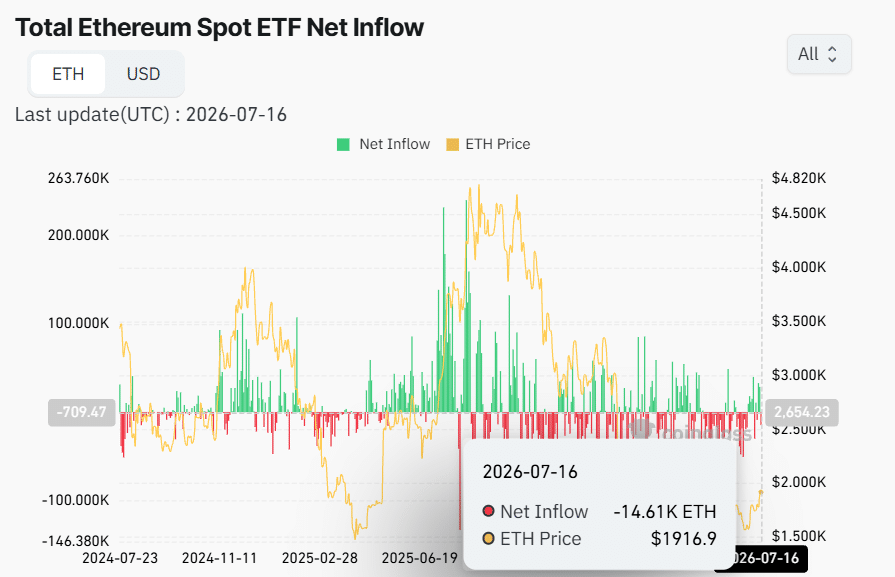
After Arthur Hayes purchased US$2.48 million in ETH, the accumulation of Ethereum's giant whales surged (5)
How do giant whale transactions shape the Ethereum market?
Large investors still account for a significant share of Ethereum spot trading. Earlier market analysis showed that the average spot order size was still in the "whale order" range, indicating that institutional investors and high-net-worth people were still executing a large number of spot transactions. This indicator highlights the continued participation of whales in the market, rather than sporadic buying behavior.
Arthur Hayes 'latest buy and a large transfer to Fidelity's escrow marked address fit this broader pattern. Increased participation by large buyers can help improve market depth during the recovery phase, but experts still stress that whale activity alone cannot confirm future price movements.
Can Ethereum break through the US$2,000 resistance barrier?
Previous market analysis showed that after Ethereum rebounded from its support level of around $1,564 in early June, the price rose to around $1,920, allowing buyers to gradually push assets closer to the key resistance level of $2,000. In terms of technical indicators, the Relative Strength Index (RSI) is 66.54, and its moving average is close to 58.08, indicating that buying momentum has increased but has not yet entered the overbought area. Prices reached higher lows throughout July, indicating that market structure is improving after the previous correction.
The current TradingView indicator shows that the 14-cycle Relative Strength Index (RSI) is 55.6, and the 14-cycle Average Direction Index (ADX) is 23.8, both reflecting neutral kinetic energy. Although buyers are still trying to gather strength, Ethereum must first achieve a steady foothold above $2,000 before it can look to the next resistance level near $2,400. If it is blocked again, prices may fall back to near the $1,800 support level and then launch a new rally.
What factors are still supporting the overall market outlook?
A number of developments continue to support the accumulation of Ethereum's giant whale. The continued outflow of funds from exchanges, the continued participation of institutional investors, and the dominance of giant whale spot orders all indicate that interest among large market participants remains undiminished. In addition, Ethereum continues to attract attention through decentralized finance (DeFi), tokenization and real-world asset (RWA) projects, and its role has gone beyond short-term transactions.
At the same time, market participants remain cautious because large custody transfers do not always mean long-term accumulation. The overall cryptocurrency market sentiment and macro environment are still affecting the trend of Ethereum, so it is necessary to comprehensively evaluate chain activities based on technical signals rather than relying on a single indicator.
What factors may strengthen or weaken current trends?
The latest transaction provides more evidence for the accumulation of Ethereum's giant whale, but does not provide conclusive evidence of an immediate breakthrough. Continued exchange outflows, continued engagement from giant whales and successful breakthroughs in the US$2,000 resistance level will strengthen the current market structure.

After Arthur Hayes purchased US$2.48 million in ETH, Ethereum's giant whale accumulation surged (6)
On the other hand, if the exchange continues to see net inflows or prices are blocked again at key resistance levels, it may delay the recovery process and bring market attention back to the US$1,800 support area.
Conclusion
The accumulation of giant whales in Ethereum remains a core theme in the market, and recent on-chain activity shows that large investors continue to participate despite prices falling below key resistance levels. Arthur Hayes's latest purchase and large transfers from Fidelity's escrow tagged addresses further strengthen the cumulative narrative. However, neither transaction alone can confirm the next step in the price.
When assessing the prospects of Ethereum, the comprehensive consideration of exchange traffic trends, giant whale participation and technical indicators is far more valuable than any single transaction. Whether buyers can maintain demand and successfully break through the $2,000 resistance level will likely determine the next major trend in the market.
Glossary
Custody Wallet: Wallet managed by a third-party custodian.
Market capitalization: The total market value of the cryptocurrency.
Exchange inflow: The amount of cryptocurrency transferred to the exchange.
Exchange outflow: The amount of cryptocurrency transferred out of the exchange.
Net flow: The difference between exchange inflows and outflows.
Frequently asked questions about the accumulation of Ethereum's giant whale
Why is it important for Arthur Hayes to buy ETH?
His purchase suggests that the well-known cryptocurrency investor is increasing his Ethereum holdings.
What factors may drive Ethereum to exceed $2,000?
Stronger buying demand and continued accumulation of giant whales may help prices exceed US$2,000.
Why is the $2,000 mark critical to Ethereum?
US$2,000 is an important resistance level, and buyers need stronger demand to push prices upward.
Does the accumulation of giant whales mean that prices will inevitably rise?
No, the accumulation of giant whales does not guarantee that the price of Ethereum will increase.
Why is online trading of reference value?
On-chain trading helps investors track wallet dynamics and market trends.
























