
 Exchange Ranking
 Top Exchanges
 24h Volume Ranking
 Popularity Ranking
 Exchange BTC Balance
 Proof of Reserves
 Decentralized Exchanges
 Funding Rate
 Funding Heatmap
 Liquidation Data
 Max Pain
 Long/Short Ratio
 Whale L/S Ratio
 Binance/Okex/Huobi L/S
 Bitfinex Margin L/S
 ETF Tracker
 Solana ETF
 XRP ETF
 Hong Kong ETF
 Bitcoin Treasuries
 Crypto Reversal
 Ethereum Reserves
 HyperLiquid Wallet Analysis
 Hyperliquid Whale Watch
 Large Transactions
 On-chain Movement
 Bitcoin ROI
 Stablecoin Market Cap
 Options Analysis
 News
News Articles
 Economic Calendar
 Features
 Wallet
 Contract Calculator


 Security
 Collections
 Watchlist
 Following
 ETH
ETH  B2
B2 Crypto Bridge Attack: DeFi security challenges resurface
Just as decentralized finance (DeFi) seems to be regaining momentum, another round of crypto bridge hacking attacks has once again exposed security risks to the public eye. According to new reports, three separate attacks stole more than $35.5 million from the DeFi protocol in one day, rekindling concerns that bridging vulnerabilities remains one of the industry's weakest links.
Although these losses are far below the multibillion-dollar attacks that shook the industry in previous years, they are still troubling for investors. DeFi has just begun to recover, and after months of sluggish activity, its total locked position value (TVL) rebounded in July. The latest events now raise the question of whether these resurfacing security concerns will slow the pace of recovery until confidence is fully restored.
Three bridging attacks expose persistent vulnerabilities
The largest attack targeted AFX Trade, where attackers used its bridging infrastructure to steal approximately $24.15 million in USDC. Blockaid, a blockchain security company, said the breach was limited to AFX's bridging system, not Arbitrum itself. The stolen assets are then bridged to Ethereum and exchanged for ETH.
The second-largest attack targeted VerusCoin's Ethereum bridging system, causing approximately $7.5 million in damage. Security researchers reported that attackers abused the same type of vulnerability that was exploited earlier this year, allowing them to withdraw unsecured funds from bridging reserves and subsequently transfer funds through Tornado Cash.
At the same time, BSquared Network also lost nearly $3.9 million, and attackers stole millions of B2 tokens, then exchanged them for and bridged multiple networks.
Although the affected protocols operate independently, what they have in common is the cross-chain bridging infrastructure. These systems are one of the most technologically complex components of DeFi because they rely on validators, messaging systems, liquidity pools, or smart contracts to securely transfer assets between blockchains. This complexity makes bridged systems a constant target for sophisticated attackers. 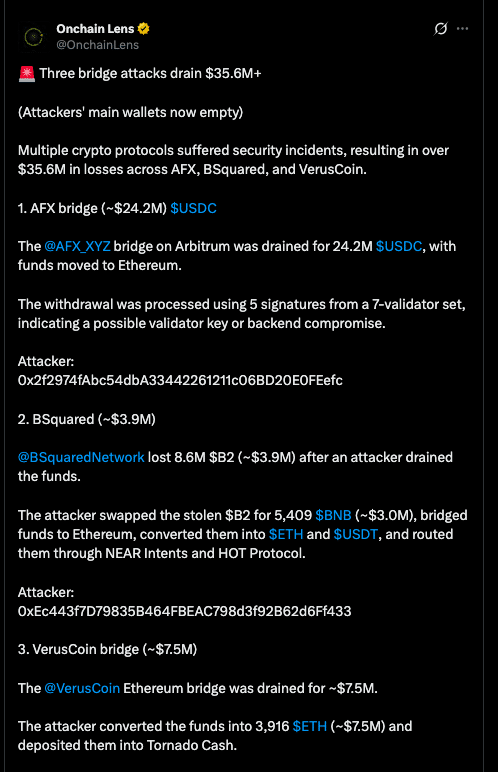
Crypto-bridging attack
DeFi recovery faces untimely confidence test
After months of cautious capital allocation, the DeFi protocol began to attract new deposits in July as investor sentiment improved and the cryptocurrency market strengthened. The rebound suggests that after early security incidents, users have become more comfortable locking money back in decentralized applications.
However, history shows that the impact of security incidents on market psychology often exceeds direct economic losses. Large-scale attacks often reduce user confidence, hinder new deposits, and increase scrutiny of protocol risk management, even if unaffected platforms remain secure.
As a result, recent cryptographic bridging attacks confirm that bridging infrastructure remains one of DeFi's biggest systemic risks. Previous academic research has consistently pointed out that cross-chain bridging is a major attack surface due to its operational complexity and reliance on on-chain and off-chain components.
Drift attacks on capital movements increase market anxiety
Investor caution has intensified after wallets linked to earlier Drift Protocol attacks began to move stolen assets. According to on-chain tracking information shared by Onchain Lens, attackers have been transferring ETH in batches through the Tornado Cash Router. While diverting stolen funds does not necessarily mean an immediate sell-off, it brings another high-profile attack back into public discussion while new attacks dominate the headlines.
The new bridging attack combines with the reactivation of previous attack activities to create a perception that DeFi security risks are re-emerging simultaneously. Even if these events are unrelated, overlapping headlines often affect market sentiment more than fundamentals, especially at a time when capital is just beginning to flow back into decentralized finance. 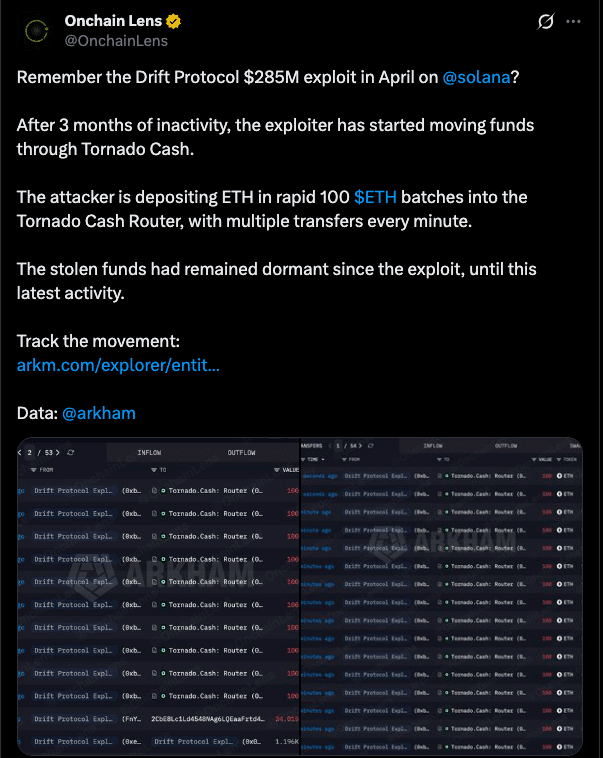
Cryptographic bridging attack
Why security may have more impact on DeFi in the next phase than price
Despite recent attacks, the industry's long-term development trajectory has not changed. Major DeFi developers have been investing heavily in security audits, vulnerability bounty programs, real-time monitoring tools, and bridging system redesigns designed to reduce risk to verifiers and smart contracts. Many newer interoperability solutions are also moving to intent-based architectures to reduce reliance on traditional mobility bridging, reflecting lessons learned from years of bridging attacks. Still, restoring confidence requires more than just technical improvements.
Institutional participation in DeFi relies on predictable risk management, especially in the context of the growing expansion of tokenized real-world assets and regulated financial products across blockchain networks. Continued high-profile attacks could raise concerns about unresolved infrastructure vulnerabilities, slowing agency adoption. If more bridging attacks occur, security issues may once again dominate market discussions. Conversely, if the agreement demonstrates an effective response without further contagion, the TVL recovery in July may be sustained.
Conclusion
Cryptographic bridging attacks once again shift attention away from DeFi's growth prospects to its security challenges. AFX Trade, VerusCoin and BSquared Network lost more than $35.5 million, which is relatively small compared to previous industry-wide attacks, but these incidents clearly demonstrate that cross-chain bridging is an ongoing vulnerability. Whether this turns into another long-term DeFi panic is likely to depend on how quickly the affected agreements can respond, whether follow-up attacks occur, and whether investor confidence continues to support the flow of funds into the decentralized financial ecosystem.
Glossary
Cross-chain Bridging: Infrastructure that enables assets to be transferred between different blockchain networks.
DeFi: Decentralized financial applications that run through smart contracts and do not require traditional intermediaries.
TVL (Total Lock Value): The total value of digital assets locked in the DeFi protocol.
Verifier: The participant responsible for verifying the transaction or approving the bridging transfer.
Tornado Cash: A cryptographic privacy protocol designed to obscure transaction history.
Bridging attack: An attack targeting a cross-chain asset transfer infrastructure vulnerability.
Frequently Asked Questions about Cryptographic Bridge Attacks
Why are Cryptographic Bridge Attacks Worth Attention? Cross-chain bridging facilitates the transfer of assets between different blockchains. Because they often host large pools of assets and involve complex infrastructure, successful attacks can cause huge losses and undermine confidence across the DeFi landscape.
How much money was stolen in the recent DeFi attack? The total damage caused by the three reported attacks was approximately US$35.55 million, with AFX Trade accounting for the largest loss.
Have recent attacks affected the entire DeFi ecosystem? No. Attacks target individual protocols, but security incidents tend to affect broader investor sentiment because they highlight recurring infrastructure risks.
Will these hacks cause DeFi's TVL to drop again? If similar attacks continue, some users may withdraw funds or postpone new deposits.
























