
 Exchange Ranking
 Top Exchanges
 24h Volume Ranking
 Popularity Ranking
 Exchange BTC Balance
 Proof of Reserves
 Decentralized Exchanges
 Funding Rate
 Funding Heatmap
 Liquidation Data
 Max Pain
 Long/Short Ratio
 Whale L/S Ratio
 Binance/Okex/Huobi L/S
 Bitfinex Margin L/S
 ETF Tracker
 Solana ETF
 XRP ETF
 Hong Kong ETF
 Bitcoin Treasuries
 Crypto Reversal
 Ethereum Reserves
 HyperLiquid Wallet Analysis
 Hyperliquid Whale Watch
 Large Transactions
 On-chain Movement
 Bitcoin ROI
 Stablecoin Market Cap
 Options Analysis
 News
News Articles
 Economic Calendar
 Features
 Wallet
 Contract Calculator


 Security
 Collections
 Watchlist
 Following
 AAVE
AAVE  BTC
BTC  DOGE
DOGE  UNI
UNI Investment changes rapidly; humanity and human aspirations remain the same.
This is how Meir Statman, a pioneer in behavioral finance and a finance professor at Santa Clara University, explains one of the oldest puzzles in investment. This may explain why every cryptocurrency cycle so far has been chasing the next hot narrative rather than the fundamentals, whether it's DeFi, memecoin, or decentralized computing.
In an ecosystem that has matured over the years and evolved into an ecosystem of institutional investors, revenue-generating agreements, and real-world use cases, investors 'attention is still tilted towards the next shiny new thing that promises excess returns.
Samar Sen, head of international markets at Talos, said: "Cryptocurrencies are still a young asset class, and price discovery in young markets is often driven by attention first and then by analysis. A new narrative provides investors with a simple story of making quick bets, while evaluating the fundamentals of a mature agreement requires practical work, from understanding usage and revenue to token design and competitive status."
This behavior is not unique to digital assets, but is particularly prominent in an industry that places greater emphasis on models and therefore unsustainable business models.
Pokémon Cards, Digital Assets and Technology Stocks
A recent MarketWise study compared assumptions of investing $10,000 each in cryptocurrencies, stocks, exchange-traded funds, and collectibles between January 2021 and April 2026. Research found that a box of sealed Pokémon cards outperformed Bitcoin, while a pair of limited-edition sneakers gave almost the same return as dogcoin. At the same time, while AI dominates investment headlines, some of Wall Street's most popular artificial intelligence funds are lagging behind the overall stock market.
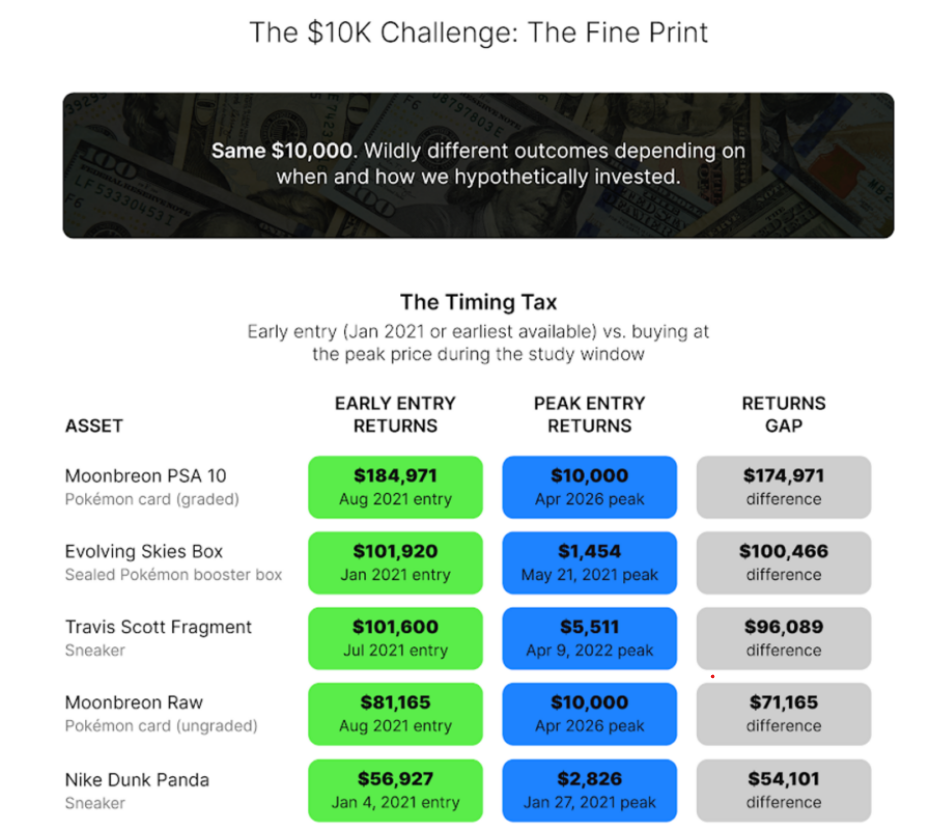 A $10,000 investment would produce completely different results.
What do Pokémon cards, digital assets and technology stocks have in common? According to Statman, they are driven by the same force: investors are not looking for the best assets, but are buying a lottery ticket that can change lives.
Investors are chasing transformation, not cryptocurrencies
Traditional finance often assumes that investors want to maximize returns while minimizing risk, but Statman believes that people often invest for very different reasons. In an unpublished paper, Statman argued that many investors psychologically divide wealth into two layers. The first layer is the "non-poor" layer, which aims to maintain living standards and avoid falling into poverty. The second level is the "getting rich" level, which is used to achieve transformation goals, such as buying a house, achieving financial independence, or fundamentally changing the situation.
Within this framework, concentrated investments are not necessarily irrational; they exist because diversification, while statistically reasonable, may never provide people with limited capital with a realistic opportunity to achieve these goals.
James Royal, a senior writer at MarketWise, said: "Asset classes may change, but behavior is almost the same... investors are not truly loyal to cryptocurrencies, stocks or collectibles. Their loyalty depends on the next promise of something that rewards well."
Stattman said that while some investors today are pinning their hopes on meme stocks,"a century ago it was rail stocks... investors today are just expressing the same desire through a new asset class."
However, investors have not become more risk-tolerant, they are simply more willing to accept fluctuations in order to gain life-changing wealth. "Investors are not necessarily looking for risk, but they are afraid of missing out on the next life-changing return, which may lead them to underestimate downside risks," Royal said.
Why stories trump fundamentals
If investors are looking for transformation rather than simple returns, this helps explain why narratives often trump fundamentals, especially in the cryptocurrency space.
The decentralized finance field is a typical example. Although some of the largest agreements such as Aave or Uniswap generate considerable revenue, attract billions of dollars in deposits, and process huge transaction volumes, their tokens are unlikely to inspire the same excitement as the new narrative built around the latest craze.
As of this writing, the Aave token is trading at approximately US$98, down approximately 85% from its 2021 high, but its total locked value (TVL) exceeds US$14 billion and reached more than US$37 billion at the peak of the bull market in October 2025.
[TAG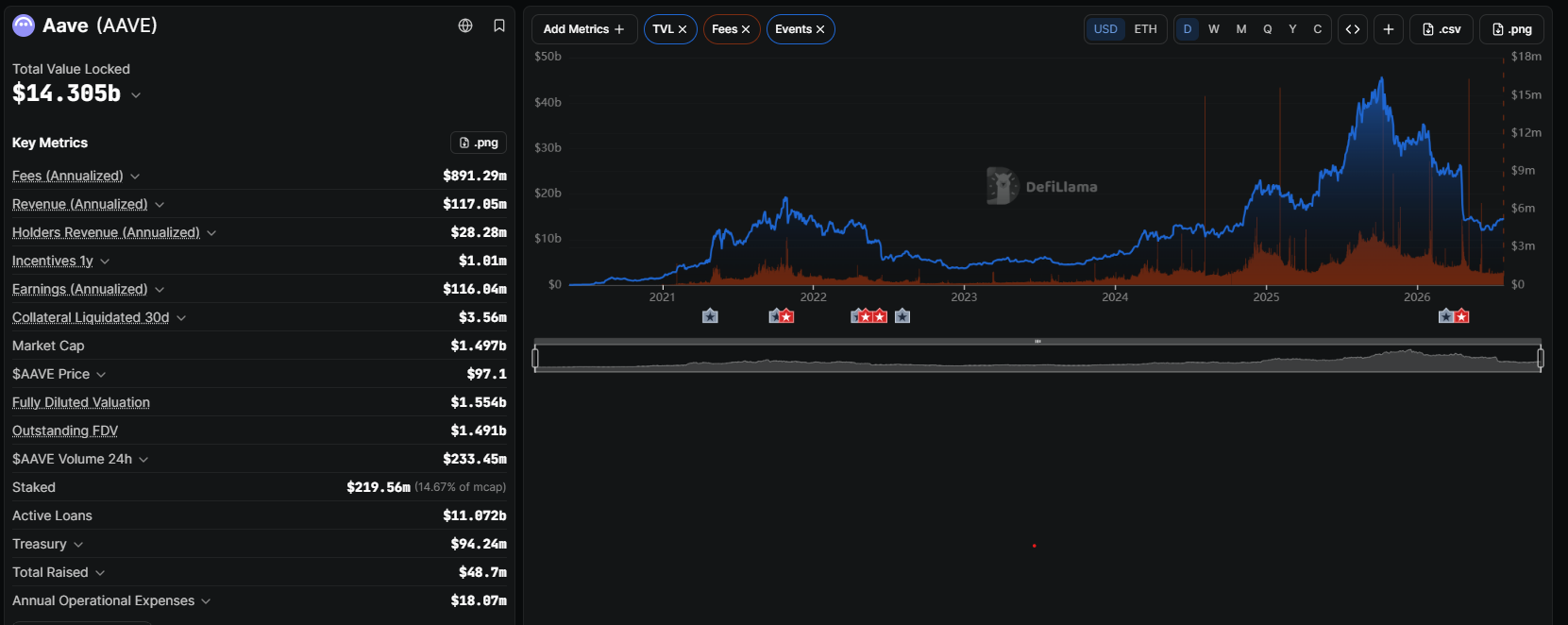 Aave has a TVL of over $14 billion, while its token price is down 85% from its 2021 high. [TAG Thomas Probst, research analyst at Kaiko Market Data Provider, said that while assets may outperform in the short term, fundamentals are always more important in the long run. "Market fundamentals continue to play an important role, particularly resilience, liquidity and volatility...[an asset's] long-term viability also depends on the robustness of its market structure," he said. [TAG
However, while a mature agreement that generates sustainable cash flow may be an attractive long-term investment, it has little appeal to investors who allocate their money to the "get rich" bucket. A token that may double in a few years will always find it difficult to compete with even the extremely distant possibility of a 100-fold surge.
Royal said: "Investors like to confuse great technological breakthroughs with great investment opportunities," which may explain why many AI-themed ETFs underperform, even though AI has arguably become the defining investment narrative of our era. "The real trick is not to identify exciting investments, but to recognize when optimism has been priced."
The same techniques are also useful when timing the market. MarketWise's report found that investors who bought Bitcoin in January 2021 had turned their hypothetical $10,000 investment into more than $24,000 by April 2026, with a yield of +141%. However, those who bought at the October 2025 cyclical high had the same investment shrunk to just over $6000 by April, with a return of-38%(which is now worth about $5000). Anyone who bought AAVE at about the same time FOMO would now face a loss of 85%.
Institutions play a different game
Sen said that institutional investors view investment from a completely different perspective: "Institutions 'tasks simply do not allow chasing excessive speculative returns. Institutions are already assessing risk-adjusted performance, liquidity, custody arrangements and operational resilience before considering upside potential."
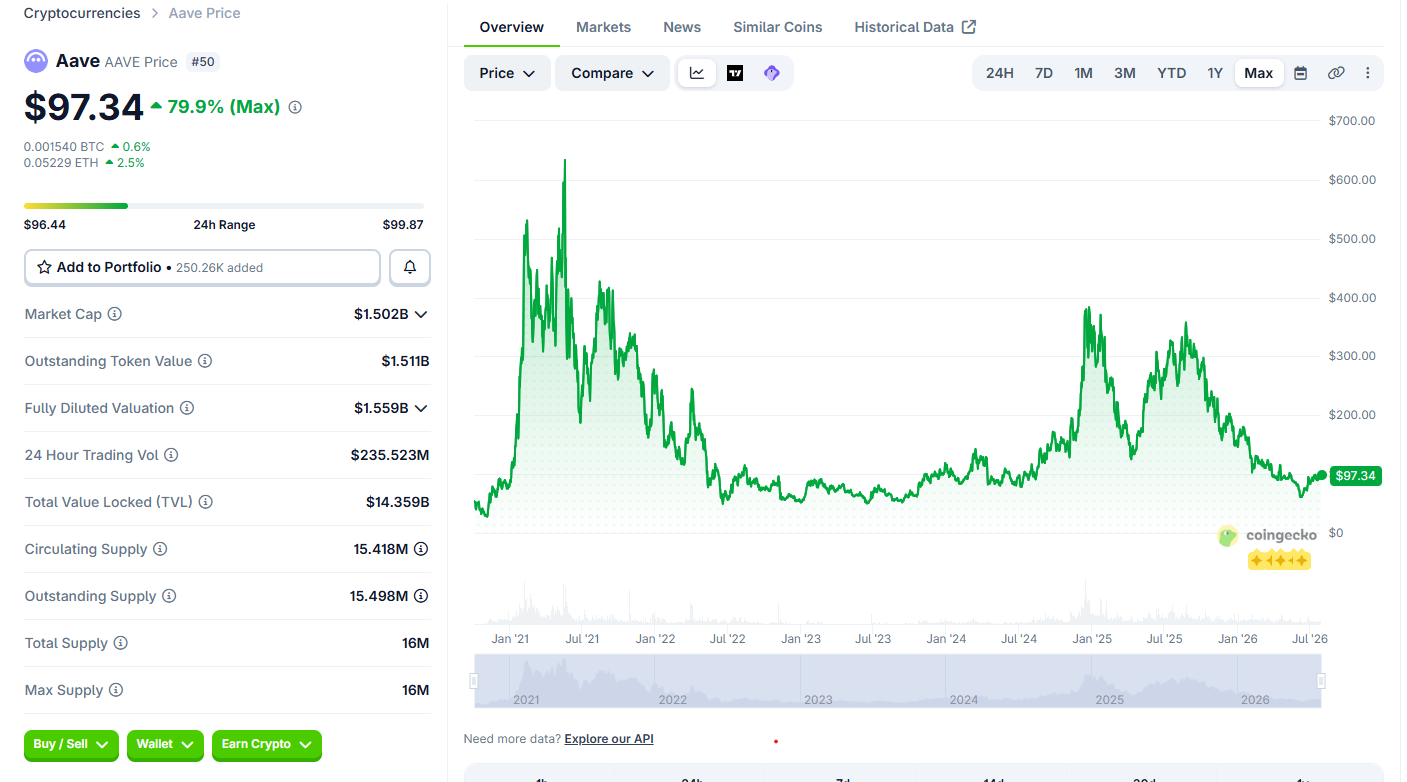 AAVE price performance since 2021.
While this does not mean that institutions are immune to emerging narratives, they usually focus on whether the underlying infrastructure can support meaningful capital allocation, rather than whether the token can rise 100 times. "It's usually mixed, and the order is important," Sen said. Most of these topics, DeFi, AI, memin, do start with a real transformation: a real technology unlock or a new use case that was previously impossible." However, once narratives begin to attract speculative money, prices tend to move faster than fundamentals, he said. "Investors who enter late in the cycle tend to respond both to the narrative that launched the cycle and to the fundamentals... Institutional capital tends to follow process and discipline rather than follow trends, often one step behind the original narrative, and one step ahead of the pullback."
The next Bitcoin is not the key
Finding the next life-changing investment is unlikely to disappear, and Statman believes that humans 'desire to improve their own situation will not disappear. The next 100-fold token does exist, and investors will continue to look for it-even if the probabilities and fundamentals suggest they are looking in the wrong place.
























