
 Exchange Ranking
 Top Exchanges
 24h Volume Ranking
 Popularity Ranking
 Exchange BTC Balance
 Proof of Reserves
 Decentralized Exchanges
 Funding Rate
 Funding Heatmap
 Liquidation Data
 Max Pain
 Long/Short Ratio
 Whale L/S Ratio
 Binance/Okex/Huobi L/S
 Bitfinex Margin L/S
 ETF Tracker
 Solana ETF
 XRP ETF
 Hong Kong ETF
 Bitcoin Treasuries
 Crypto Reversal
 Ethereum Reserves
 HyperLiquid Wallet Analysis
 Hyperliquid Whale Watch
 Large Transactions
 On-chain Movement
 Bitcoin ROI
 Stablecoin Market Cap
 Options Analysis
 News
News Articles
 Economic Calendar
 Features
 Wallet
 Contract Calculator


 Security
 Collections
 Watchlist
 Following
 ETH
ETH On July 21, three weeks after Robinhood's new blockchain was launched, it accomplished an unexpected thing: the number of daily active users exceeded Coinbase's Base, reaching approximately 324,000, while the Base was 274,500. By August, Robinhood Chain ranked first among all Ethereum Layer 2 networks by transaction volume, processing more than 10 million transactions per day. For a brokerage company's "sideline" application, such results are quite good.
A broker with its own blockchain
Robinhood Chain is a second-layer Ethereum network built based on the Arbitrum technology stack: ETH is used to pay fuel bills, blocks are generated every 100 milliseconds, and transactions are finally settled back to Ethereum. Its sorter uses a first-come, first-served mechanism, so it cannot be paid higher to gain priority (which is rare in second-layer networks and reflects an anti-MEV stance), but the sorter is centrally operated by Robinhood, and 10% of its net revenue will flow back into the Arbitrum ecosystem. The chain itself is permission-free: anyone can deploy contracts or operate across the chain.
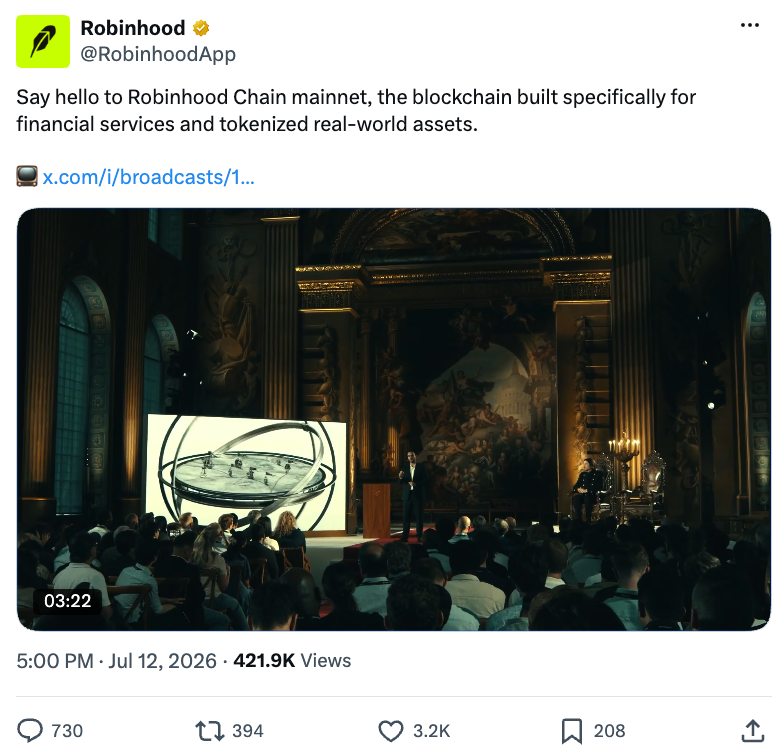
However, the stock tokens on it are not license-free. It all started at Robinhood's event in Cannes in June 2025, when the company launched more than 200 tokenized U.S. stocks for European users and gave away "OpenAI" and "SpaceX" tokens-the latter were publicly denied by OpenAI, triggering an investigation by the Central Bank of Lithuania. Subsequently, the public testnet was launched in February 2026, processing 4 million transactions in the first week. By the time the main net was launched on July 1, this number had exceeded 200 million-the main net was released at the "World is Flat" event in London, which pushed HOOD's share price up 8% that day.
Growth Curve
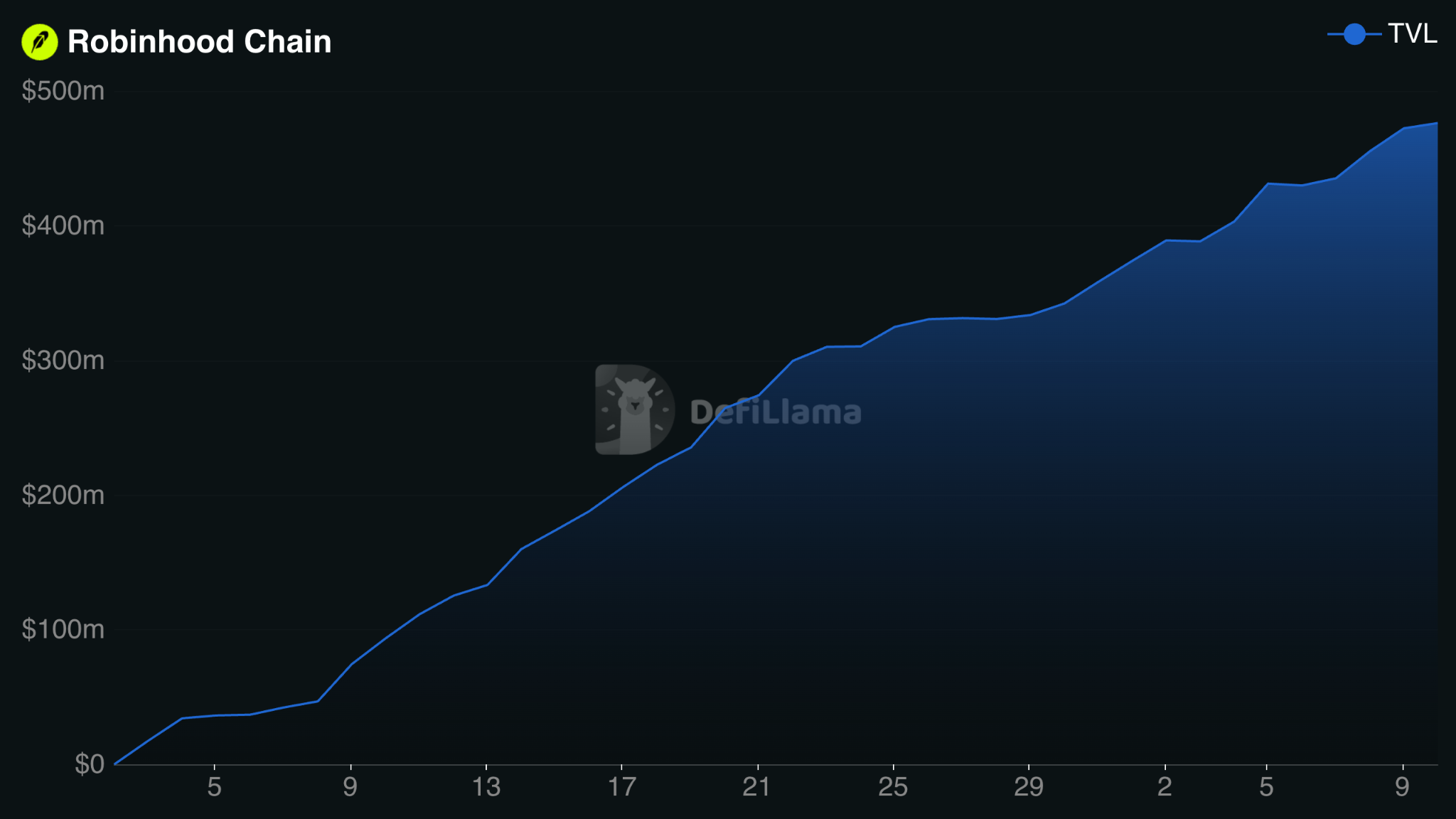
Data since its launch clearly demonstrates the speed with which Robinhood Chain attracts users. According to data from L2Beat, its total locked position value (TVL) has grown rapidly from US$39 million in three days of launch to approximately US$476 million in early August, with a total cross-chain value exceeding US$1 billion.
Source: DefiLlama
Bernstein analysts pointed out that the chain attracted US$3.1 billion in DEX transactions in its first week alone, making it one of the five most active networks. Its cumulative DEX transaction volume currently exceeds US$18 billion. Monthly active users have exceeded 2 million in just three weeks, the supply of stablecoins is currently close to US$584 million, and single-day fee revenue once ranked fourth among all blockchains.
For a second-layer network, this growth rate is almost unprecedented. It took Base nearly three years to reach the level of daily active users, but Robinhood Chain surpassed it in three weeks. By week five, analytics platform growthepie rated the newcomer as number one in daily and weekly transaction volumes among all Ethereum Layer 2 networks, surpassing Arbitrum, Base and OP Mainnet-all of which are three to five years older.
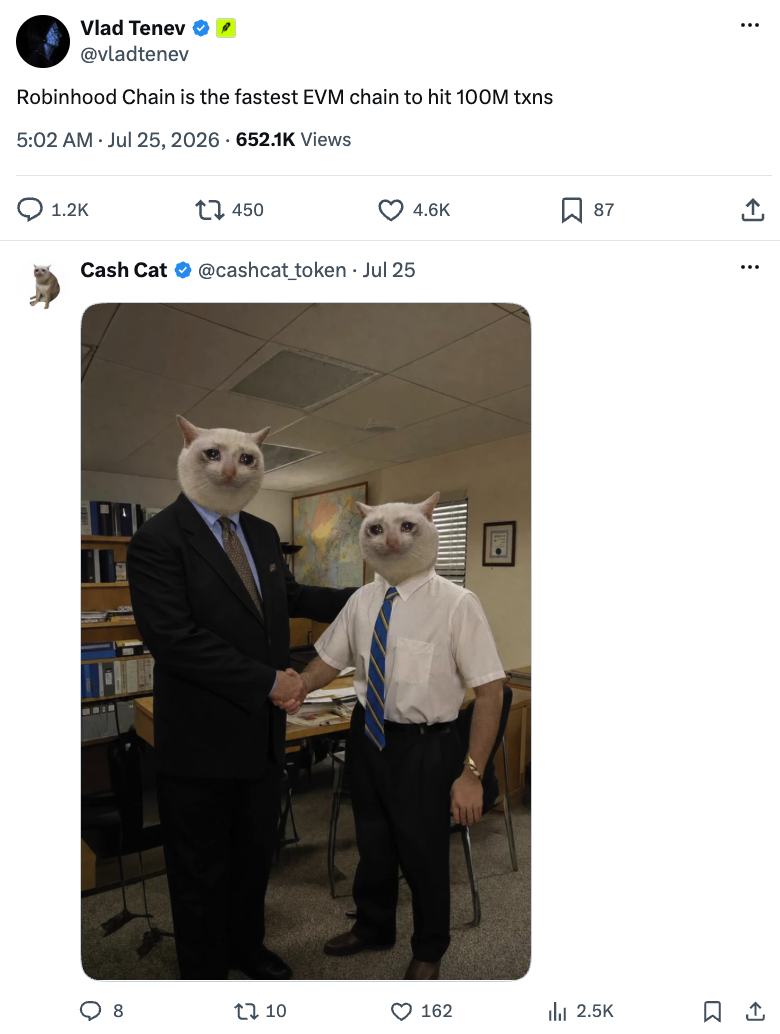
Robinhood CEO Vlad Tenev claims it reaches 100 million transactions faster than any EVM chain in history. Unlike those incentive-driven launches, such as Plasma, whose TVL reached $5.6 billion in the first week, far exceeding Robinhood, but then largely evaporated, the chain's TVL continued to climb throughout July without a significant pullback.
Why is everyone rushing in?
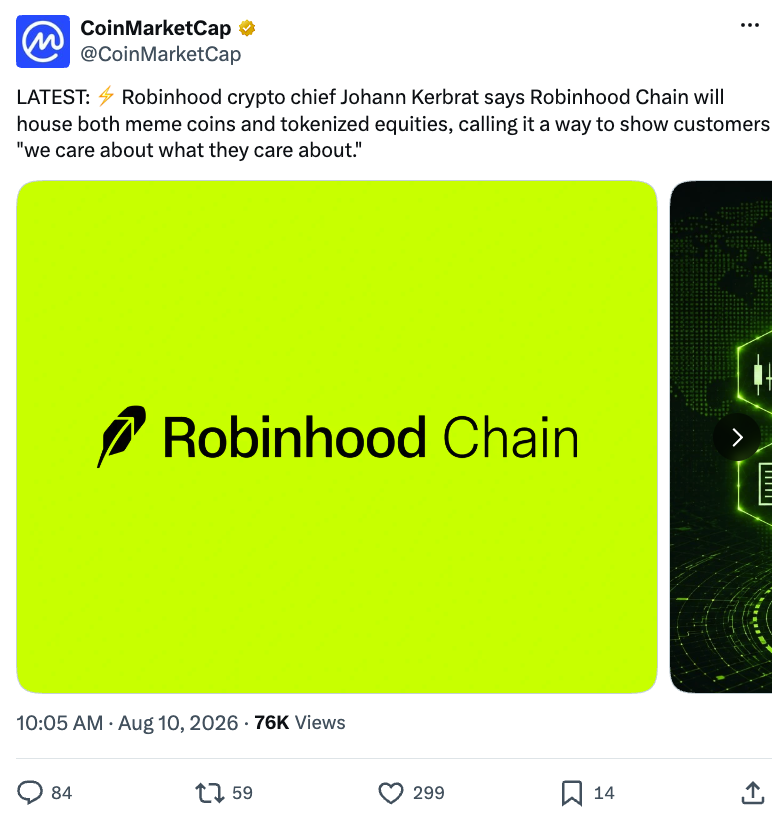
Johann Kerbrat, head of Robinhood's crypto business, described the strategy as a "barbell":"The chain is permission-free and open to everything-whether it's memocoins, RWA (real-world assets), or many other products." In fact, the memin end of the barbell is taking on the main workload. Most of the early trading volume came from speculative memein trading. The network's largest memin coin, Cash Cat (CASHCAT), soared in typical fashion and then fell back, and Tenev enjoyed it.
Two catalysts promoted the rapid growth of the chain in the early stages. First, Robinhood paid Internet fees for Robinhood Wallet users for the first 90 days, making early activities almost free. Second, there are no native tokens, so airdrop hunters "farm" based on the expectation that "airdrops may be coming soon."
Robinhood Stock Tokens
The chain's flagship RWA product requires an asterisk. Stock tokens are tokenized debt securities issued by Robinhood Jersey entities: they track stock prices and pay dividend equivalents, but confer neither ownership nor voting rights. They can trade 24/7 in more than 120 countries, but exclude the United States, the United Kingdom and Canada. Because Robinhood is a U.S. brokerage firm, its home market cannot reach these products.
But they are still very small, very small. Although the market value of stocks on the chain jumped about fivefold at the end of July, Robinhood's tokenized equity was still worth only $28 million, far behind Ondo ($871 million), Binance's bStocks, xStocks and Securitize. Robinhood's advantage lies in its sheer size: it accounts for approximately 44% of all tokenized stock holders. It is also lobbying to address gaps in the U.S. market, submitting a 42-page proposal to the SEC in May to establish a tokenized asset framework.
What does "AI native" mean?
Robinhood promotes this chain as a permission-free, AI-native blockchain-this is marketing rhetoric with three specific elements behind it. The smart trading feature allows users to authorize AI to automatically perform investment operations. Nearly 100,000 accounts (holding more than $100 million in assets) have participated, and crypto support is coming soon.
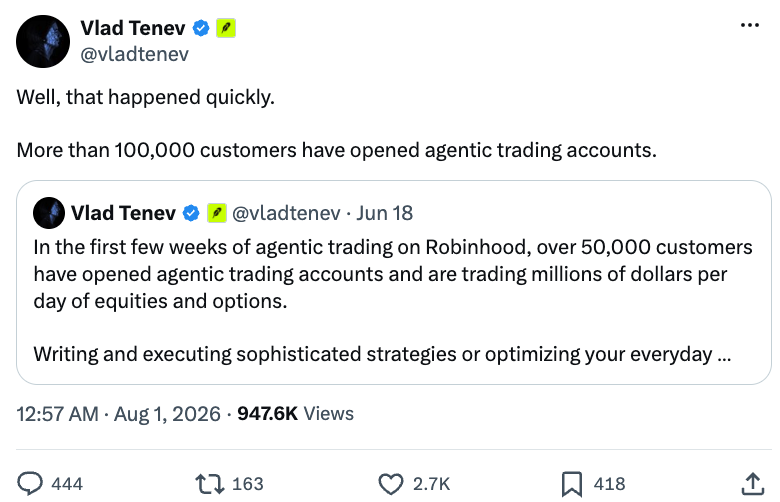
Trading MCP (Model Context Protocol) also allows U.S. users to connect their AI models to Robinhood's data and execution tools. Finally, the chain supports ERC-4337 account abstraction, so autonomous AI agents can hold smart wallets, conduct bulk transactions, and pay on-chain fees themselves. The idea is that if AI agents are going to trade, they need tracks designed for software, not humans.
(Hide content directed to other URLs here)
Items actually running on the chain
Uniswap (v2 to v4, and UniswapX) handles spot transactions. Morpho is the largest agreement in the chain, supporting Robinhood Earn, a USDG lending product launched with Mainnet with an annualized return of approximately 7%. Lighter runs a perpetual contract with an incentive pool of 11 million LIT (double points earned through Robinhood Wallet transactions). Arcus provides another venue for trading perpetual contracts and stock tokens. Meridian is a token-free prediction market, and Doppler is the resident memein launch platform. Chainlink, Paxos, BitGo and LayerZero are all contributing to the underlying infrastructure.
How to try
If you use Robinhood Wallet, the chain is built into it and your fees will be borne by the platform before the end of September. Otherwise, you can add Robinhood Chain to MetaMask, Rabby or Phantom through Chainlist, transfer a small amount of ETH across the chain, and you can start using it.
Convert on Uniswap, borrow on Morpho, trade perpetual contracts on Lighter, and verify everything through the Blockscout browser. Stock tokens require KYC verification through Robinhood. Recommend using a new wallet, assuming that airdrops will never come, and treat memes as pure entertainment, as most will eventually fail.
Whether the trading flow of memin can be transformed into the RWA economy remains an open question. But just a month into its launch, Robinhood Chain has done something that the more well-funded second-layer networks have never done: getting millions of people involved.
(The relevant guidance on "Read More" is hidden here)
























