
 Exchange Ranking
 Top Exchanges
 24h Volume Ranking
 Popularity Ranking
 Exchange BTC Balance
 Proof of Reserves
 Decentralized Exchanges
 Funding Rate
 Funding Heatmap
 Liquidation Data
 Max Pain
 Long/Short Ratio
 Whale L/S Ratio
 Binance/Okex/Huobi L/S
 Bitfinex Margin L/S
 ETF Tracker
 Solana ETF
 XRP ETF
 Hong Kong ETF
 Bitcoin Treasuries
 Crypto Reversal
 Ethereum Reserves
 HyperLiquid Wallet Analysis
 Hyperliquid Whale Watch
 Large Transactions
 On-chain Movement
 Bitcoin ROI
 Stablecoin Market Cap
 Options Analysis
 News
News Articles
 Economic Calendar
 Features
 Wallet
 Contract Calculator


 Security
 Collections
 Watchlist
 Following
 AVAX
AVAX  BTC
BTC  ETH
ETH  GMX
GMX Bitcoin (BTC), even after recovering from its low in early July, is still well below its October 2025 high of about $126,000. This means looking for profit opportunities in 2026, unlike usual bull market advice, because simply waiting for BTC price movements may mean waiting for an uncertain period of time.
CMC Crypto Fear and Greed Index is still in the "fear" range, although it no longer shows "extreme fear" as it did last month. 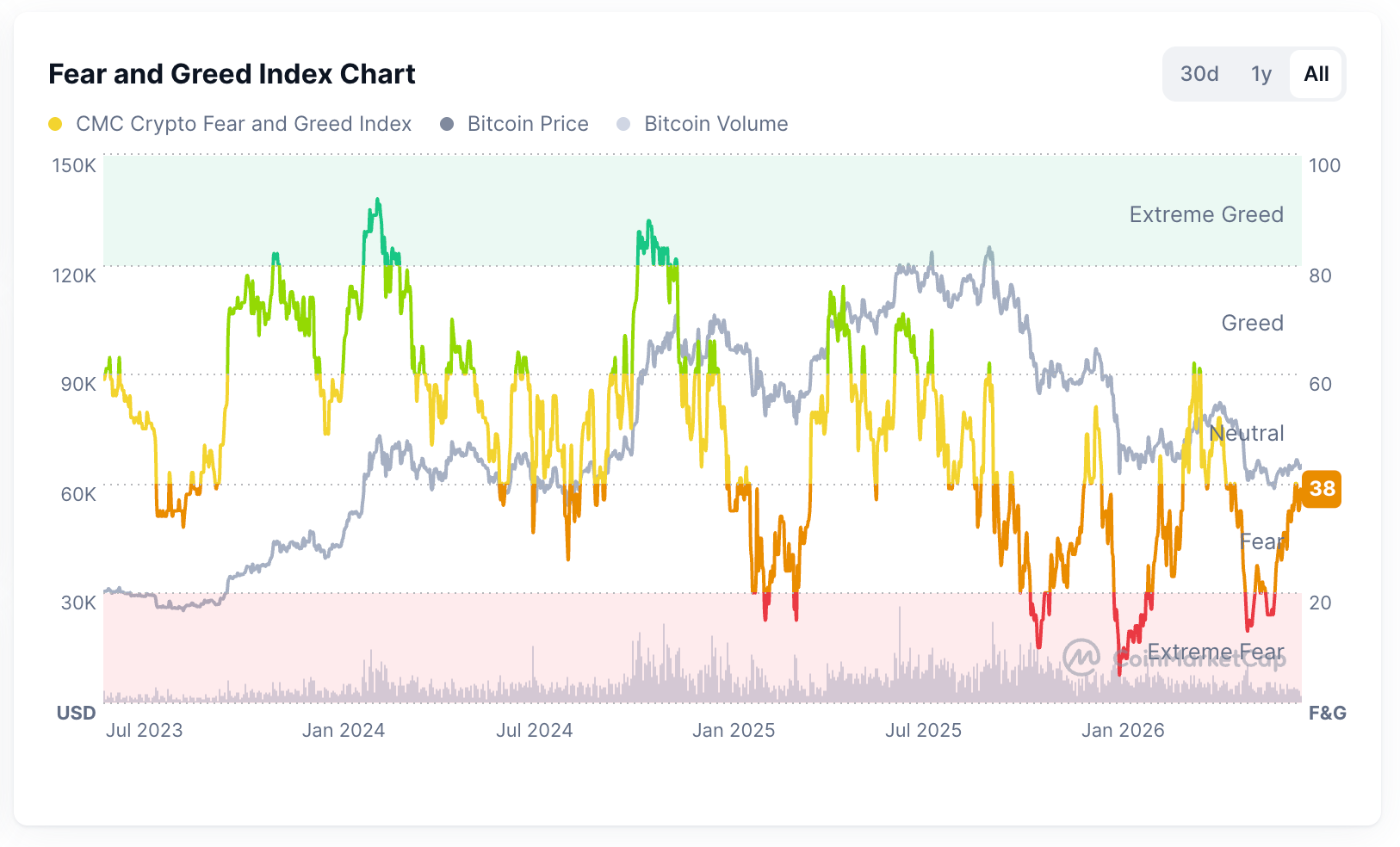
Faced with this situation, most people default to one action: sit still, pledge some tokens on the exchange, and then wait for the market to turn green. But this strategy still relies on the market picking up before your patience runs out.
This article focuses on a revenue-based strategy, which means that even if the K-chart does not move or continues to fall, you can still gain benefits.
Overview of crypto revenue strategies
For time-pressed readers, here is a complete list of all methods, the actual funding sources for each method, and the main risks that accompany it: 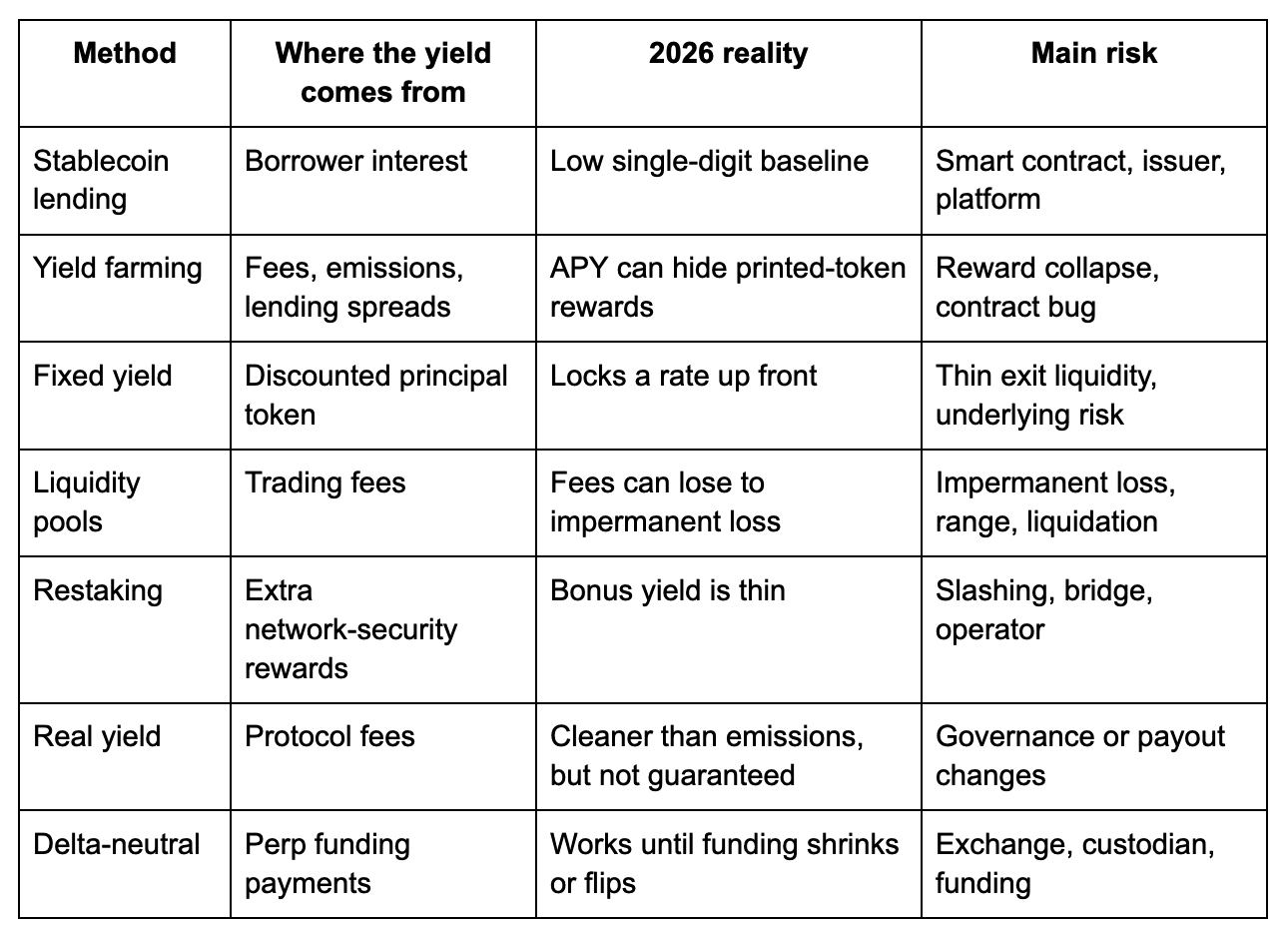
Interest rates, agreement details and market data in this guide are as of late July 2026, but please treat each annualized rate of return (APY) as a dynamic number rather than a fixed commitment.
1. Liquidity mining
Liquidity mining is a way to earn interest in DeFi. The agreement requires holding a pool of crypto assets, called a "pool," in order to lend out the tokens or allow traders to exchange them with them. When you deposit assets, the agreement will pay you part of the proceeds. 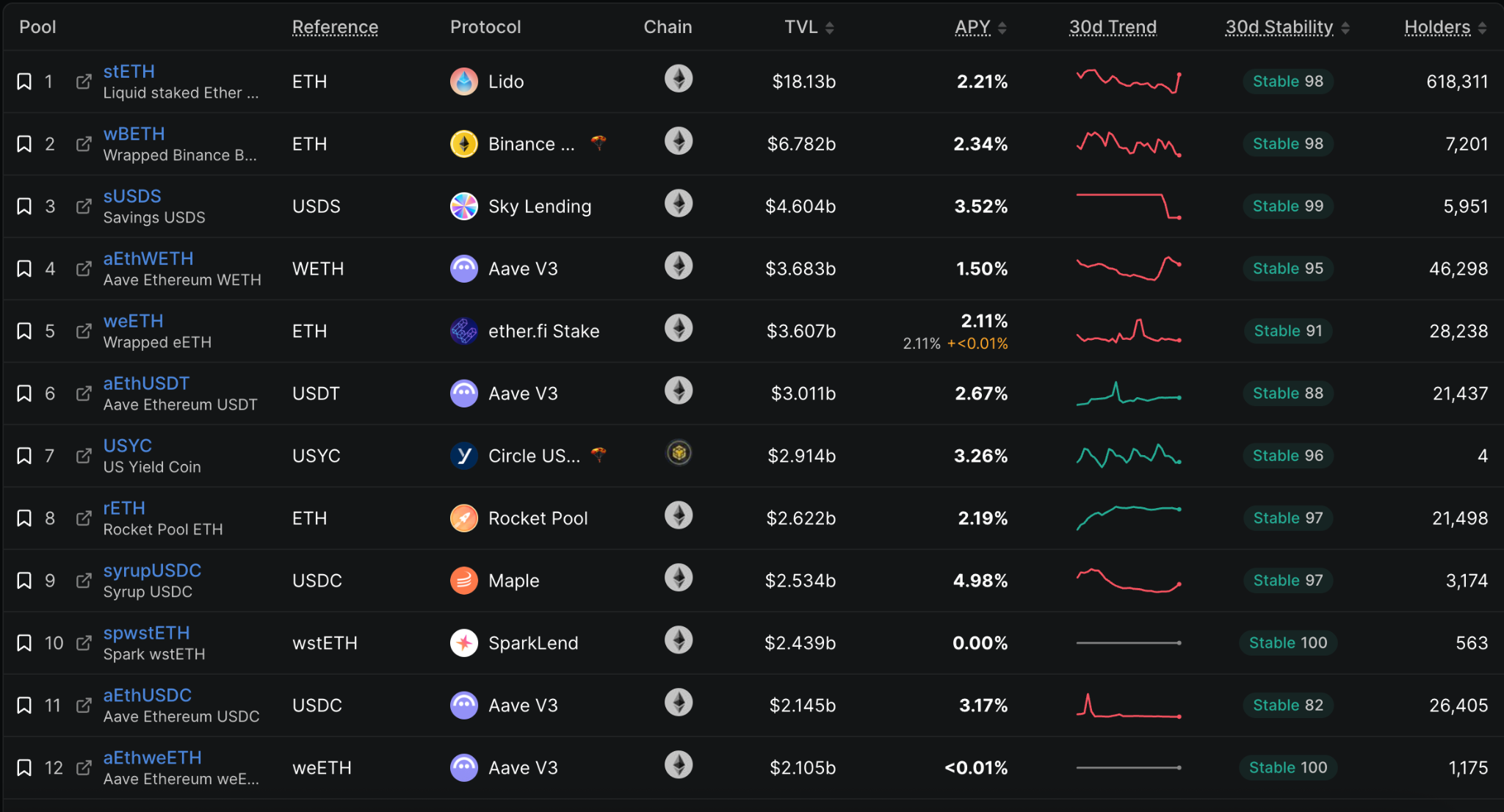
DefiLlama revenue aggregator.
Participation usually takes a few steps: connecting a self-managed wallet, selecting a pool, and then approving the deposit.
The stablecoin pool is smoother in price than waiting for market fluctuations, but issuer risks, decoupling risks, potential smart contract vulnerabilities, and cross-chain bridge risks are still implicit under the APY.
Now let's talk about the key points. Two seemingly identical APY may come from completely different sources.
As a benchmark, DeFiLlama lists more than 280 stablecoin pools with a median yield of 3.32%.
An attractive 20% or 77% APY is usually funded in one of two ways. The first type is "token issuance", which means an agreement to forge your own new tokens and allocate them to you in addition to the basic income. The risk here is that this extra gain will eventually collapse to the true base interest rate.
The second type is transaction fees. The risk here is that half of the assets you put in the pool could be an asset that is continuing to fall, which could offset any gains you make from trading fees.
2. Lock in interest rates instead of praying that they remain unchanged
Some protocols attempt to convert variable benefits into fixed benefits that you can lock in advance. 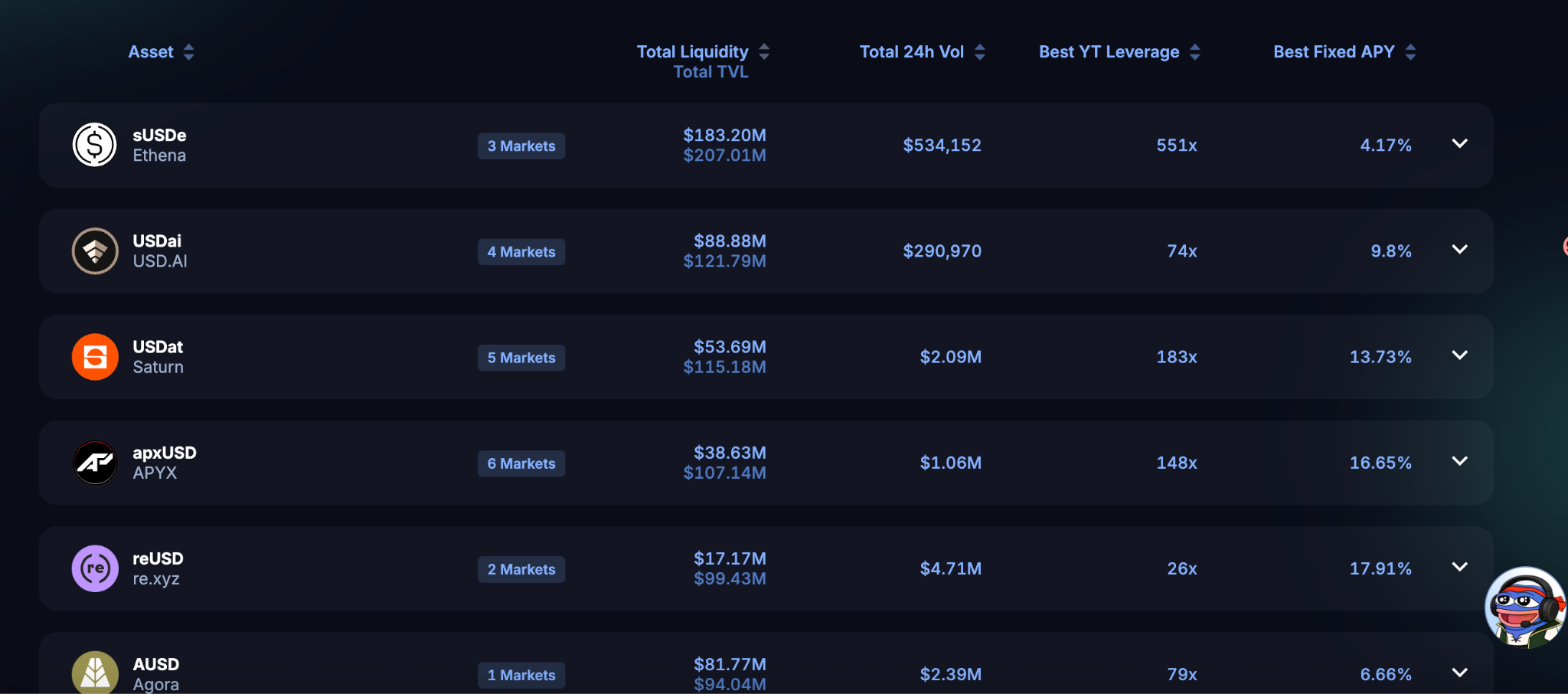
Take Pendle as an example, which splits an interest-bearing token into two parts. One part is the principal token, which is your deposit. The other part is the revenue token, which is its future revenue. 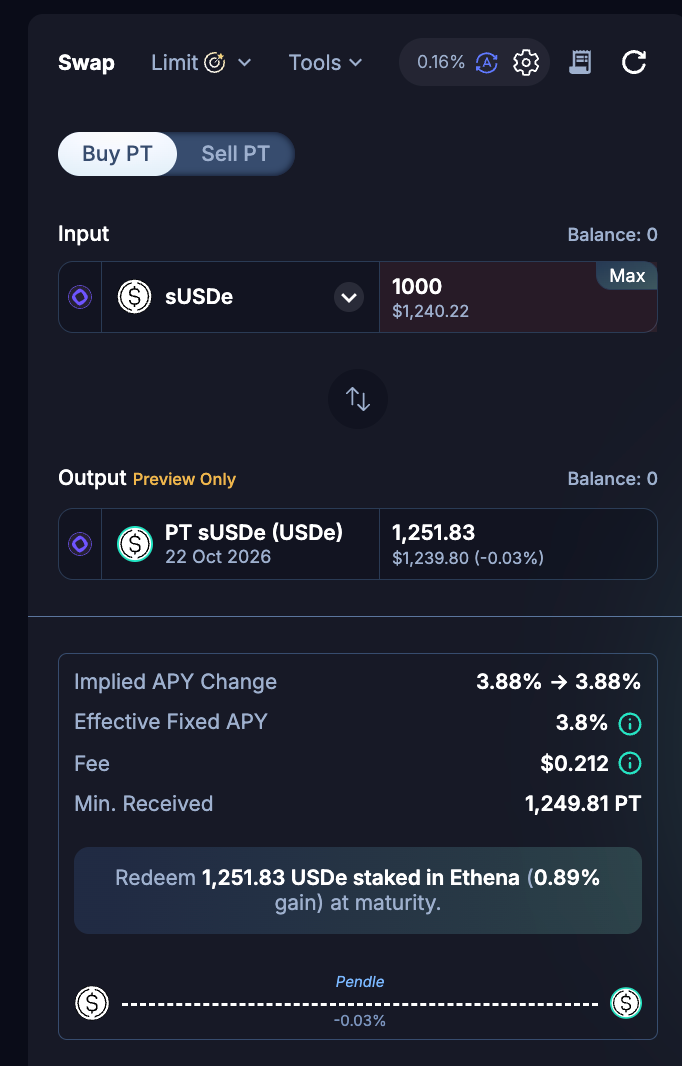
You only purchase the principal token at a discounted price, and then redeem it for the full amount at maturity. This intrinsic spread is your return and is fixed the day you buy.
The risks of this strategy lie in two aspects. First, when a fixed income is much higher than a similar pool, this may mean that the market is pricing a risk-such as lack of liquidity, unstable underlying agreements, expiration dates that no one wants to hold.
Second, the liquidity trap. Full redemption is guaranteed only at maturity, so to exit early, you must find a buyer to take over your principal tokens, and lack of liquidity may leave you stuck when you want to exit.
3. Liquidity pools
Providing liquidity is the most well-known strategy in liquidity mining, but it is also the most easily misunderstood strategy. Instead of lending out tokens, you deposit two tokens as a pair into a pool (e.g. equivalent Ethereum ETH and USDC) for traders to redeem. 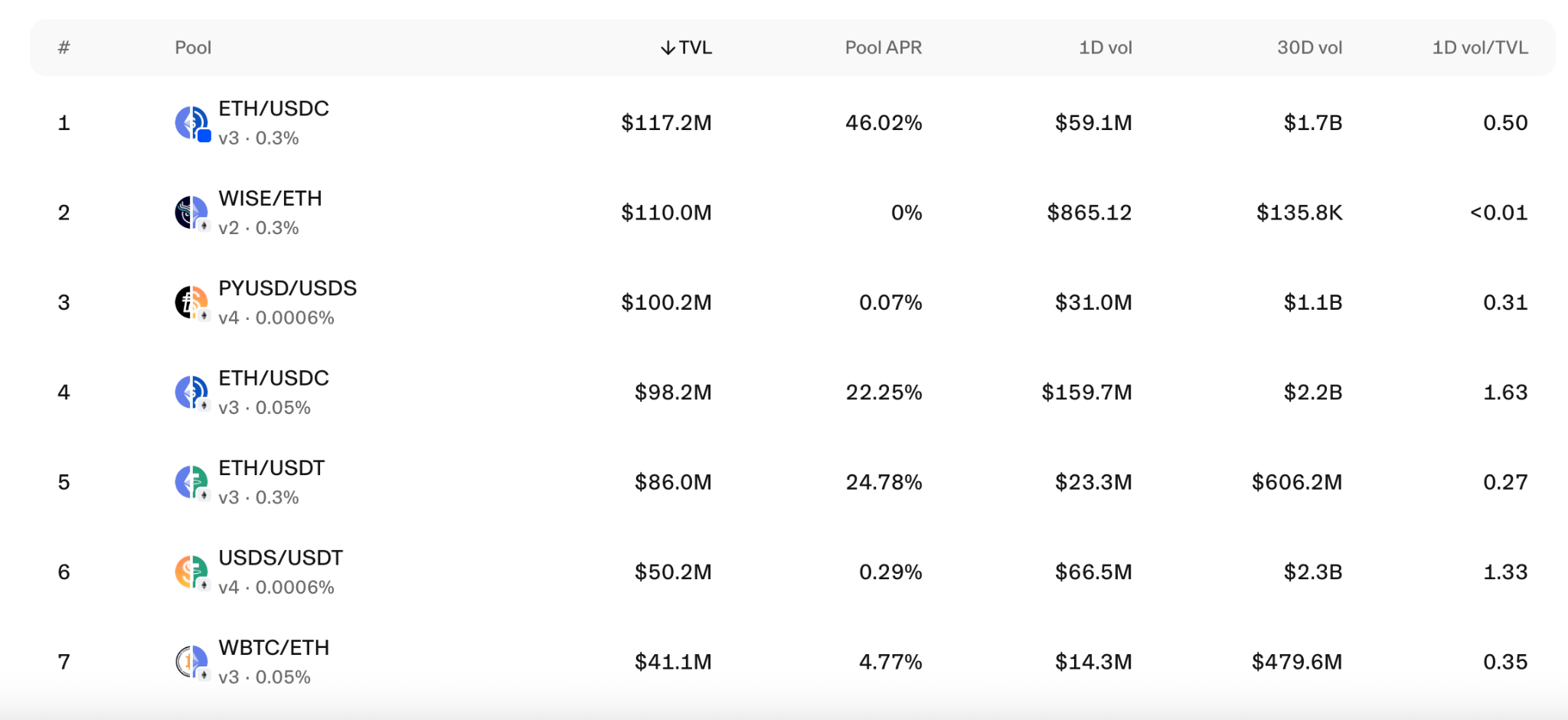
Liquidity pool on Uniswap.
The operation method is: Connect your wallet, select a pair of tokens, and deposit two assets. There is a small fee for each redemption, and you, as a liquidity provider (LP), get a piece of the action.
However, there is an inherent loss hidden behind this expense income that may even completely devour the benefits. Bancor and IntoTheBlock studied the pool in Uniswap v3 that holds nearly half of the liquidity in 2021. Fee income was $199 million, while impermanence losses were as high as $260 million. In the end, only about 48% of LP wallets were profitable.
How impermanent losses work is as follows: When the prices of the two tokens you deposit deviate, the pool will automatically sell the rising token and buy the falling token, resulting in you ultimately holding fewer assets than if you directly held the two tokens.
4. Re-pledge
Re-pledge is a variant of ordinary pledge. It puts the tokens you have pledged back into operation, using the same pledge to protect other networks. 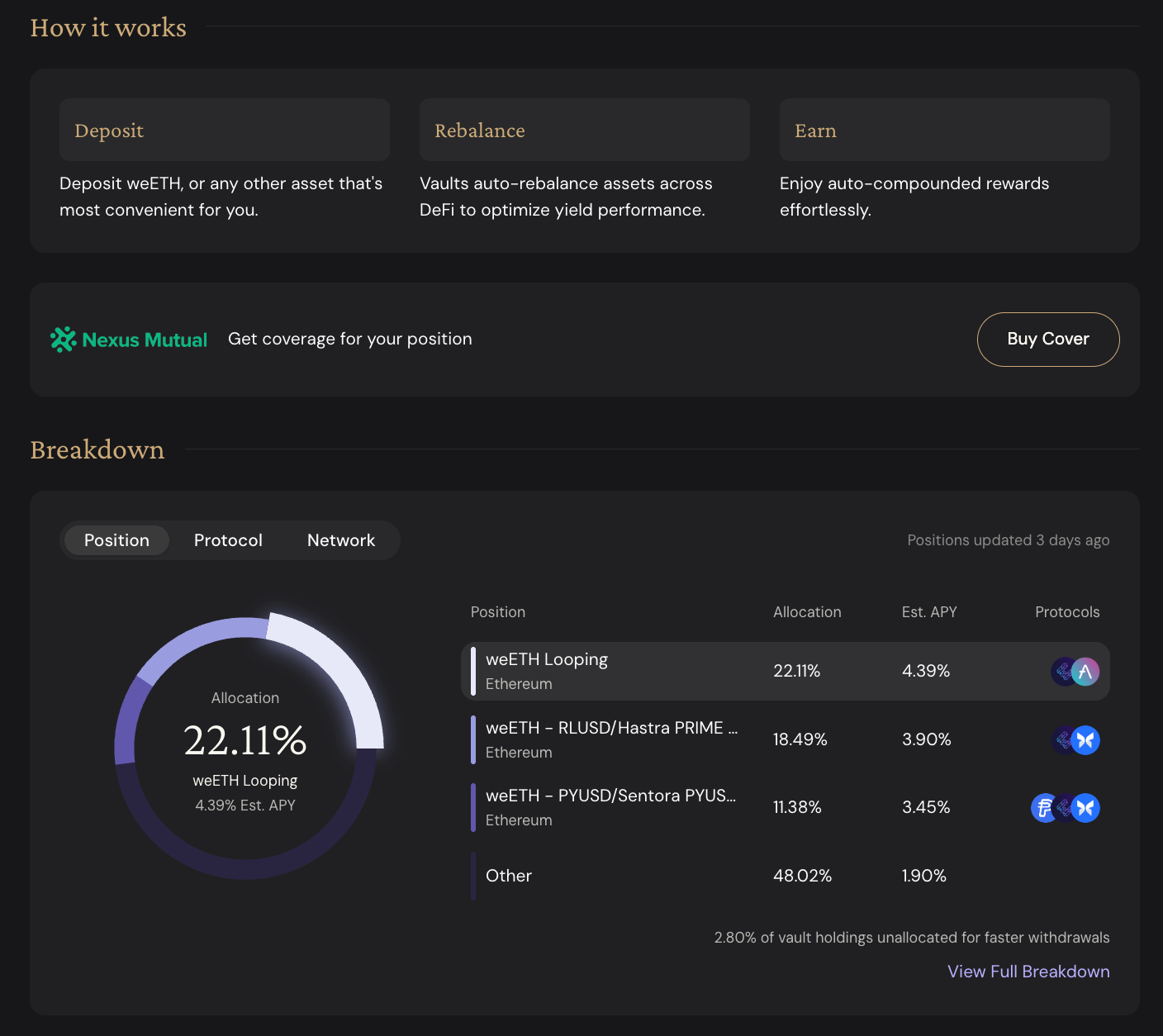
Source: Ether.fi
There are two factors you need to consider in this strategy.
First of all, the additional benefits are meager. The entire category has shrunk significantly from its peak in total locked value (TVL), with real pool yields like Renzo's ezETH still below 3% and no additional reward tokens are available as of this writing. 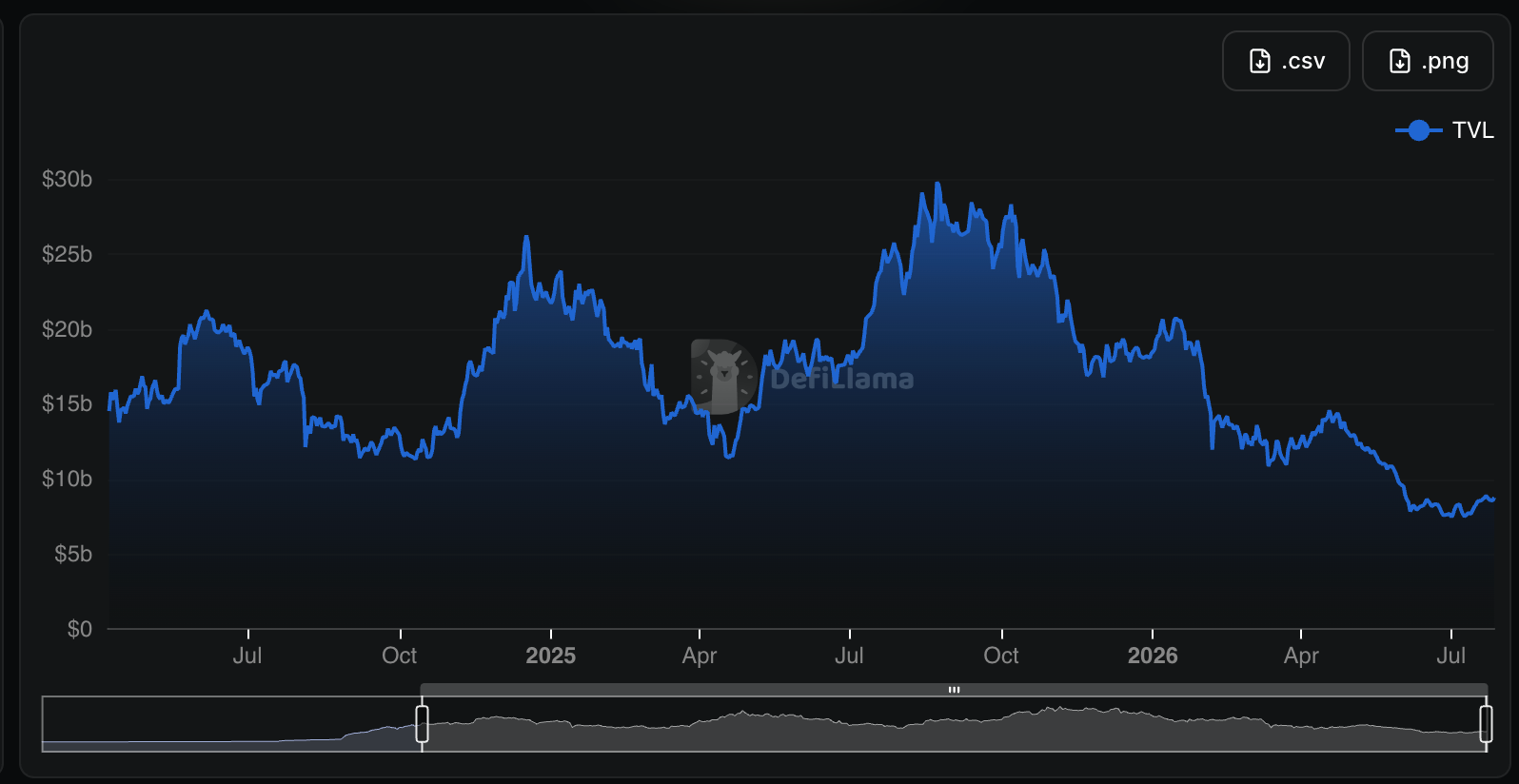
Re-pledge TVL.
Second, the pattern of risk has changed. For example, EigenLayer launched a forfeiture mechanism in April 2025-which means that if the network operator you support misbehaves, some of the tokens you pledge will be confiscated and destroyed.
5. Real revenue
Real revenue is a direct response to the aforementioned "token issuance" model. Agreements pay you out of fees charged by users, rather than by minting new tokens, just like a company paying dividends out of profits, rather than issuing new shares to pay dividends.
GMX is such an example. The decentralized trading platform charges a fee for each transaction, and in the past it allocated 27% directly to pledgers in the form of ETH and Avalanche's AVAX, but that allocation stopped in March 2026, when GMX suspended direct payments. The pledger's 27% share will still buy back GMX tokens using the actual fee charged, but the tokens are currently in its vault until the GMX price reaches $90.
The decentralized trading platform dYdX is still paying as planned. Each transaction fee and Gas fee on its chain is allocated to verifiers and their pledgers in the form of USDC.
Why do many investors prefer this model? An agreement that uses only its own token as a means of payment can easily fall into a "death spiral" when the price of the token falls-in which earnings and token value fall simultaneously. Agreements funded by fees reduce this spiral risk because payments come from user activity rather than newly minted tokens. However, if trading volume declines or governance changes the way fees are allocated, earnings may still fall.
6. Delta Neutral
This is the closest yield strategy in this article to "basically ignoring price ups and downs". "Delta" is the abbreviation for a trader's price exposure, and "delta-neutral" means that positions are constructed so that these exposures cancel each other out and return them to roughly zero.
Ethena's sUSDe is such an example, which as of late July 2026 paid out approximately 4% of its proceeds through basis transactions.
In this strategy, you simultaneously hold assets (go long) and short the same amount of assets, hedging each other. Use perpetual contracts for short positions. Since long and short positions are of the same size, any price fluctuations will be offset between the two.
What some people can easily confuse is that these two positions are not meant to make money. Their role is to absorb price shocks from any direction. So, where does the profit come from?
The first is the funding rate, which is a cyclical fee paid by one party to the other by a crowded long contract. When more traders are bullish rather than bearish, the short party (you) will charge this fee.
The second is the collateral itself: the ETH portion of the pledge will continue to receive its pledge rewards.
Add the two together and you get your payoff.
It should be noted that neutrality in direction does not mean no risk. Funding rate payments can shrink or even turn negative, which usually occurs when markets fall and everyone is pouring into short positions at the same time. Your short positions also exist on an exchange, so you need to trust the exchange to remain solvent while it holds your funds.
Before using any of the above options, check three things: what is paying out the income, what may cause loss of principal, and how easy it is for you to exit. If you can't answer these three questions in easy-to-understand language, please carefully consider whether the advertised APY are really worth it.
























