
 Exchange Ranking
 Top Exchanges
 24h Volume Ranking
 Popularity Ranking
 Exchange BTC Balance
 Proof of Reserves
 Decentralized Exchanges
 Funding Rate
 Funding Heatmap
 Liquidation Data
 Max Pain
 Long/Short Ratio
 Whale L/S Ratio
 Binance/Okex/Huobi L/S
 Bitfinex Margin L/S
 ETF Tracker
 Solana ETF
 XRP ETF
 Hong Kong ETF
 Bitcoin Treasuries
 Crypto Reversal
 Ethereum Reserves
 HyperLiquid Wallet Analysis
 Hyperliquid Whale Watch
 Large Transactions
 On-chain Movement
 Bitcoin ROI
 Stablecoin Market Cap
 Options Analysis
 News
News Articles
 Economic Calendar
 Features
 Wallet
 Contract Calculator


 Security
 Collections
 Watchlist
 Following
 DOGE
DOGE  LTC
LTC DOGE has become the focus of a new technology debate today.
The core of the controversy lies in the dependence of the world's largest memin on Litecoin. Some developers argue that the encryption project must have full control of its own infrastructure, while others (more pragmatic) warn that this synergy ensures an unparalleled level of security.
Summary
On July 18, 2026, developer Paul Vidal rekindled discussions about Dogecoin relying on Litecoin for security. Crypto developer Chromatic X corrected that Dogecoin relies on all Srypt cryptocurrencies that use merged mining, not just Litecoin. Co-founder Billy Marcus reminds that Dogecoin is still the most profitable Srypt cryptocurrency from mining. The Dogecoin Foundation pointed out that there is a reverse dependence.
Crypto developers reignite the debate 12 years ago
On July 18, 2026, Paul Vidal, developer of the Dogcoin Foundation, raised questions on the X platform, which triggered a technical controversy: Does Dogcoin really need to rely on Litecoin for security, or will it one day achieve autonomy?
Paul Vidal believes that Dogecoin encourages mergers and mining with other networks, but does not mine independently. He concluded that the security of the cryptographic network was still tied to another blockchain, Litecoin (LTC). Litecoin, created by Charlie Lee in 2011, has exactly the same PoW algorithm as Dogcoin.
Crypto analysts agree that this issue is by no means insignificant. It touches the core of the robustness of PoW-based cryptographic blockchains: the higher the computing power, the more difficult and costly it will be to launch a 51% attack.
Crypto developer Chromatic X quickly proposed a correction to Vidal's observations.
In a post posted on the X platform on July 19, he strongly advocated that Dogecoin does not particularly rely on Litecoin, but relies on all first-level (L1) cryptocurrencies that use the Srypt algorithm and implement merged mining. This distinction changes the nature of risk. In other words, dogcoin is not subject to a single project, but is a beneficiary of a shared crypto mining ecosystem.
Chromatic X further points out that dogcoin should be able to achieve self-security from a purely philosophical standpoint, not out of technical necessity. Explanation: Autonomous mining in the strict sense is more like an ideological principle than a security requirement, because current systems already effectively perform this function.
Combined mining of dogcoin and litecoin is not new
Combined mining allows crypto miners to simultaneously verify blocks on multiple different blockchains without increasing computing power or hardware expenditure. But only if they share the same proof-of-work algorithm.
Technically, it is based on a protocol called Assisted Proof of Work (AuxPoW). Here's how it works: The blocks dug up on Litecoin contain an encryption certificate that can be verified by the Dogcoin network. Therefore, there is no need for Litecoin to conduct any "social" verification. The dogcoin node only verifies whether the proof of workload conforms to its own rules. (Your first cryptocurrency started with KuCoin-this link uses the alliance program)
In addition to dogcoin and litecoin, other cryptocurrency projects that use the Srypt algorithm also use the same mechanism. It is worth noting that Namecoin is one of them.
The combined mining between Dogcoin and Litecoin was activated in August 2014 after Charlie Lee proposed the proposal in the spring of the same year. Prior to this, the computing power of Dogecoin was too low to continue to withstand 51% attacks. The situation immediately changed after the adoption of AuxPoW: According to a case study released by Binance Research, the computing power of Dogcoin is said to have soared by about 1500% in a month. Twelve years later, this interdependence remains structural. Market estimates show that more than 70% of Dogcoin's hash power now comes from combined mining with Litecoin.
What does the computing power data of Dogcoin and Litecoin reveal in 2026?
Computing power represents the total computing power dedicated to cryptographic mining. The data released in June 2026 can specifically measure the balance of power between Dogecoin and Litecoin.
During this period, the computing power of Dogecoin ranged from approximately 2.7 to 3.4 petahashes per second (PH/s), which previously peaked at 8.72 PH/s in February 2026 and then stabilized. At the same time, the computing power of Litecoin in early June 2026 is close to 2.7 PH/s.
This just means that the two encrypted networks are operating at comparable sizes. In other words, their joint security is based on a widely shared miner base, rather than dogcoin simply being subject to Litecoin. This proximity is due in part to the deployment of new application-specific integrated circuits (ASICs) that are compatible with Srypt. These chips are more powerful than previous generations and are enough to enhance mining activities on both crypto blockchains at the same time.
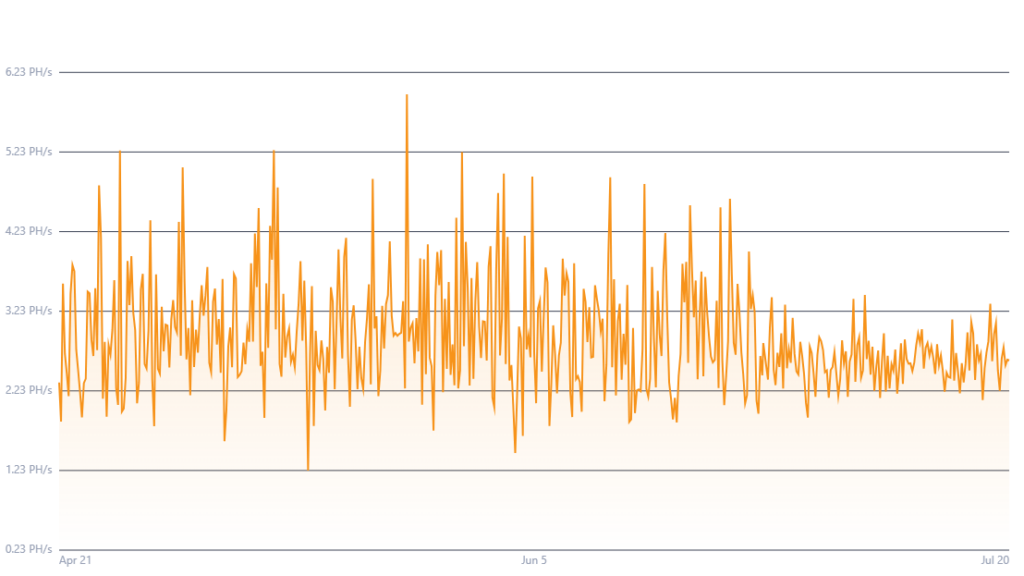
Chart: Dogecoin's computing power trend in three months (Source: CoinWarz)
The co-founder of Dogecoin also expressed his views
Billy Marcus, alias "Shibetoshi Nakamoto", also joined the discussion. According to him, dogcoin is still the most profitable Srypt cryptocurrency for mining. This view shifts the focus of the debate: it's not so much that Dogecoin relies on Litecoin, but rather the opposite. He believes that many Srypt miners are attracted to Litecoin precisely because it allows them to earn DOGE at no additional cost.
This observation was echoed by Timothy Stebin, director of the Dogecoin Foundation. According to him, most of the Srypt assets generated through combined mining actually rely on Dogecoin's currency issuance to maintain economic viability. So abandoning merger mining would not only weaken Dogecoin, but also the Srypt miner ecosystem that has been built around this interdependence since 2014.
This view questions the idea that one blockchain overrides another. In fact, this is not a one-way dependence, but an economic balance: each cryptographic network brings value to the other-Litecoin provides hash power, Dogcoin provides attractive mining benefits.
What will happen if Dogecoin withdraws from merged encryption mining?
Crypto analysts envision three possible scenarios.
Scenario 1: AuxPoW is disabled for dog coins. Srypt miners continue to mine litecoin, but lose their DOGE rewards. Srypt's computing power declines. Dogecoin must attract specialized miners, which will cost millions of dollars for infrastructure and electricity. Probability: Nearly zero because no major developer supports the idea.
Scenario 2: Mixed transition. The "Sakura" project mentioned by the Dogcoin Foundation is exploring a hybrid PoW/PoS model. However, developers have repeatedly stressed that this is not to abolish mining, but to add a pledge incentive mechanism at the second level. Proof of work will remain the basic safety mechanism. Probability: Possible, but long-term solution.
Scenario 3: Merge mining continues. Srypt's computing power grows. Dogecoin remains the most profitable Srypt cryptocurrency. This is the most likely scenario, supported by the economic and technical arguments of current crypto developers.
In any case, the debate surrounding merger mining does not question the current security of Dogecoin. Instead, it reveals two visions for its future: either retaining a proven model or pursuing complete independence.
























