
 Exchange Ranking
 Top Exchanges
 24h Volume Ranking
 Popularity Ranking
 Exchange BTC Balance
 Proof of Reserves
 Decentralized Exchanges
 Funding Rate
 Funding Heatmap
 Liquidation Data
 Max Pain
 Long/Short Ratio
 Whale L/S Ratio
 Binance/Okex/Huobi L/S
 Bitfinex Margin L/S
 ETF Tracker
 Solana ETF
 XRP ETF
 Hong Kong ETF
 Bitcoin Treasuries
 Crypto Reversal
 Ethereum Reserves
 HyperLiquid Wallet Analysis
 Hyperliquid Whale Watch
 Large Transactions
 On-chain Movement
 Bitcoin ROI
 Stablecoin Market Cap
 Options Analysis
 News
News Articles
 Economic Calendar
 Features
 Wallet
 Contract Calculator


 Security
 Collections
 Watchlist
 Following
Hackers hacked into Robinhood CEO Vlad Tenev's X account and released false meincoin promotion information
Hackers hacked into Robinhood CEO Vlad Tenev's X account and used the account to publish unauthorized meincoin promotion information. Robinhood confirmed the breach on July 23, 2026, saying that the fraud mentioned Robinhood Chain and contained a token contract address. The company quickly took action to delete the relevant post and regained control of the account through coordination with Platform X.
This post quickly attracted the attention of a large number of traders and promoted the rapid trading of the token on Robinhood Chain. Blockchain records show that during the short window during which official confirmation news spread, the memin experienced violent price fluctuations and a significant increase in transaction volume. Once Robinhood publicly clarified the situation, the token's momentum shifted as the market responded to the verification information.
Robinhood CEO Vlad Tenev's X account was compromised and used to promote a fake memin. Unauthorized posts were deleted following company intervention. On-chain data reflects a surge in instant transactions followed by a correction in prices. Robinhood Chain's active trading environment amplifies its early visibility. The company stated that it is not associated with any such tokens.
Event history
Unauthorized actors hacked into Vlad Tenev's personal X account and posted false content claiming that a type of memin was linked to Robinhood and its blockchain network. The message contains a promotional description and a specific contract address named $VLAD or Vladhood token.
Robinhood's communications team publicly disclosed the breach and confirmed that it was working with Platform X to ensure account security. The misleading post was quickly deleted. Robinhood emphasized that the company had never issued any official tokens and that the promotion was completely fraudulent.
Fake token activity and on-chain analysis
For tokens with contract address 0x92D176ccBeEffeCd8089e841D09ea17b6C22D969, its blockchain data shows that trading activity is highly concentrated shortly after the hacking post is posted. Internet indicators show that the market value of the token peaked at $10.7 million, but fell sharply after the hacking incident was publicly confirmed.
The token recorded more than US$22 million in transaction volume in the first few hours, with approximately 85,000 conversions occurring in the main liquidity pool. Amid rapid price fluctuations, multiple wallets operating in coordination are estimated to have achieved profits of approximately $1.2 million to $1.3 million.
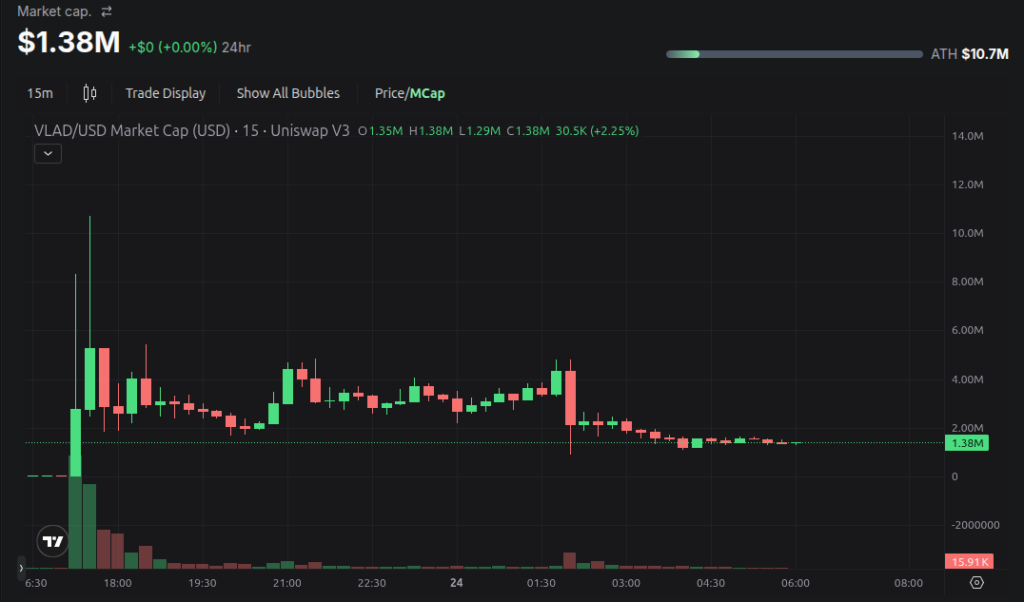
Trading records reflect high buying and selling volumes, with many participants trading during the initial window. During periods of volatility, the number of holders and the liquidity pool adjust quickly. These fluctuations reflect on-chain reactions triggered by typical high-profile social events, rather than continued fundamentals driven, with activity fading after official denials. This pattern is similar to the sharp pull-up and crash that occurred in the recent Roaring Kitty X account breach that affected Solana-based memocoins.
Robinhood Chain Background
Robinhood Chain provides a highly liquid trading platform, with significant DEX trading volume and stablecoin supply supporting rapid token issuance and speculative activity. According to DeFiLlama data, as of the time of the incident on July 24, 2026, the total locked position (TVL) of the chain exceeded US$300 million, the market value of the stablecoin was approximately US$461 million, and the daily DEX transaction volume often exceeded US$600 million. These conditions allow a currency that sounds like a brand token to quickly attract attention by sensing its association with Robinhood.
The chain's existing infrastructure and user base create an environment where a single high-profile mention of even unverified projects can generate immediate financial flows along the chain. Similar social engineering techniques have been used in SpaceX and Starlink account breaches involving Scatman tokens.
Why this incident deserves attention
Executive social media accounts have become a common target for attackers who try to use brand trust to gain quick financial gain. In this incident, the intrusion circumvented a technical protocol vulnerability and directly implemented social engineering against a widely watched platform.
Events like this demonstrate how error messages can affect decentralized transactions in minutes. They reinforce the need for market participants to cross-check announcements against major official channels, especially in the fast-changing mein space. This trend was equally evident in the breach of Airbnb CEO Brian Chesky's X account involving the promotion of fake cryptocurrencies.
The Robinhood CEO account breach illustrates the speed at which social media intertwine with on-chain markets and can drive real economic activity. Even a brief exposure on a high-profile account was enough to mobilize traders on Robinhood Chain before correcting the spread of information. As cryptocurrency platforms and Social networks continue to overlap, rapid detection and transparent communication remain key tools for maintaining market integrity.
























