
 Exchange Ranking
 Top Exchanges
 24h Volume Ranking
 Popularity Ranking
 Exchange BTC Balance
 Proof of Reserves
 Decentralized Exchanges
 Funding Rate
 Funding Heatmap
 Liquidation Data
 Max Pain
 Long/Short Ratio
 Whale L/S Ratio
 Binance/Okex/Huobi L/S
 Bitfinex Margin L/S
 ETF Tracker
 Solana ETF
 XRP ETF
 Hong Kong ETF
 Bitcoin Treasuries
 Crypto Reversal
 Ethereum Reserves
 HyperLiquid Wallet Analysis
 Hyperliquid Whale Watch
 Large Transactions
 On-chain Movement
 Bitcoin ROI
 Stablecoin Market Cap
 Options Analysis
 News
News Articles
 Economic Calendar
 Features
 Wallet
 Contract Calculator


 Security
 Collections
 Watchlist
 Following
 BTC
BTC  DOGE
DOGE Bitcoin's slow climb back to the six-digit mark will affect almost every corner of the cryptocurrency market, and Dogecoin, like other major cryptocurrencies, is very close to this wave. DOGE has continued to fall for most of the past two years. If Bitcoin rebounds to $100,000, it will test whether Dogecoin has enough vitality to follow the rise. This article reviews the current situation of the two currencies, the conditions that a Bitcoin rebound really needs to meet, and the three different price outcomes that Dogecoin may face if a rebound occurs.
Dogecoin hit an all-time high of US$0.7376 in May 2021, and the coin has not approached this level since then. As retail enthusiasm waned and a long and severe decline ensued, DOGE has been trading in downward and range-limited channels for years.
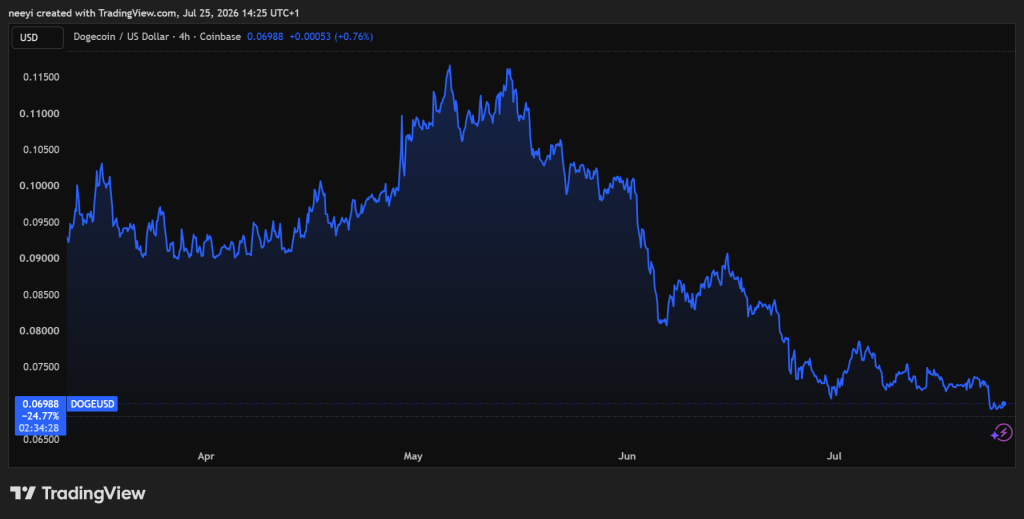 DOGE Price Chart/ TradingView
At the end of 2024, there was a brief recovery as broader cryptocurrency risk appetite rebounded. Dogecoin climbed to a two-year cycle high of approximately US$0.468 on December 8, 2024, and then fell back to close at approximately US$0.316 that year.
This momentum did not continue into the new year. In 2025, Dogecoin will fall into a continuous downward trend, forming lower highs and lower lows month after month. Even the launch of the U.S. spot dogcoin ETF in late November 2025 failed to change direction. Trading volume for these products was sluggish, with net inflows almost zero. By the last few hours of 2025, Dogecoin fell below US$0.12, retracing more than 70% from its high at the end of 2024.
The decline continues directly into 2026. By March, prices had dropped to around $0.09, and the decline never really found bottom support. As of July 2026, Dogecoin has stabilized in a weak range of US$0.068 to US$0.075, down about 90% from its 2021 high. Weak macro momentum and lack of direction in technical indicators have kept the currency trapped in this range for months.
Bitcoin turned into a correction this year after reaching a record high.
Bitcoin's path is different from Dogecoin, although the current destination is equally disturbing. After a long bear market and slow recovery in 2022, the launch of a spot Bitcoin ETF in early 2024 changed the market structure. Institutional adoption, the April 2024 halving event and friendlier regulatory sentiment in the United States have jointly pushed Bitcoin to exceed the $100,000 milestone by the end of 2024. At the close of the year, Bitcoin was close to $93,586.
The rally continues to climb in 2025. The United States established a strategic bitcoin reserve in March 2025, a move that became a major catalyst, pushing prices up steadily throughout the summer. Continued institutional ETF inflows sent Bitcoin to a record high of $126,198 in early October 2025.
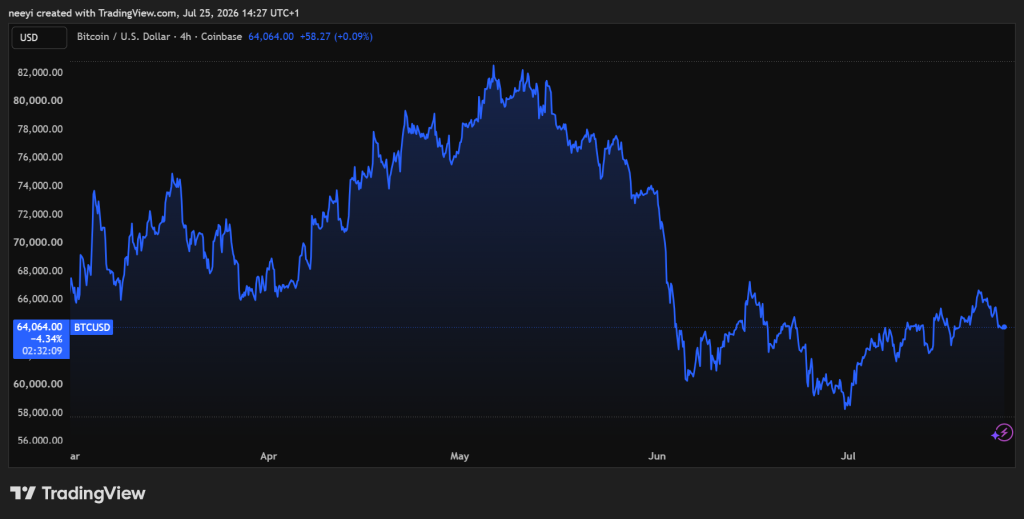 BTC Price Chart/ TradingView
This high point did not last long. On October 10, 2025, extensive international tariff announcements triggered a record $19 billion liquidation event, causing Bitcoin to fall sharply, closing at close to $87,700 that year. This year we face another kind of pressure. Retail venture capital shifted heavily from cryptocurrencies to artificial intelligence stocks, and trading volumes shrank as a result. Rising Treasury yields and tightening financial conditions resulted in net ETF outflows of more than $2.7 billion by mid-summer.
Bitcoin has fallen about 25% so far this year. The bottom of $58,000 was briefly tested in June and is now stable in the $64,000 to $65,000 range.
What conditions do Bitcoin really need to return to US$100,000 before the end of the year?
Getting Bitcoin from its current US$64,000 range back to the US$100,000 milestone by the end of 2026 requires a major shift in macroeconomic conditions and institutional behavior. Forecasting platforms like Polymarket currently believe that Bitcoin will reach six digits this year at only 17%.
Several conditions need to be met at the same time:
Aggressive interest rate cuts: The rise in U.S. Treasury yields has drawn institutional capital away from non-yielding assets. A clear shift to interest rates would reduce the cost of holding Bitcoin relative to bonds.
ETF outflow reversal: Spot Bitcoin ETFs need to turn away from the current trough of billions of dollars in outflow. A new wave of institutional inflows, such as 401k configurations, will need to absorb existing floating supplies in the market.
Funding flows out of artificial intelligence trading: Throughout 2026, retail and speculative capital poured into artificial intelligence stocks. A true fourth-quarter cryptocurrency rebound may require some funds to rotate back into digital assets.
Regulatory breakthrough: Passing stalled cryptocurrency-friendly bills such as the U.S. CLARITY Act would provide conservative corporate finance departments with the legal cover they have been waiting for to buy into the asset class.
Key support and resistance levels that Bitcoin needs to break through
Looking at the Bitcoin chart, you can see the current fairly clear boundaries, based on the latest technical analysis from Forbes Digital Assets and TradingView in July 2026.
Main resistance: US$70,000 to US$72,000-this year's main ceiling. Recovering this area would break the downward trend in 2026, and breaking through the area could open the door to $84,000.
Immediate resistance: US$67,000 to US$68,000-a short-term supply wall that limits the recent daily rally.
Pivot support: US$64,000-current local bottom. A daily close below this level will expose deeper weaknesses.
Macro support: US$60,000 to US$58,000-a firm psychological bottom. A major break here could fall towards $53,000.
The actual correlation between the price of dogcoin and the trend of Bitcoin
There is a strong positive price correlation between Bitcoin and Dogecoin, which is usually between 0.65 and 0.85 on a macro scale. The rolling five-year window shows a stable historical correlation of 0.67, a figure that suggests that dogcoin's price trend is fundamentally related to Bitcoin's broader market direction.
Bitcoin acts in part as a tide for the entire cryptocurrency market because it dominates overall liquidity and determines overall sentiment. Whether it is the peak or the bottom of the market, major turning points will seriously affect Dogecoin. When Bitcoin falls, Dogecoin almost always follows the same downward path.
Even if the two fluctuate in the same direction, the magnitudes are different. Dogcoin behaves as a high-beta version of Bitcoin. In a bull cycle, a 5% rise in Bitcoin could push Dogecoin up 20% or more, as retail speculation amplifies the volatility. Bear market cycles are the opposite, with Dogecoin often recording larger percentage losses than Bitcoin during this period.
This correlation is sometimes interrupted. Asset-specific events, such as high-profile social media endorsements, network upgrades, or technological forms (such as the Golden Cross in February 2026), may cause a brief independent rise in Dogecoin while Bitcoin remains flat.
If Bitcoin reaches US$100,000, the bullish, neutral and bearish scenarios for Dogecoin
These do not guarantee that Dogecoin is fully synchronized with Bitcoin, but historical correlations provide a reasonable framework for three different outcomes.
Bear scenario,$0.09 to $0.10: Bitcoin's return to $100,000 will not automatically bring speculative retail funds back to memecoin. If institutional buying drives most of Bitcoin's recovery and retail participation remains weak, Dogecoin may lag far behind Bitcoin's percentage increase. Under this path, Dogecoin may only climb to the US$0.09 to US$0.10 range, recovering moderately, but still well below its 2024 cycle high.
Neutral scenario, US$0.13 to US$0.15: A more balanced result is Dogecoin approaching its historical correlation of 0.67 tracking Bitcoin's gains and adding some beta as retail interest returns. This path could put Dogecoin between $0.13 and $0.15, about double the current range.
Bullish scenario, US$0.25 to US$0.30: A real return to retail speculation, coupled with Bitcoin's return to US$100,000, may trigger the high beta effect that Dogecoin has shown in past bull cycles. If Dogecoin can capture a small part of the enthusiasm that pushed it to $0.468 in December 2024, the price may return to the $0.25 to $0.30 range.
Dogecoin has experienced cruel declines before, and its price has always been closely linked to Bitcoin's next trend. Whether Bitcoin can truly return to $100,000 this year is far from certain.
FAQs
Can DOGE reach $1? Theoretically possible, but the probability is extremely low. The historical high of dogcoin is US$0.74, which will be reached on May 8, 2021.
Which currency will reach 1 dollar in 2026? Dogecoin is widely regarded as a viable candidate for reaching $1, requires a market value of approximately $150 billion and is supported by X-Pay infrastructure integration and its vast community. For corporate and first-level practicality, Cardano and Wave Fields are high-profile alternatives that currently trade for less than $1.
























