Exchange Ranking
 Top Exchanges
 24h Volume Ranking
 Popularity Ranking
 Exchange BTC Balance
 Proof of Reserves
 Decentralized Exchanges
 Funding Rate
 Funding Heatmap
 Liquidation Data
 Max Pain
 Long/Short Ratio
 Whale L/S Ratio
 Binance/Okex/Huobi L/S
 Bitfinex Margin L/S
 ETF Tracker
 Solana ETF
 XRP ETF
 Hong Kong ETF
 Bitcoin Treasuries
 Crypto Reversal
 Ethereum Reserves
 HyperLiquid Wallet Analysis
 Hyperliquid Whale Watch
 Large Transactions
 On-chain Movement
 Bitcoin ROI
 Stablecoin Market Cap
 Options Analysis
 News
News Articles
 Economic Calendar
 Features
 Wallet
 Contract Calculator


 Security
 Collections
 Watchlist
 Following
AMD is a U.S. semiconductor company with businesses covering a wide range of technology areas from computer processors to artificial intelligence accelerators, from graphics cards to data center solutions. The company was founded in 1969 as Advanced Micro Devices and is now particularly known for its Ryzen, EPYC, Radeon and Instinct product lines. AMD shares are traded on Nasdaq under the symbol AMD. In recent years, artificial intelligence has played an important role in its growth strategy. AMD now competes not only on computer processors, but also through data centers, AI accelerators, network solutions, and the software infrastructure that supports these hardware. The new products launched in 2026 are also the core of this transformation.
What does AMD produce and what is it used for?
AMD's core business is developing high-performance processors and accelerators needed for computers and other electronic systems. The company also develops software that enables these hardware to be used in artificial intelligence and high-performance computing.
AMD's products can be reviewed in several main categories from daily use to data centers:
Ryzen processors: Processors for desktops and notebooks. The Ryzen AI series provides the ability to run artificial intelligence processing locally on a computer.
EPYC processors: Processors developed for servers and data centers for cloud services, enterprise applications, high-performance computing and AI infrastructure.
Radeon graphics cards: A family of GPUs used for gaming, content creation and graphics processing.
Instinct accelerator: Data center GPUs developed for training, reasoning, and high-performance computing of large artificial intelligence models.
Adaptive SoC and FPGA Solutions: Popular programmable, adaptive solutions in specific application areas such as automotive, industrial, communications and edge computing.
Pensando Network Solutions: For high-speed network connections and data traffic management required by data centers, especially AI systems.
ROCm: An open source software ecosystem that enables AMD GPUs to be used in artificial intelligence and high-performance computing scenarios.
In short, AMD products provide computing power at different levels, from computer computing processing to running artificial intelligence models in large data centers.
For example, in a notebook, the Ryzen processor runs applications, while the Radeon GPU handles graphics processing tasks. In the data center, EPYC CPUs perform general-purpose computing tasks, while Instinct GPUs accelerate artificial intelligence and high-performance computing workloads.
AMD's most well-known product lines
The easiest way to understand AMD's product portfolio is by looking at the company's major brands used in different areas.
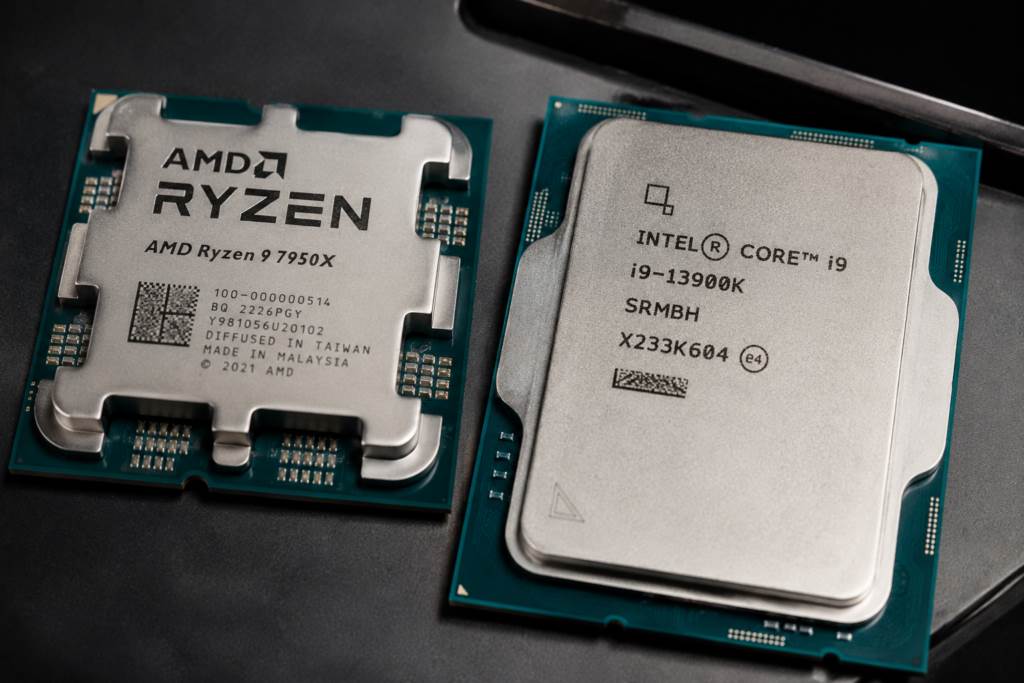
Ryzen stands out for its processors used in consumer and enterprise computers, while the Radeon brand stands for its graphics processors. In terms of data centers, EPYC server processors occupy an important position. Instinct covers accelerators developed for artificial intelligence and high-performance computing.
AMD's business does not stop there. The company also provides technology for automotive, industrial systems and other specific application areas through Versal, Kria and FPGA solutions. As a result, AMD's product structure covers multiple different categories such as processors, graphics solutions, data center products, artificial intelligence accelerators, adaptive systems, and software tools.
What has AMD done in the field of artificial intelligence?
The rapid development of artificial intelligence has also greatly expanded AMD's business model. The company now not only produces processors used to run AI models, but also builds an infrastructure that integrates CPUs, GPUs, network hardware and software.
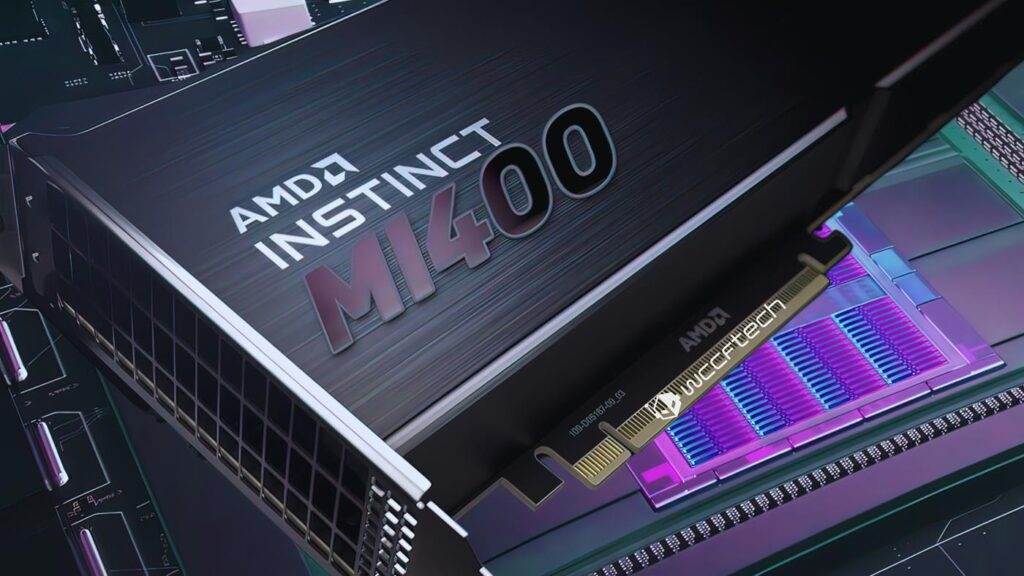
At the heart of this strategy is the AMD Instinct accelerator. In 2026, AMD launched the Instinct MI400 series. The family includes products such as the MI 455X for large-scale AI training and reasoning, and the MI 430X for high-performance computing and sovereign AI workloads.
In addition, AMD will launch a rack-level AI infrastructure called Helios in 2026. The system integrates Instinct GPUs, EPYC processors, Pensando network solutions and ROCm software into a unified AI infrastructure.
Therefore, it is not comprehensive to regard AMD's AI strategy as just a "production GPU." The company is targeting the broader computing infrastructure needed to run AI applications in the data center.
Why is ROCm important?
In the artificial intelligence race, software is as important as hardware. Powerful GPUs require appropriate software tools to be efficiently utilized by developers.
One of AMD's most important projects in this area is ROCm. ROCm, based on an open source software approach, helps developers apply AMD GPUs to AI and high-performance computing. In 2026, AMD also launched an AI developer experience platform called ROCm.ai.
This architecture is critical to AMD because its competition in the AI market depends not only on hardware performance, but also on the combination of hardware, software, and developer ecosystems.
In what areas is AMD technology used?
AMD's technology is not just for personal computers. The company's products serve different purposes in different industries.
Personal computers and notebooks: Ryzen processors and Ryzen AI products.
Games: Radeon graphics processor and high-performance Ryzen processor.
Data center: EPYC processor, Instinct accelerator and Pensando network solution.
Artificial Intelligence: Instinct GPU and ROCm software ecosystem.
Industrial and embedded systems: Solutions such as FPGA, adaptive SoC and Kria.
Edge Computing: A computing solution that processes data on the device side without sending it to a central data center.
In AMD's 2026 strategy, the proportion of data centers and AI has increased significantly. The company's second-quarter earnings report showed that its data center revenue more than doubled year-on-year.
When was AMD founded?
AMD was founded on May 1, 1969 by Jerry Sanders and seven technical experts. The company spent its first few years in the semiconductor market in Silicon Valley. Over time, AMD has focused on processor and graphics technology and now has a broader product line from computers to data centers to artificial intelligence systems.
AMD was launched in 1972. At the time of the initial public offering, 620,000 shares were sold at $15.50 per share. The company's shares are now traded on Nasdaq under the symbol AMD.
To understand AMD's architecture today, it is not enough to focus solely on its processors. Ryzen and EPYC processors, Radeon graphics cards, Instinct AI accelerators and data center solutions together make up the company's business in different markets. In recent years, artificial intelligence has also become one of AMD's most prominent areas.

What is AMD Stock (AMD)?
AMD stock refers to Advanced Micro Devices 'publicly traded shares on Nasdaq. Investors focus on AMD stocks through the code AMD.
AMD shares are a much-watched technology stock, especially for investors looking to venture into semiconductors, artificial intelligence, data centers and high-performance computing.
The company's development in the AI field has become an important factor affecting its stock. However, when evaluating AMD's valuation, we cannot just look at AI expectations, but also need to comprehensively consider factors such as the company's revenue, profitability, data center growth, product investment, and competition status.
AMD's Current Financial Overview
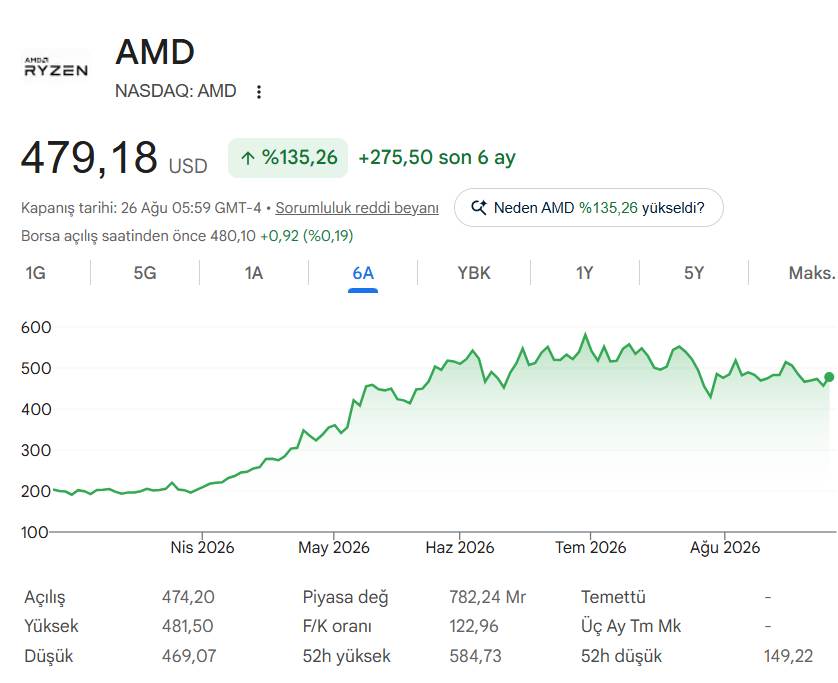
As of August 25, 2026, AMD's share price was approximately US$479.18. According to Yahoo Finance, as of August 24, the company's market value was approximately $745.62 billion, and its price-to-earnings ratio (F/K) for the past 12 months was 116.52.
AMD's latest financial results for the second quarter of 2026 show that the company achieved revenue of US$11.5 billion. Gross margin was 54%, operating income was $2 billion, net income was $2.3 billion, and diluted earnings per share based on GAAP was $1.38.
Among these results, the strong growth in the data center sector is particularly eye-catching. AMD management said growing demand for EPYC and the popularity of Instinct products will be critical to growth in the second half of the year.
Where can I buy AMD stock?
Investors in Turkey can purchase AMD shares through banks and brokers that provide access to the U.S. market.
After opening an investment account, you can access the Nasdaq stock by searching for the code AMD on the trading platform. Depending on the institution used, commissions, exchange costs, minimum transaction amounts and market access conditions may change.
Before trading overseas stocks, you should carefully understand the broker's Turkish Capital Market Council (SPK) regulations, charging standards, and trading conditions in the U.S. market.