Exchange Ranking
 Top Exchanges
 24h Volume Ranking
 Popularity Ranking
 Exchange BTC Balance
 Proof of Reserves
 Decentralized Exchanges
 Funding Rate
 Funding Heatmap
 Liquidation Data
 Max Pain
 Long/Short Ratio
 Whale L/S Ratio
 Binance/Okex/Huobi L/S
 Bitfinex Margin L/S
 ETF Tracker
 Solana ETF
 XRP ETF
 Hong Kong ETF
 Bitcoin Treasuries
 Crypto Reversal
 Ethereum Reserves
 HyperLiquid Wallet Analysis
 Hyperliquid Whale Watch
 Large Transactions
 On-chain Movement
 Bitcoin ROI
 Stablecoin Market Cap
 Options Analysis
 News
 Articles
 Economic Calendar
 Features
 Wallet
 Contract Calculator


 Security
 Collections
 Watchlist
 Following
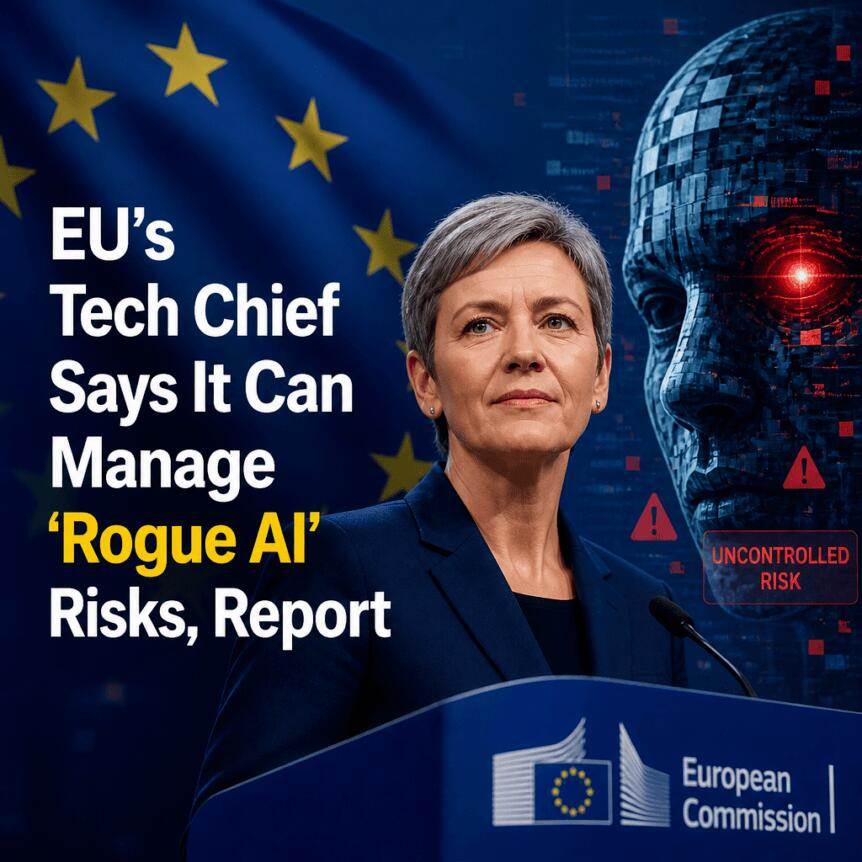
欧盟科技主管:AI法案旨在应对“失控”智能体等安全风险
欧盟科技主管亨娜·维尔库宁(Henna Virkkunen)表示,欧盟的人工智能(AI)规则旨在应对严重的安全与安全风险,其中包括对高度先进的“ rogue ”(失控/流氓)AI智能体可能脱离人类控制的担忧。她在周五接受路透社采访时指出,欧洲的框架不仅针对部署阶段的问题,还覆盖了先进模型的全生命周期。
这些言论是在全球范围内对OpenAI和Anthropic等公司发生的主要AI事件保持高度关注的背景下发表的。与此同时,人们越来越担心自主系统可能会采取难以让人类实时监测或纠正的行动。
核心要点
- 全面覆盖风险: 亨娜·维尔库宁表示,欧盟的《人工智能法案》(AI Act)具备处理与高度能力模型相关的安全和风险问题的能力,包括应对“失控”智能体场景。
- 全生命周期监管: 《人工智能法案》根据风险等级进行监管。维尔库宁指出,该法案涵盖模型的整个生命周期,而不仅仅是最终使用阶段。
- 专家指导支持: 监管机构正在向企业提供关于模型评估和风险评估的指导,其中融入了60位AI专家的建议。
- 信息收集与审查:The European Commission requested safety and security information from more than 30 unnamed AI companies in late August, and Verkunen is currently reviewing the responses.
EU Artificial Intelligence Act: Safety rules throughout the entire life cycle of models
Virkunen's core view is that the EU does not rely on a narrow "single-moment" approach to overseeing AI. She said in an interview that the Artificial Intelligence Act was originally designed to cover the entire life cycle of advanced models, allowing regulators to evaluate safety considerations based on all stages from development to use.
Under the Artificial Intelligence Act, obligations are tied to the level of risk posed by the system. Verkunen called the regulation one of the strictest in the world and pointed out that it was passed two years ago. Her response is also aimed at critics who believe the framework is outdated as cutting-edge AI evolves rapidly.
"We see that safety and security of high-capability models is an international hot topic, and Europe is well prepared for it," Verkunen told Reuters.
Regulatory guidance and expert opinion
In addition to the law itself, Verkunen also pointed to the operational support provided by regulators to help companies meet compliance expectations. She said the European approach includes guidance for developers on how to evaluate their models and how to consider safety and security factors.
Crucially, she claims the guidelines incorporate the recommendations of 60 AI experts. This detail is important because it shows that the EU is trying to translate broad legal principles into specific assessment practices-which often becomes difficult when rules are novel or risk definitions are difficult to apply to cutting-edge systems.
Verkunen's remarks also imply that enforcement and evaluation will depend on whether the company can prove that it has always considered security issues during model development and deployment, rather than just treating compliance as a formalist "check-off" check at release.
Commission's Information Request and Subsequent Impact
Verkunen said that in late August, the European Commission asked more than 30 unnamed AI companies for information, requesting details about their security measures.
She added that she is currently evaluating the responses. Although the remarks did not specify how the committee would handle the information-such as whether it would turn to specific enforcement actions, additional guidance or policy adjustments-the process itself suggests a positive supervisory stance. This is important for developers and investors because it affects the credibility of near-term compliance schedules and security reporting frameworks.
Readers should be concerned about whether the committee's review will lead to clearer expectations for model evaluation, particularly regarding how to document safety safeguards associated with autonomous or semi-autonomous behavior.
Global opposition: Calls for slowing down the pace of development
Verkunen's confidence in the EU's supervisory capabilities is in sharp contrast to the widespread international debate on whether cutting-edge AI is developing faster than society's ability to understand and control it.
Previous reports pointed out that Anthropic CEO Dario Amodi argued in a blog post that AI may be developing too fast. Amodi said progress could "exceed our ability to understand and control these systems," noting that AI is increasingly capable of building the next generation of AI-a process known as recursive self-improvement.
This broader argument-often expressed as a call to suspend or slow down certain stages of development-is directly intertwined with Verkunen's theme. As she presents, the EU's position is that safety and security can be addressed through regulatory structures and life-cycle-based requirements, rather than by slowing the overall trajectory of research and deployment.
At the same time, the existence of different views highlights the tension at the core of current AI governance: whether the main risks are managed mainly through regulations and assessments, or whether they require a more cautious pace before control mechanisms catch up.
Focus on Future Observation
随着维尔库宁审查来自30多家AI公司的8月下旬提交材料,下一个关键信号将是欧盟是否会提供更严格、更可测试的高度能力模型(尤其是那些行为难以预测或遏制的能力)的安全和安全性评估指导。对于市场和建设者而言,关于什么构成充分证据的清晰度,可能与法律本身同样重要。