Exchange Ranking
 Top Exchanges
 24h Volume Ranking
 Popularity Ranking
 Exchange BTC Balance
 Proof of Reserves
 Decentralized Exchanges
 Funding Rate
 Funding Heatmap
 Liquidation Data
 Max Pain
 Long/Short Ratio
 Whale L/S Ratio
 Binance/Okex/Huobi L/S
 Bitfinex Margin L/S
 ETF Tracker
 Solana ETF
 XRP ETF
 Hong Kong ETF
 Bitcoin Treasuries
 Crypto Reversal
 Ethereum Reserves
 HyperLiquid Wallet Analysis
 Hyperliquid Whale Watch
 Large Transactions
 On-chain Movement
 Bitcoin ROI
 Stablecoin Market Cap
 Options Analysis
 News
News Articles
 Economic Calendar
 Features
 Wallet
 Contract Calculator


 Security
 Collections
 Watchlist
 Following
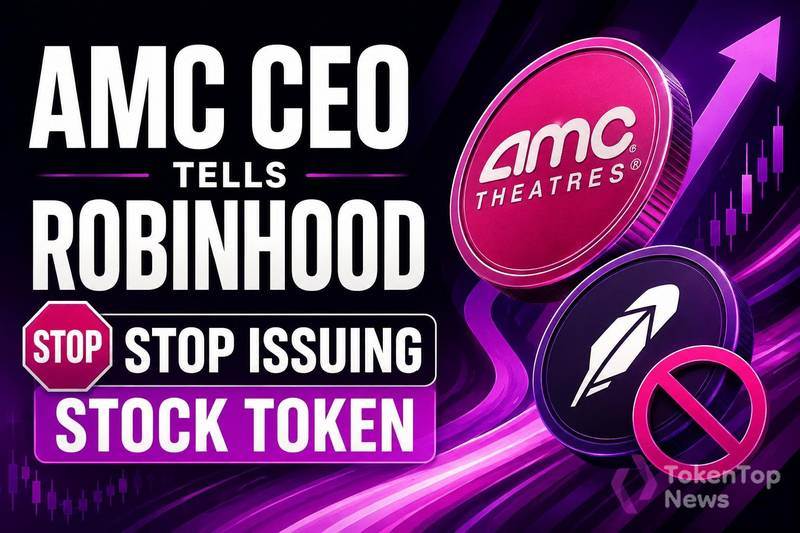
AMC CEO publicly calls on Robinhood to stop issuing stock tokens linked to AMC
AMC Entertainment CEO Adam Aron has publicly called on Robinhood to stop issuing stock tokens linked to AMC's share price, putting the movie theater company at the center of the storm over the fast-growing issue of "tokenized stocks." Aron raised his objection directly on Platform X (formerly Twitter), pitting a listed company against a broker that markets its shares based on a blockchain-based version.
Aron's reason for challenging Robinhood's stock token
The core of Aron's request lies in a token product issued by Robinhood that aims to track AMC's share price. The company said it did not authorize the product. He posted a post on his verified X account to make the controversy public rather than deal with it privately. Simply put, stock tokens are a blockchain-based tool designed to reflect the price of real stocks, allowing holders to gain price exposure without directly owning the underlying shares. Robinhood's own stock token documentation describes these products as derivative-like tokens offered to qualified users, rather than direct shares in the company.
The friction point is that this tokenized product uses the name of AMC and provides price exposure, but AMC itself is not a participant in the product, which is the core of Aron's public opposition.
What Robinhood's conflict with AMC means for tokenized stocks
Tokenized stocks are at the intersection of traditional stock markets and cryptocurrencies, thus attracting the attention of readers who focus on on-chain products and how regulators reshape access to new asset structures. Tokens that mirror well-known stock symbols are the kind of bridge-like product that attracts equity investors to the crypto track.
The controversy also highlights the ownership and credibility issues raised by these products: When contemporary currency quotes a company's stock without the company's participation, buyers must understand that they may hold synthetic exposure rather than true equity. This gap is particularly important for retail names like AMC, whose shareholder base overlaps with the audience currently being provided with familiar crypto packaging versions of stocks and is expanding retail access to crypto-related tools.
In addition to AMC, the case is a field test of how issuers respond to scenarios where brokers tokenize their equity without consent, a situation that may recur as more platforms attempt to tokenize stocks.
Future developments worth watching for AMC, Robinhood and regulators
The immediate question is whether Robinhood will respond to Aron's requests, adjust the product, or defend its structure. Given the CEO of AMC has a history of communicating directly with retail investors, any subsequent announcement could escalate or resolve the standoff.
Tokenized stock offerings often draw compliance concerns, and this public conflict could invite regulators to examine how such products are marketed and disclosed, and officials have already signaled in this area that they are preparing new crypto rules. Currently, the dispute remains a direct challenge between listed companies and brokers over who has the right to list stocks.