
 Exchange Ranking
 Top Exchanges
 24h Volume Ranking
 Popularity Ranking
 Exchange BTC Balance
 Proof of Reserves
 Decentralized Exchanges
 Funding Rate
 Funding Heatmap
 Liquidation Data
 Max Pain
 Long/Short Ratio
 Whale L/S Ratio
 Binance/Okex/Huobi L/S
 Bitfinex Margin L/S
 ETF Tracker
 Solana ETF
 XRP ETF
 Hong Kong ETF
 Bitcoin Treasuries
 Crypto Reversal
 Ethereum Reserves
 HyperLiquid Wallet Analysis
 Hyperliquid Whale Watch
 Large Transactions
 On-chain Movement
 Bitcoin ROI
 Stablecoin Market Cap
 Options Analysis
 News
News Articles
 Economic Calendar
 Features
 Wallet
 Contract Calculator


 Security
 Collections
 Watchlist
 Following
 BTC
BTC  ETH
ETH Trump supports transatlantic stablecoin agreement-why now?
The biggest cryptocurrency news in the past 24 hours has not been price movements, but political events. As the Senate accelerates its push for the CLARITY Act, President Trump has stepped up support for a new Anglo-American stablecoin framework despite growing opposition from banking groups over its stablecoin provisions.
The framework itself originated from a body called the Transatlantic Working Group on Future Markets. The working group was established in September 2025 and described stablecoins as "an important carrier of digital currency innovation." The two governments agreed that stablecoins, subject to appropriate supervision, can improve cross-border payments, financial market infrastructure and competition, while providing more consistent regulatory treatment for companies within the jurisdiction of both countries.
The technical standards set by both parties are a key part. Regulated stablecoins should be supported on a one-to-one basis by clearly defined, high-quality liquid reserve assets within the legal framework of their respective countries. It is crucial for those who hold these tokens: During bankruptcy or reorganization, stablecoin holders should have priority over reserve assets in accordance with law, over other creditors, but must comply with domestic bankruptcy laws.
Trump's motives are not obscure. He has repeatedly linked cryptocurrency legislation to the goal of making the United States the "cryptocurrency capital of the world" and has continued to push the Senate to pass the Clarity Act before it recess in August.
What is the Clarification Act-why is it deadlocked?
It's not surprising if you can't keep up with the bill-it's been stalled in Washington for more than a year. The Digital Asset Markets Clarity Act is a federal market structure bill that divides regulatory authority over digital assets to the U.S. Securities and Exchange Commission (SEC) and the Commodity Futures Trading Commission (CFTC), establishes intermediary rules, handles self-custody and Bank Secrecy Act (BSA) coverage, and adds anti-central bank digital currency (CBDC) provisions. The bill received bipartisan support and passed the House in July 2025.
Since then, the bill has stalled in the Senate over a top issue. The bill has stalled over a highly controversial provision on stablecoins and whether digital asset companies can provide revenue to customers.
Why is Bank of America strongly opposed to this?
This is where the conflict really escalates. Banks don't hate cryptocurrencies in the abstract-they're worried about their deposit base. Banking groups believe that multiple provisions are still too vague and could encourage consumers and businesses to move funds from traditional bank accounts into stablecoins. They warned that continued deposit outflows could put additional pressure on community and regional banks that rely heavily on customer deposits for lending, and called on lawmakers to tighten language before the bill moves forward.
The numbers behind this concern are staggering. Analysts at Standard Chartered Bank had previously estimated that if the yield clause was implemented, as much as US$1 trillion in deposits could flow from traditional banks to stablecoin products by 2028. This is all the reason why the American Bankers Association opposes the bill item by item.
Interestingly, even some people in the cryptocurrency industry do not fully support the current draft. Coinbase CEO Brian Armstrong withdrew his support for the Clarity Act shortly before the Senate Banking Committee review, saying the draft was "much worse than it is"-a reminder that "bad cryptocurrency laws" have both sides worried for very different reasons.
What is this related to Europe and MiCA?
For EU readers, a transatlantic perspective is crucial. Europe already has its own rulebook-MiCA (Crypto Asset Markets Regulation)-in effect and enforced, with full reserve and redemption requirements very similar to the agreement just reached in principle by the United States and the United Kingdom. The global direction of development has now clearly shifted to a one-to-one support, legally isolated stablecoins. If you are thinking about where to hold or trade these stablecoins, using an exchange regulated by MiCA-is the safest option given these increasingly stringent frameworks.
Bitcoin price analysis: cooling inflation meets political benefits
While the regulatory drama is unfolding, the market is also affected by macro data. Bitcoin prices rose to a three-week high above $65,000 after U.S. inflation data showed the consumer price index fell 0.4% in June, the largest monthly decline since April 2020, and the annual inflation rate slowed to 3.5%, lower than analysts 'expectations. Core inflation, which excludes food and energy, fell to 2.6%, from 2.9%.
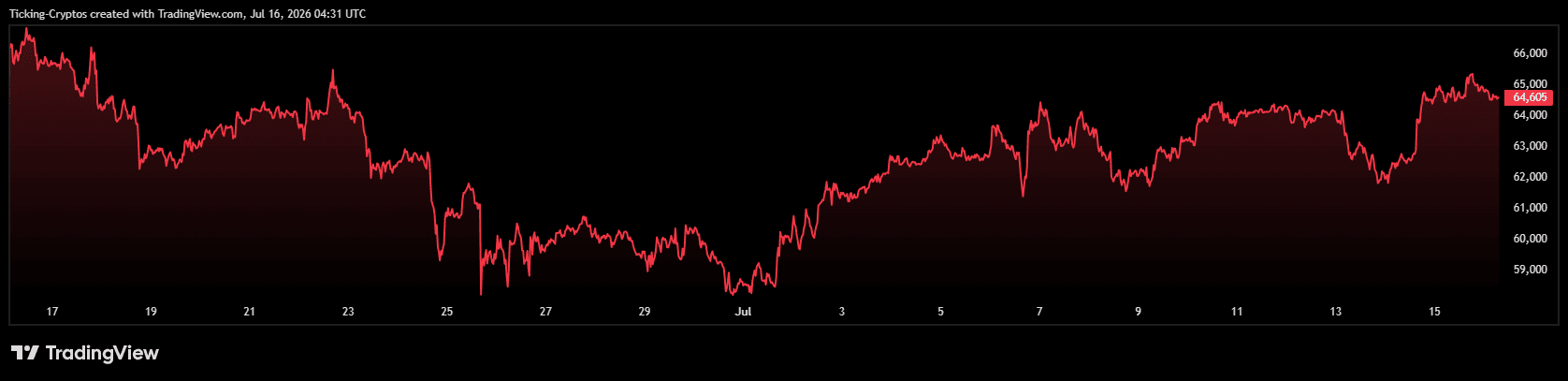
Bitcoin Price (USD)
This almost immediately changed interest rate hike expectations. After the data was released, the probability of the Federal Reserve raising interest rates this month dropped sharply from 43% to just 13%. However, not everyone believes this trend will continue. The decline in inflation was mainly due to the fall in oil prices during the June ceasefire between the United States and Iran-but as the fighting resumed, Brent crude oil prices have rebounded to around $80 a barrel, which may be reflected in July's CPI data. As of this writing, market momentum has weakened slightly. Bitcoin was still up about 3% in 24 hours, but fell about 0.5% since midnight, and Ethereum rose 4.7% in 24 hours before a similar correction followed. Prices to watch: Traders are closely watching the resistance level of $64,800, with some warning of the possibility of a lower high, while there is selling pressure at $65,000. If this price can be clearly exceeded, it is expected to open a channel to the June high of approximately $67.25 million. However, market sentiment remains fragile-the cryptocurrency fear and greed index rose to 25, but remains in the "extreme fear" range.
Events worthy of attention
Senate action on the Clarity Act-Trump hopes to pass the bill before the August recess; focus on a full vote and any last-minute compromise on the benefits terms.
U.S. producer price index (PPI) and personal consumption expenditure (PCE) data-Producer price data will be released soon, and PCE data will be released at the end of the month; both will affect the Fed's next judgment on inflation.
July Federal Open Market Committee (FOMC) meeting (July 28-29)-This is the interest rate decision that is really concerned about for all CPI data positioning.
Oil/Strait of Hormuz-Uncertainty that could reignite inflation and drag down risky assets.
























