
 Exchange Ranking
 Top Exchanges
 24h Volume Ranking
 Popularity Ranking
 Exchange BTC Balance
 Proof of Reserves
 Decentralized Exchanges
 Funding Rate
 Funding Heatmap
 Liquidation Data
 Max Pain
 Long/Short Ratio
 Whale L/S Ratio
 Binance/Okex/Huobi L/S
 Bitfinex Margin L/S
 ETF Tracker
 Solana ETF
 XRP ETF
 Hong Kong ETF
 Bitcoin Treasuries
 Crypto Reversal
 Ethereum Reserves
 HyperLiquid Wallet Analysis
 Hyperliquid Whale Watch
 Large Transactions
 On-chain Movement
 Bitcoin ROI
 Stablecoin Market Cap
 Options Analysis
 News
News Articles
 Economic Calendar
 Features
 Wallet
 Contract Calculator


 Security
 Collections
 Watchlist
 Following
 BTC
BTC  CARDS
CARDS On-chain collectibles
On-chain collectibles are NFTs that have physical support behind them. A professionally rated card is stored in a vault, with tokens representing ownership, and in most cases, destroying the tokens will send the card to your doorstep. It responds to the "right-click save" query that has plagued the NFT for years. In July 2026, the transaction volume of this market was US$290.3 million.
A brief history of on-chain collectibles
The field of on-chain collectibles has currently experienced three waves, and each wave was born to solve the credibility problem. Pure digital NFT proved the feasibility of the technology, subsequent authorized collectibles proved market demand, and physically supported tokens provided a bottom line of value for the entire field.
2020-2021: NBA Top Shot and PFP craze. Value is purely driven by narrative.
2021: Courtyard was established to put rated physical cards into storage and publish them in NFT format on Polygon.
August 29, 2025: Collector Crypt launched the CARDS token based on the twist mechanism, which later became a landmark feature in the field.
February 16, 2026: Logan Paul's PSA10-rated Pikachu Illustrator Card was sold at Goldin for US$16.5 million (including buyer commissions), compared with approximately US$5.3 million when he purchased it.
March 2, 2026: MemeStrategy (HKEx: 2440) launched Trading Card Fund I through its licensed platform EVIDENT, which is only open to professional investors.
April 25, 2026: Phygitals launches on Fanatics Collect, displaying tokenized cards to buyers who have never touched a wallet.
July 13, 2026: Jupiter partnered with Collector Crypt to launch a beta version of Gacha, with a transaction volume of US$3.29 million in 22 hours.
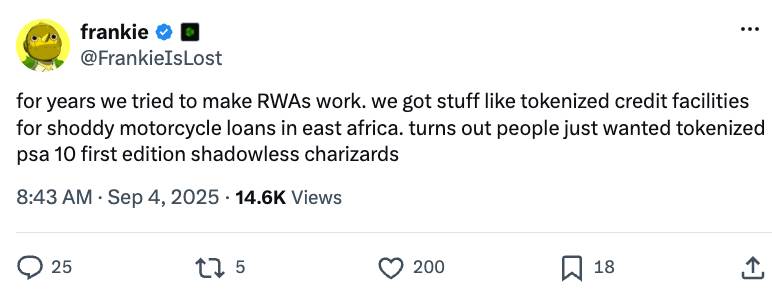 Paradigm general partner Frankie foresaw this in September 2025, before the field entered the mainstream. The real-world asset (RWA) community has been chasing tokenized credit and treasury bonds for years, but paper Pokémon cards have been the first to achieve breakthroughs.
Why are they becoming more and more popular?
To understand its growing popularity, you must first look at the rate of return, because that is the key. According to a Pokémon Card Index (quoted by CCN through Yahoo Finance in August), the asset class is up about 28% year-to-date, while the S & P 500 is up about 13%, and Bitcoin (BTC) is down 29%. Looking at a longer time span, Card Ladder data cited by Fortune shows that the increase over the past 20 years is close to 3261%, with an annualized rate of return of about 19%.
Nostalgia is the entrance that attracts users to enter. The generation that promoted the popularization of cryptocurrency was the same group of people who cracked the treasure Kemeng card bags when they were children. The 30th anniversary edition doesn't go on sale until September 16, so it can be seen as a boost rather than a cause of a market that peaked three months ago.
The real breakthrough lies in distribution channels, and it is institutional rather than viral. Phygitus cards are available on Fanatics Collect, and ordinary collectors can purchase them directly in US dollars with a credit card without creating a wallet. Jupiter integrates its brand into the category through Jupiter Gacha. Courtyard has completed a $30 million Series A round led by Forerunner Ventures, which includes NEA, Y Combinator, Burst Capital, Prelude Ventures and ParaFi.
In addition, asset stratification is also a major trend. Now, the same asset can be sold to buyers with different risk appetites in a variety of ways: whale bags priced at $2500, low-priced packages for retail users, professional investor funds holding only PSA10-rated gray felt hat pikachuca, and card mortgages made through Jupiter Offerbook.
Five years ago, a rated fire-breathing dragon card was just a product. Today, it has developed into an entire product line.
Noteworthy sales and tokenization products
The transaction of Pikachu Illustrator cards is the ceiling of the physical market: one card, one buyer,$16.5 million.
The ceiling of the chain market is completely different. Collector Crypt launched the $2500 Pokémon card bag on June 10. According to Blockworks Research, the bag generated $82.9 million in sales in three weeks, accounting for approximately 40% of the platform's June transaction volume. Tens of thousands of buyers for one product.
MemeStrategy's funds are another unique product: a listed company packages a card variant in a licensed product. The fund completed oversubscribed capital raising in May and has not released any performance data since then.
Which platforms are leading
The valuation of the physical transaction card market is generally between US$10 billion and US$15 billion. For rating cards alone, TCGCharts is valued at nearly US$10.8 billion. Due to different definitions, it is difficult to accurately measure the current market size. 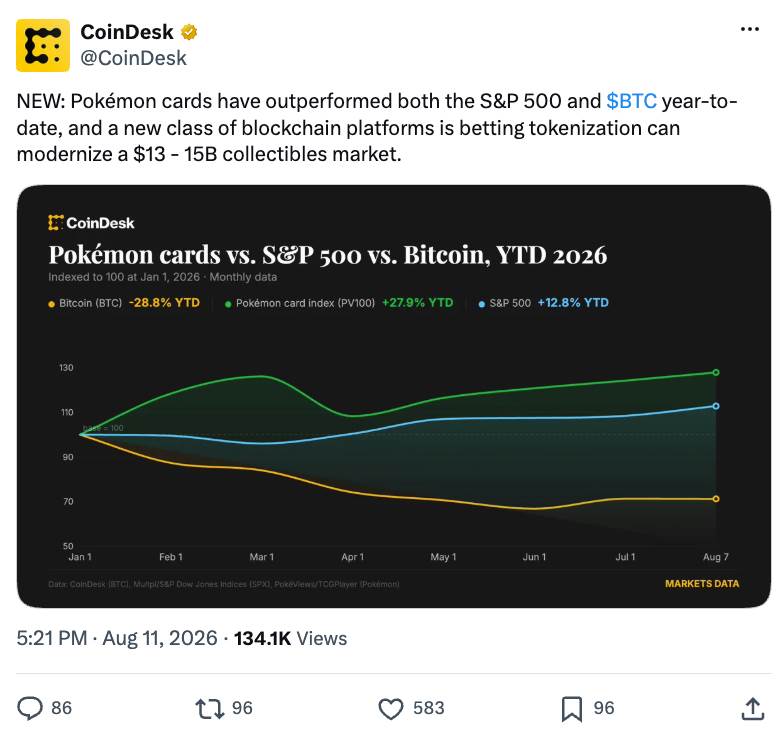 The random card package mechanism that these platforms rely on set a record spending of $354.8 million in June, before cooling to $290.3 million in July, but it was still the second-highest month in history. The real story lies in trends: The field generated only $11.7 million in January 2025.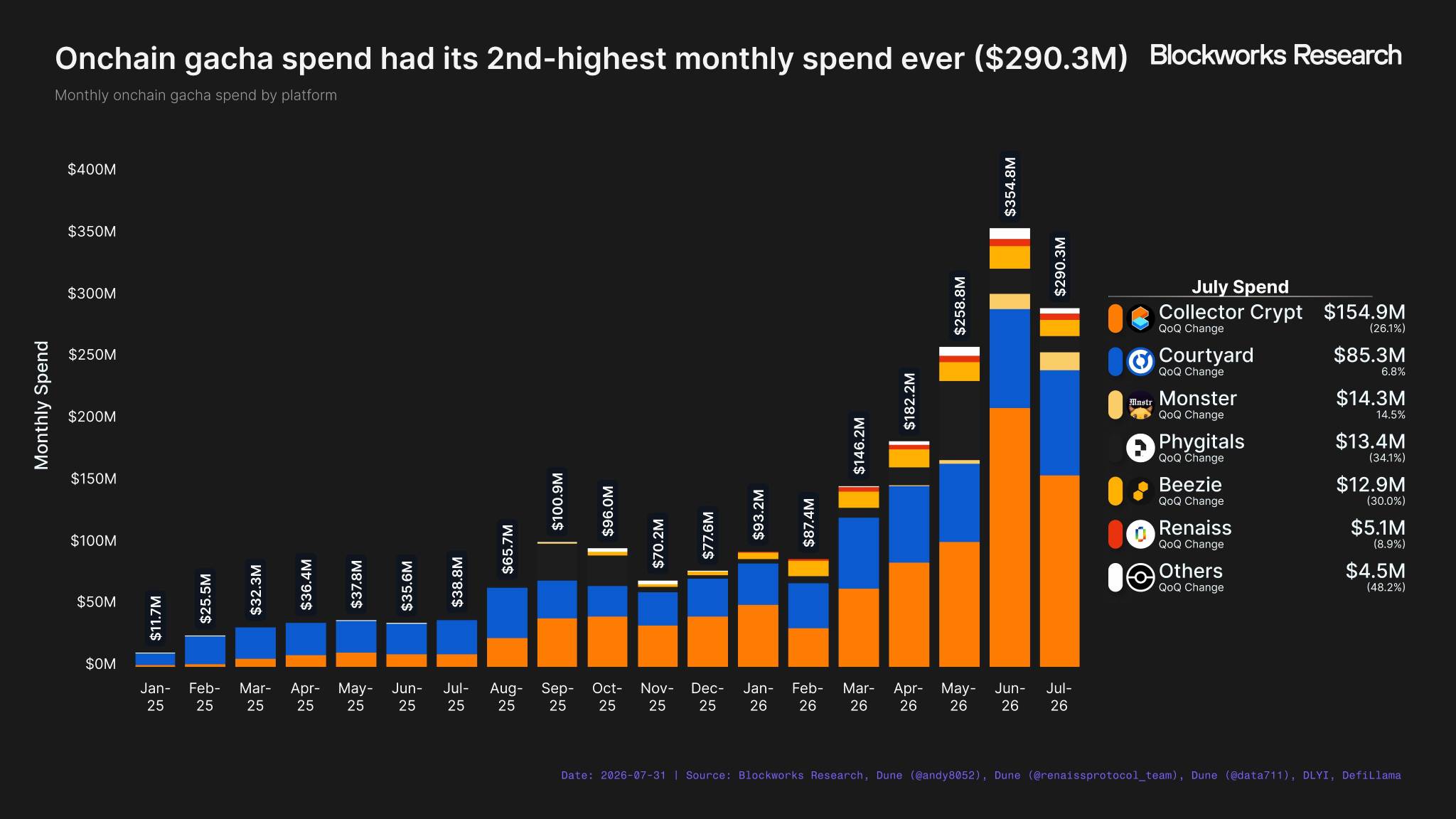
The following is a brief introduction of the six major players: 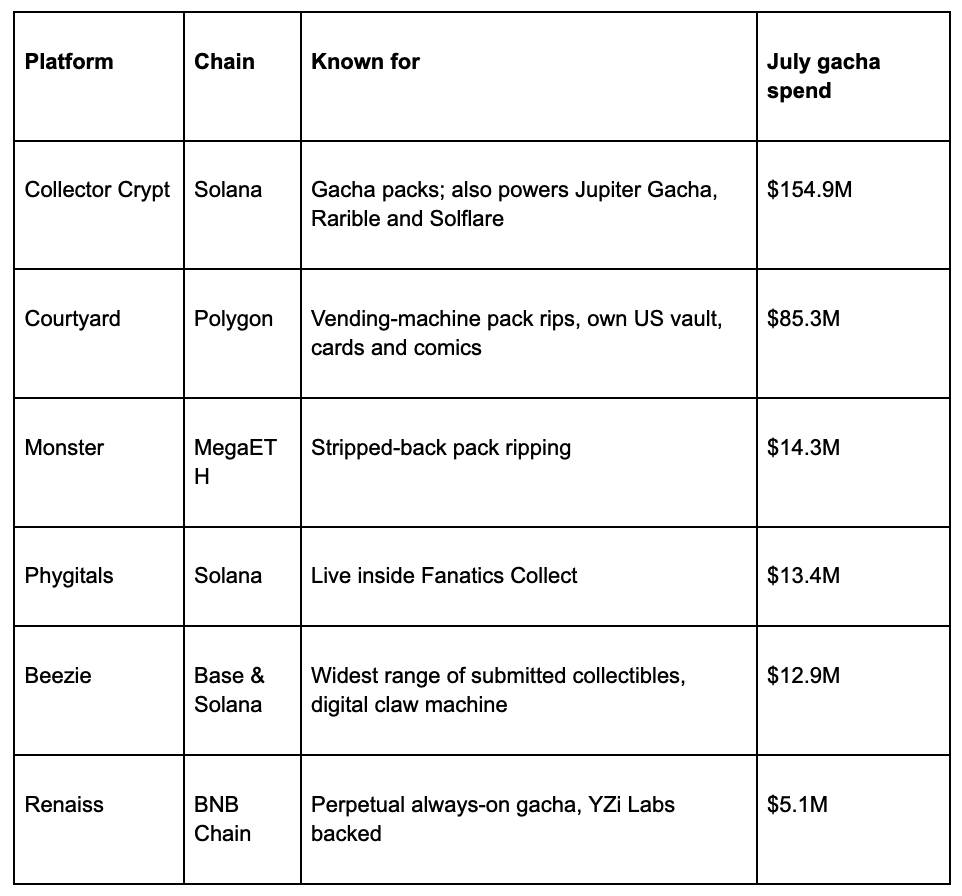
How many of these are real collections?
Almost all of this transaction volume comes from opening and instant repurchase, rather than transactions between collectors. According to Four Pillars, as of that time, the real secondary activity on eBay and peer-to-peer channels was less than US$5 million, while the amount of twisted egg transactions reached US$635 million. Beezie's own data also clearly shows that as of May, there were 540,000 "claw machine" grabs, while instant repurchase exchanges were 530,000.
Collector Crypt's position is that the purse itself is a product, and whale driven revenue is normal for gamified consumer applications. At least when it comes to redemptions, the data refute what critics are saying. After the company showed revised figures (4660 items with an insured value of $2.41 million were withdrawn from 587 wallets in one month), Four Pillars later withdrew its previously low redemption statistics.
How to try to participate
The least volatile way is to buy a specific card. Connect to Solana or Polygon Wallet and buy a named and rated card on the platform market. This is the closest thing to traditional collecting.
As an advanced step, you can draw a pack of cards. These are usually fixed-priced, random content, and many platforms offer instant repurchase features to recover cards you don't want at announced discounts. Of course, the repurchase price is lower than the market price, and the difference is how the platform makes money.
You can also tokenize your own card. Submit the rating card to Collector Crypt, Phygitals, or Beezie for warehousing and casting. The rating agencies and categories accepted vary, please confirm in advance.
If you prefer to speculate on the trading platform itself rather than on the cards, you can make a card mortgage through Jupiter Offerbook, and Collector Crypt (CARDS) tokens allow you to gain platform exposure without holding inventory. 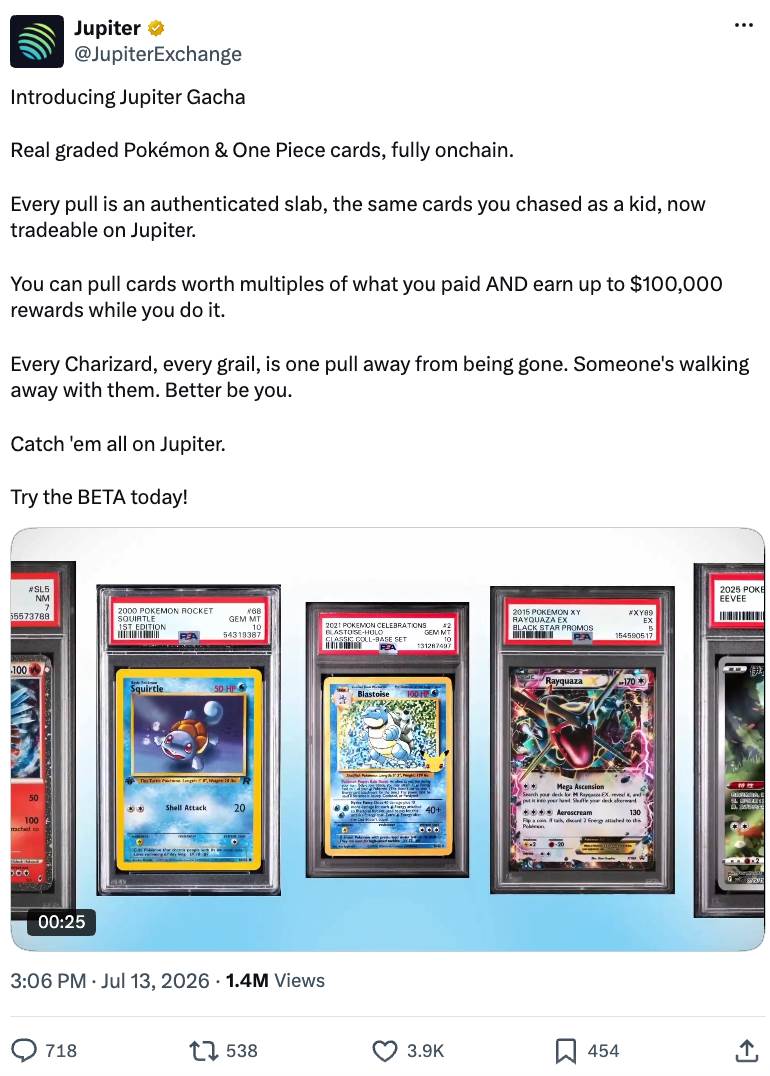 Developers can skip all aspects and directly embed the card package mechanism, just as Jupiter did.
Adam Hollander, chief marketing officer of OpenSea, believes that the collectibles category on the chain will bring NFT back into the mainstream view.
























