Exchange Ranking
 Top Exchanges
 24h Volume Ranking
 Popularity Ranking
 Exchange BTC Balance
 Proof of Reserves
 Decentralized Exchanges
 Funding Rate
 Funding Heatmap
 Liquidation Data
 Max Pain
 Long/Short Ratio
 Whale L/S Ratio
 Binance/Okex/Huobi L/S
 Bitfinex Margin L/S
 ETF Tracker
 Solana ETF
 XRP ETF
 Hong Kong ETF
 Bitcoin Treasuries
 Crypto Reversal
 Ethereum Reserves
 HyperLiquid Wallet Analysis
 Hyperliquid Whale Watch
 Large Transactions
 On-chain Movement
 Bitcoin ROI
 Stablecoin Market Cap
 Options Analysis
 News
News Articles
 Economic Calendar
 Features
 Wallet
 Contract Calculator


 Security
 Collections
 Watchlist
 Following
 BTC
BTC  ETH
ETH The disappearance of Bitcoin's "huge wealth": Warning behind the recovery of cryptocurrencies
A case involving the alleged disappearance of Bitcoin's "huge wealth" has become a thought-provoking case. It reveals that asset recovery efforts in cryptocurrencies are often more than just a technical challenge, but more likely a crisis caused by scams, misunderstandings and a lack of clear understanding of what is stored in wallets.
In 2021, Chris Brooks, founder and CEO of cryptocurrency asset recovery company Crypto Asset Recovery, received help from a client codenamed "Rusty." Rusty and two other men claimed they won about 5000 bitcoins (worth about $53 million at the time) in a lawsuit and said they could withdraw up to $300,000 a week. Brooks and his son went to help crack the wallet, only to find that the clues provided pointed in a completely different direction.
Core Points
- The nature of cryptocurrency "recovery": usually refers to rebuilding access information (mnemonics, passwords, or missing words) rather than recovering funds from the blockchain.
- Misunderstandings between mnemons and passwords: Even if you have the correct mnemons, if you forget the password, users may still think that funds have been lost; and the wrong password sometimes does not trigger an error prompt.
- Irreversible loss: If mnemonics are completely destroyed and generated completely randomly, there is no actual recovery path-there is a hard limit to self-hosting.
- Service provider risk: Recovery companies may also become targets of scammers, and selecting a service provider is itself a security decision.
- Red flags: Unsourced promises, requirements for upfront fees, and urging quick action through unsecured channels are all major red alerts.
When "millions of cryptocurrencies" are not the truth
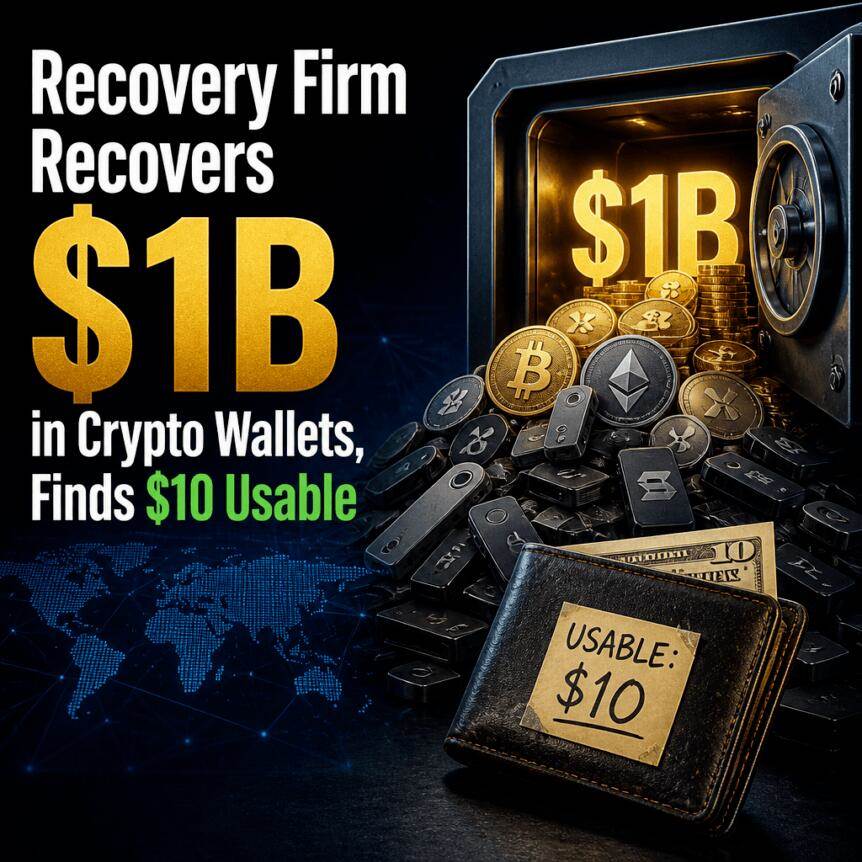
Brooks recalled that Rusty initially showed an address he claimed contained approximately $53 million in Bitcoin. During the first call, Brooks noticed an anomaly: Rusty also showed another balance, purportedly about $1 billion in Ethereum (ETH).
Then, Rusty drove the Brooks and his son to an office in an office building on Commerce Street and handed them several notebooks containing dozens of recovery mnemonics. They tried to open their wallets all day, but ultimately only found about $10 in Bitcoin. It has never been clarified what the notebooks represent and whether they match the claimed balance. Brooks was also not reimbursed for travel expenses. In hindsight, he suspected that Rusty might have been misled by a scammer and mistakenly believed that he held a huge amount of crypto assets that did not exist.
Brooks sees this incident as a lesson early in his business: Sometimes cryptocurrency is lost, sometimes the wallet or password is lost, but sometimes the money is not there in the first place.
What a wallet recovery expert actually does
For companies focused on recovery services,"lost cryptocurrency" can mean several very different scenarios. According to Bruno Krauss, co-founder and chief technology officer of restoration company ReWallet, experts are typically not "undo" transactions on the chain, but aim to regain information needed to access existing wallets-information that may be incomplete, forgotten, or corrupted.
In many cases, missing access material can be reconstructed. Krause explained that Bitcoin's BIP39 standard uses a vocabulary of 2048 words. Therefore, if someone remembers most mnemonic words, recovery may involve systematically testing the remaining unknown words. The fewer missing elements, the smaller the search space.
Password recovery follows a similar logic, including reconstructing possible characters when the user recalls the pattern or background when the password was created. Klaus also describes a behavioral approach: understanding how people tend to choose secrets. In one example, a customer believed that her password used the name of her child. Eventually, she realized that the password was actually related to a phone number connected to a local delivery service-something she remembered when she thought about when the package would arrive at the store.
Password: silent hidden funds
Even if the user has the correct mnemonic, forgetting the password can make funds inaccessible. Tom Bennet, a Bitcoin educator who studies wallet security, points out that passwords add a layer of information to mnemonic words: Enter the wrong password and you may enter another valid wallet rather than receive an explicit error prompt.
"The wrong password will not throw an error; it will execute successfully and show a zero balance." This means that users may reasonably conclude that their Bitcoin has disappeared, and that the fundamental problem is simply entering the wrong password. Bennett also argued that passwords do not provide the same built-in protection mechanisms as mnemonic words-there is no fixed list of words and no equivalent checksum. If the password is random enough and completely forgotten, recovery is almost impossible.
There are also practical nuances in hardware wallets. Even if the device is damaged, the key may still be recovered as long as the seed backup survives. In other words, recovery experts may not need the original hardware, but they need enough information to re-establish access to the key.
Recovery may even involve fixing human error. Brooks said the company was commissioned to crack more than 3000 wallets belonging to about 1500 people, with passwords cracked in about 63% of cases. Some cases may depend on understanding which chain assets were sent to where and whether the receiving wallet was controlled by the customer.
Hard limit: When randomness disappears, recovery may become impossible
Although many cases are resolved in some form, beyond certain boundaries, recovery becomes impractical. Bennett said that if wallet mnemonics were generated completely randomly and completely lost, Bitcoin would be gone forever.
Bitcoin's self-custody model is based on this trade-off: there is no centralized account recovery system, no bank-like mechanism to verify identity and restore access. If the information needed to derive keys is irretrievably destroyed-and the wallet containing those keys is inaccessible-there is no recovery service to help.
Lucien Bourdon, a Bitcoin analyst at hardware wallet maker Trezor, bluntly stated that if both the backup and the wallet are lost or inaccessible,"no recovery company can help." He warned that if such wallets could be restored, the concept of self-custody would be fundamentally undermined.
That being said, the reality of technology sometimes brings unexpected opportunities. For example, in the recent context of Coldcard hardware wallets, firmware vulnerabilities were reported to have weakened the randomness of seeds in some wallets, allowing seeds to be brute-force without physical contact-an example of how hardware and implementation flaws can change recoverability. The broader question of weak randomness is not new in history.
Still, Krause emphasized that experts sometimes find "edge cases" of technology, such as recoveries enabled by older versions of wallet software, corrupt files, generated bad passwords, or hardware vulnerabilities. But these are exceptions; the basic rule remains that secrets that are truly destroyed and truly random cannot be restored in practice through brute force.
Recovery as a security risk: Scammers may be one step ahead
Rusty's story highlights a difficult irony: The information needed to recover other people's funds is the same as the information used to control those funds. This means that selecting a recovery expert is not just an administrative decision, it is also part of the security model.
Bourdon said users should conduct due diligence. He recommends looking for companies with verifiable records and authentic customer reviews. He also recommends confirming that providers charge only if they are successful, rather than requiring a prepayment and transfer funds to a new wallet with a new backup after the recovery is complete.
He further warned users to remain skeptical of unsolicited messages claiming that someone can recover their cryptocurrency. Krause echoed that concern, pointing to red flags such as pressure to communicate through WhatsApp, contact from personal email addresses, requests for advance payments and requests to open accounts on exchanges.
Charging fees based on a percentage of restored assets is common in the industry, but Brooks 'experience clearly shows why prepayment commitments should raise alarms-especially when the "recovery" story is based on exaggerated balances.
Points for users to focus on before contacting a service provider
Brooks said that when it comes to handling highly sensitive cases, Crypto Asset Recovery has now shifted to remote processing and handles sensitive wallet information through automated and air isolation systems. He also pointed out that many of the cracked wallets involved balances well below customers 'expectations: About 71% of wallets had balances below $100, and the company does not charge for asset restoration below that threshold.
In Brooks 'view, the easiest way to avoid the need for recovery services is to understand what the seeds of recovery are and their importance-because the greatest vulnerabilities often come from artificial cognitive gaps rather than cryptographic weaknesses.
Looking ahead, readers should pay attention to more public discussions about wallet randomness and hardware implementation issues, as these technical details often determine whether "recovery" is feasible-or whether the most important step is preventing loss from occurring.