Exchange Ranking
 Top Exchanges
 24h Volume Ranking
 Popularity Ranking
 Exchange BTC Balance
 Proof of Reserves
 Decentralized Exchanges
 Funding Rate
 Funding Heatmap
 Liquidation Data
 Max Pain
 Long/Short Ratio
 Whale L/S Ratio
 Binance/Okex/Huobi L/S
 Bitfinex Margin L/S
 ETF Tracker
 Solana ETF
 XRP ETF
 Hong Kong ETF
 Bitcoin Treasuries
 Crypto Reversal
 Ethereum Reserves
 HyperLiquid Wallet Analysis
 Hyperliquid Whale Watch
 Large Transactions
 On-chain Movement
 Bitcoin ROI
 Stablecoin Market Cap
 Options Analysis
 News
 Articles
 Economic Calendar
 Features
 Wallet
 Contract Calculator


 Security
 Collections
 Watchlist
 Following
 ADA
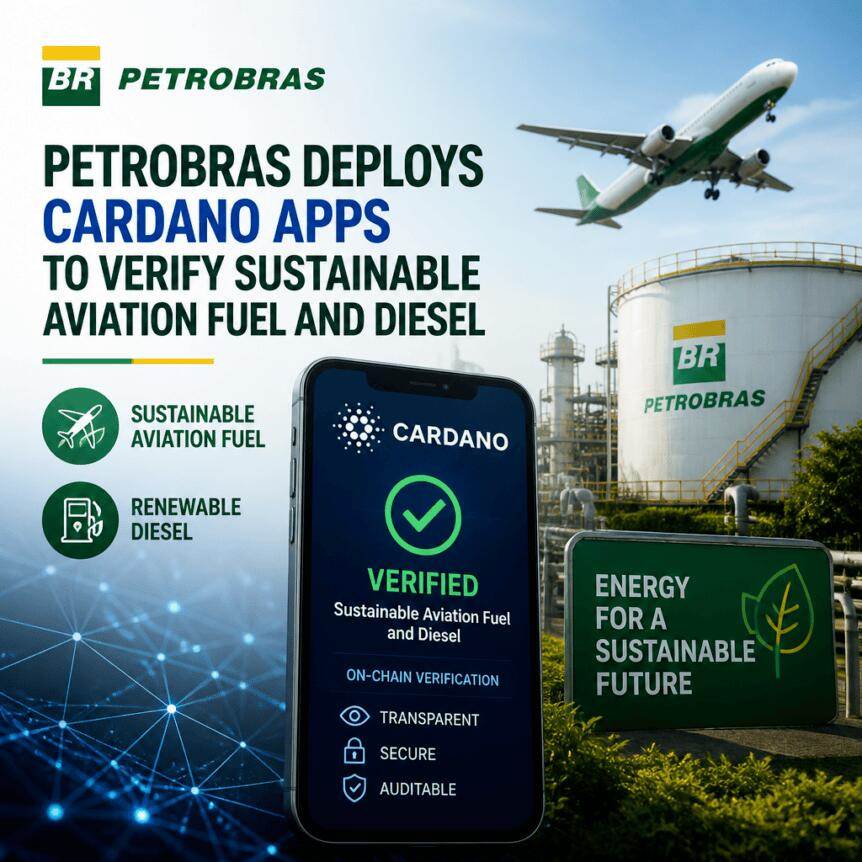
Brazilian state-owned oil company Petrobras builds a blockchain application based on Cardano to track sustainability claims for renewable energy fuels
Brazilian state-owned oil company Petrobras announced that it has developed two applications on the Cardano blockchain to improve the way renewable energy fuel sustainability claims are tracked. According to an announcement issued by the Cardano Foundation, the two projects focus on solving the problem of double counting of environmental benefits-a problem that has long hindered the verification of claims related to sustainable aviation fuels (SAF) and renewable diesel.
Core Points
Petrobras has developed two Cardano-based applications: one for SAF's sustainability attributes and the other for tracking the entire process of its "Diesel R" renewable diesel from production to use.
- SAF Application: Tokens environmental attributes into digital tokens to reduce the risk of reuse of the same statement.
- Book-and-Claim model: Petrobras's SAF model uses an "accounting and claims" approach that separates environmental benefits from physical fuels so that they can be assigned to specific participants.
- Diesel R Application: Create "digital checkpoints" that purports to support Scope 3 reporting, covering indirect emissions in the value chain.
- Disclosure: has not announced the promotion scope or fuel volume covered by the two applications. Investors need to pay attention to future deployment details.
Tokenize SAF environmental attributes through the "Bookkeeping and Claims" model
The first app, developed in collaboration with LedgerLabs of the Federal University of Rio de Janeiro (PUC-Rio), converts SAF-related sustainability attributes into digital tokens on Cardano. According to the Cardano Foundation, the tokens are designed to be consistent with the International Civil Aviation Organization's (ICAO) International Aviation Carbon Offsetting and Emission Reduction Program (CORSIA), and are structurally designed to prevent the same environmental declaration from being used multiple times.
The core of this system is the Book-and-Claim model. Under this model, the environmental benefits represented by SAF are separated from the physical fuel itself. This means that even if the underlying SAF is used elsewhere, its environmental benefits can be allocated to airlines, businesses or passengers. This approach aims to make it easier to match sustainability credit lines with end-users and reporting obligations.
The foundation also describes a path for passengers: users can claim these tokens associated with the SAF through the app and obtain certificates linked to their journey and related environmental claims.
For market participants, the practical implications are obvious: a reliable tracking system can reduce administrative friction between airlines and their partners when verifying sustainability reports, while reducing the risk of environmental attributes being double counted at different stages of the supply chain.
Tracking Diesel R in the Value Chain
The second application is aimed at Petrobras 'renewable diesel "Diesel R". The Cardano Foundation said the system does not tokenize a single attribute, but instead uses "digital checkpoints" to record information at critical stages, including production, transportation and end use.
The foundation added that the data generated by this workflow can support Scope 3 reporting. Scope three includes indirect emissions in the company's value chain, so a system that provides structured traceability may help companies compile more defensive emission disclosures.
Although the announcement outlines the intended use of the report, it does not specify how checkpoints will be verified in practice, what data formats will be captured, or the scope of the planned widespread deployment of the solution. These details are critical because the credibility of any emissions or sustainability statement ultimately depends on audit capabilities and consistency among counterparties.
How Petrobras and the Cardano Foundation achieved this progress
The Cardano Foundation positions these projects as extensions of its existing R & D relationship with Petrobras. The foundation said the collaboration began in 2023 with blockchain education for Petrobras employees and expanded in 2025 to include broader energy field research in collaboration with PUC-Rio's LedgerLabs.
Notably, the foundation did not disclose the volume of fuel the app is expected to cover, nor did it provide a timetable for broader implementation beyond the development work described in the announcement. For traders and investors concerned about blockchain adoption, the lack of scale indicators makes it difficult to assess the near-term impact on networks or revenue-but it does confirm that the technology is being evaluated for real-world sustainable infrastructure.
Continuous aviation credit tracking is becoming a focus of competition
Petrobras is not the first energy or aviation participant to explore a blockchain-based SAF "accounting and claims" system. The Cardano Foundation's announcement mentioned Shell's Avelia platform launched in 2022, which aims to track environmental attributes and reduce double counting.
Based on updates cited in the announcement, Shell said that since its launch in 2022, Avelia has facilitated more than 84 million gallons of SAF to the global fuel network and has reduced more than 780,000 tons of carbon dioxide equivalent (CO ˇ e) emissions through the process as of June 2026.
The broader push is also evident in other markets. Recently, Australia Viva Energy reportedly signed an agreement with NoviqTech in January this year to study a digital "accounting and claims" system for sustainable aviation fuels-clearly including how blockchain supports emissions reporting and tracks environmental claims.
The most striking of these efforts is the common challenge: sustainability claims require a technical means to prove origin, attribute ownership, and prevent double counting crediting in a fragmented ecosystem of producers, logistics providers, airlines, and buyers. Blockchain networks are one tool to achieve this goal, but the competitive question for the industry is whether any particular method can provide consistent, verifiable data processing that can gain large-scale recognition from counterparties.
Currently, Petrobras 'Cardano-based SAF and Diesel R tools clearly demonstrate where blockchain traceability is heading in the energy transition-however, investors and industry observers should pay close attention to the missing parts: deployment timelines, coverage volumes, verification mechanisms, and how these solutions integrate with existing sustainability reporting and audit processes.