Exchange Ranking
 Top Exchanges
 24h Volume Ranking
 Popularity Ranking
 Exchange BTC Balance
 Proof of Reserves
 Decentralized Exchanges
 Funding Rate
 Funding Heatmap
 Liquidation Data
 Max Pain
 Long/Short Ratio
 Whale L/S Ratio
 Binance/Okex/Huobi L/S
 Bitfinex Margin L/S
 ETF Tracker
 Solana ETF
 XRP ETF
 Hong Kong ETF
 Bitcoin Treasuries
 Crypto Reversal
 Ethereum Reserves
 HyperLiquid Wallet Analysis
 Hyperliquid Whale Watch
 Large Transactions
 On-chain Movement
 Bitcoin ROI
 Stablecoin Market Cap
 Options Analysis
 News
News Articles
 Economic Calendar
 Features
 Wallet
 Contract Calculator


 Security
 Collections
 Watchlist
 Following
 ETH
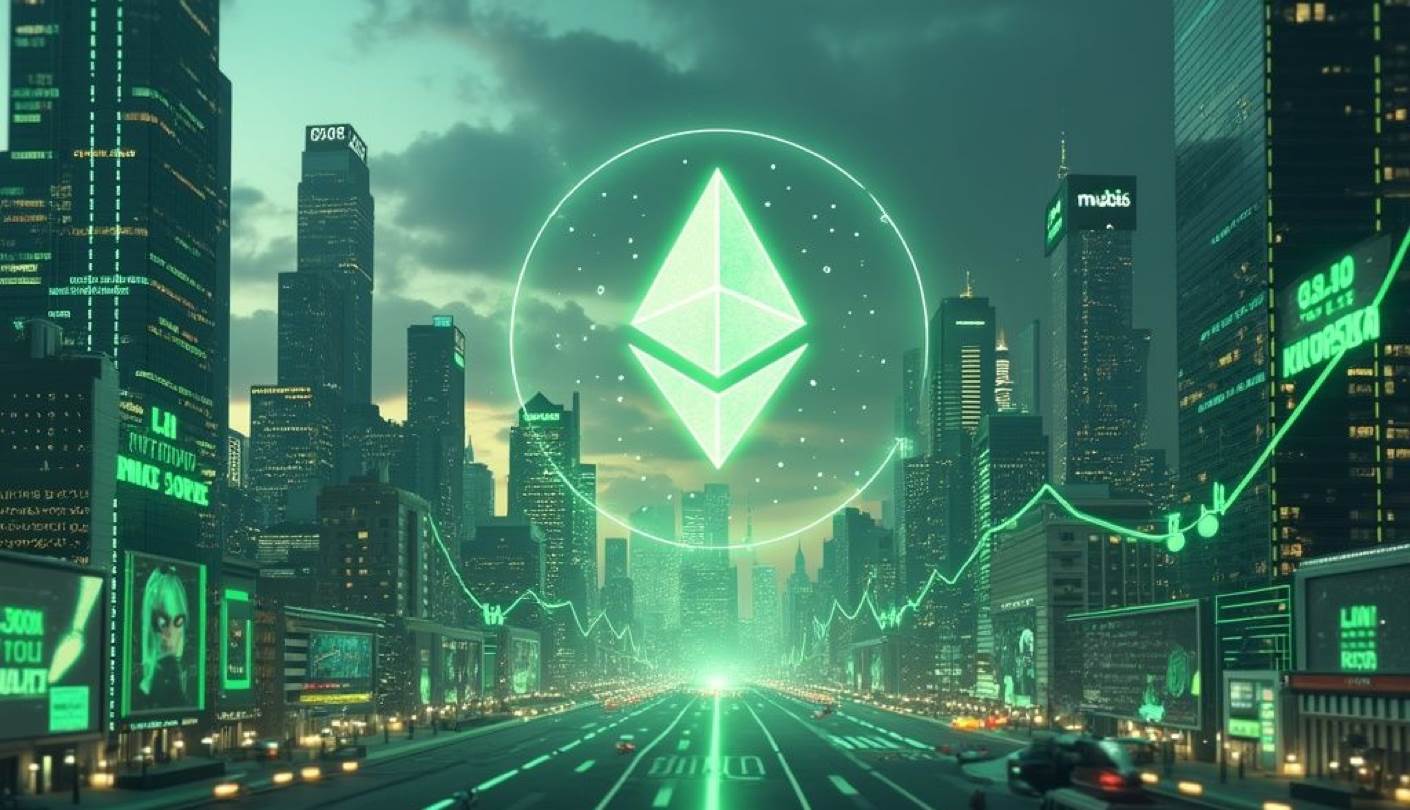
ETH Ethereum is seeing tangible activity in Robinhood\'s new Layer-2 network. According to Token Terminal data, in the first week after Robinhood Chain was launched, more than US$70 million worth of ETH has been bridged to the network, highlighting how quickly large user platforms can bring on-chain mobility into the Ethereum expansion environment.
Robinhood Chain performed well in its first week after launch
Robinhood Chain was launched on July 1. It is an EVM-compatible Layer-2 based on Arbitrum, using ETH as a native Gas token. The network is also positioning itself as \"natively adapted to AI and built for real-world assets,\" while Robinhood is expanding tokenized stock services to customers in more than 120 countries-an effort that has boosted the market\'s interest in blockchain infrastructure for traditional asset exposure.
Key Points
The Token Terminal report shows that Robinhood Chain bridged more than US$70 million in ETH in its first week of launch, marking the rapid arrival of liquidity. DefiLlama data shows that Robinhood Chain\'s total locked value (TVL) is 46,748 ETH (approximately US$83 million at current prices), and inflows on Thursday alone reached 31,855 ETH (approximately US$55 million). Early use appeared to be priced in ETH, with Uniswap founder Hayden Adams saying that most activity used ETH as the \"basic trading pair\" for primary trading and settlement. Analysts believe that this structure could create continued ETH demand through the use of Gas in networks based on Arbitrum and linked to Ethereum clearing. Despite bullish online indicators, ETH remains in weak price range, trading near multi-year bear market lows after a sharp retreat from its 2025 highs.
ETH inflows accelerate after the launch of Robinhood Chain
Robinhood Chain\'s first-week data showed that the network attracted a large amount of capital inflows almost immediately. Token Terminal said that the amount of ETH connected to the network within seven days of launch exceeded US$70 million. In a post on Thursday, Token Terminal also noted that if adoption rates continue to improve, the chain could become \"a meaningful new source of ETH demand.\" This mechanism is crucial to Ethereum observers: Robinhood Chain uses ETH as a Gas token, meaning that daily on-chain activities on the network are directly linked to ETH consumption. Unlike Layer-2 designs that rely on alternative Gas assets, ETH native token-based settings combine the economics of user transactions with assets that traders typically anchor.
On-chain interaction: Users, revenue and lockup value
Token Terminal\'s evaluation of network performance is not limited to bridging amounts. It reported that Robinhood Chain reached 194,000 daily active users in its first week of launch, while daily revenue grew to $39,000-an annualized operating rate of approximately $14 million based on data at the time of reporting. The data displayed on the protocol page of the Robinhood Chain Bridge on DefiLlama is basically consistent with the \"fast start\" narrative. The page shows the total locked value of 46,748 ETH, which is approximately US$83 million based on current market prices, and records an inflow of 31,855 ETH (approximately US$55 million) on Thursday. Although TVL may be affected by many factors, for a fledgling chain, such a scale of daily inflows is worthy of attention. Uniswap founder Hayden Adams added another useful piece of data: He said that most activity on Robinhood Chain is priced in ETH. According to his description, ETH serves as the basic trading pair for transactions, the asset with the highest transaction volume, and the Gas token used to pay for block space. He also said that ETH was burned on Ethereum Layer-1 to pay for data storage, tying part of Layer-2\'s operating costs to the main network.
Why investors pay attention to the \"Layer-2 flywheel\"
The argument of sustained demand is at the heart of some market participants \'bullish reactions. Andri Fauzan Adziima, research director at Bitrue Research, told the media that early trading volume \"verified the Layer-2 flywheel effect\" and characterized it as a \"meaningful new demand pool.\" His core view is that when ETH serves as a Gas token for the highly active Arbitrum network, transactions can be transformed into sustained, measurable demand while locking in capital and attracting a large number of users. Tim Sun, senior researcher at HashKey Group, also sees this development as a structural benefit for ETH. He emphasized that Robinhood Chain\'s use of ETH as a Gas is the most immediate benefit: with the increase in bridging assets, wallet activity and on-chain transactions, new demand for ETH will arise. Sun also pointed out the greater strategic significance. He said that the deeper importance lies not only in how much Gas is consumed, but also in the fact that Robinhood is building its own on-chain financial ecosystem within the Ethereum network. In his view, this strengthens the role of the Ethereum main network as the settlement layer and liquidity foundation for tokenized assets.
This is important because Ethereum\'s long-term value proposition is largely related to its function in real-world asset tokenization. Data cited in the source shows that Ethereum and its Layer-2 ecosystem together account for more than 50% of the market share in this space; if Robinhood Chain successfully attracts the use of large-scale tokenized RWAs, it will further consolidate Ethereum\'s position.
Tokenized assets encounter institutional user channels
Robinhood\'s participation provides an important perspective for the market: distribution. The platform has made tokenized shares available to customers in more than 120 countries, reflecting the continued demand for tokenized exposure to U.S. stocks. If tokenized assets continue to migrate onto blockchain, networks that integrate ETH-based settlement and on-chain execution will be able to capture transactions and transaction needs. The contradiction faced by Ethereum traders is that network fundamentals do not always translate into price action immediately. According to data cited in the source, ETH prices rose slightly to $1775 on Friday, but were still trading near multi-year bear market lows-down 64% from their August 2025 high. This means that the key question for participants is whether early technology appeal can evolve into lasting use that can influence broader market expectations.
Bulls believe that Ethereum\'s growth path relies on multiple superimposed drivers, including RWA tokenization, artificial intelligence proxy payments, institutional adoption, and continued expansion and upgrades. Sources also mentioned that an upgrade to the Glamsburg network expected to be launched before the end of 2026 will increase Layer-1 capacity-an important piece of the scalability puzzle for any ecosystem that wants to absorb the need for additional tokenized assets in the long term. For now, the focus should be on measurable signals: whether Robinhood Chain\'s ETH-denominated activity can continue beyond the initial launch window, how TVL and daily revenue change from week to week, and whether the use of tokenized assets has significantly increased the number of users interacting with on-chain contracts.