
 Exchange Ranking
 Top Exchanges
 24h Volume Ranking
 Popularity Ranking
 Exchange BTC Balance
 Proof of Reserves
 Decentralized Exchanges
 Funding Rate
 Funding Heatmap
 Liquidation Data
 Max Pain
 Long/Short Ratio
 Whale L/S Ratio
 Binance/Okex/Huobi L/S
 Bitfinex Margin L/S
 ETF Tracker
 Solana ETF
 XRP ETF
 Hong Kong ETF
 Bitcoin Treasuries
 Crypto Reversal
 Ethereum Reserves
 HyperLiquid Wallet Analysis
 Hyperliquid Whale Watch
 Large Transactions
 On-chain Movement
 Bitcoin ROI
 Stablecoin Market Cap
 Options Analysis
 News
News Articles
 Economic Calendar
 Features
 Wallet
 Contract Calculator


 Security
 Collections
 Watchlist
 Following
 ETH
ETH How blockchain fees affect transactions, lending, token minting and fund transfers
Blockchain fees remain a key factor affecting people's transactions, lending, token minting and transfer of funds. On Ethereum, costs rise when a large number of users compete for limited block space. Gas fee optimization is now key to whether decentralized applications can serve millions of users, so that they don't make routine operations too expensive or unpredictable.
Why blockchain Gas fees will rise
Gas fees are fees paid to the network to process transactions or smart contract instructions. On Ethereum, each operation consumes a certain amount of computing work, called Gas. The final cost depends on the amount of Gas used and the Gas price at the time.
Failed transactions may also incur fees because the validator has already performed relevant work before the operation is rolled back.
Ethereum transformed its fee market with EIP-1559. It introduces a base fee for being destroyed and a priority fee to reward verifiers. Base fees are adjusted based on demand, which improves the accuracy of fee estimates, but does not guarantee low transaction fees during peak usage periods.
Gas fee optimization starts with Layer 2 expansion
The main approach to Gas fee optimization on Ethereum is to migrate activities from the main network to Layer 2 Rollup. These networks perform a large number of transactions outside the Ethereum main network, compress the results, and then publish the data or certificates back to the base layer. 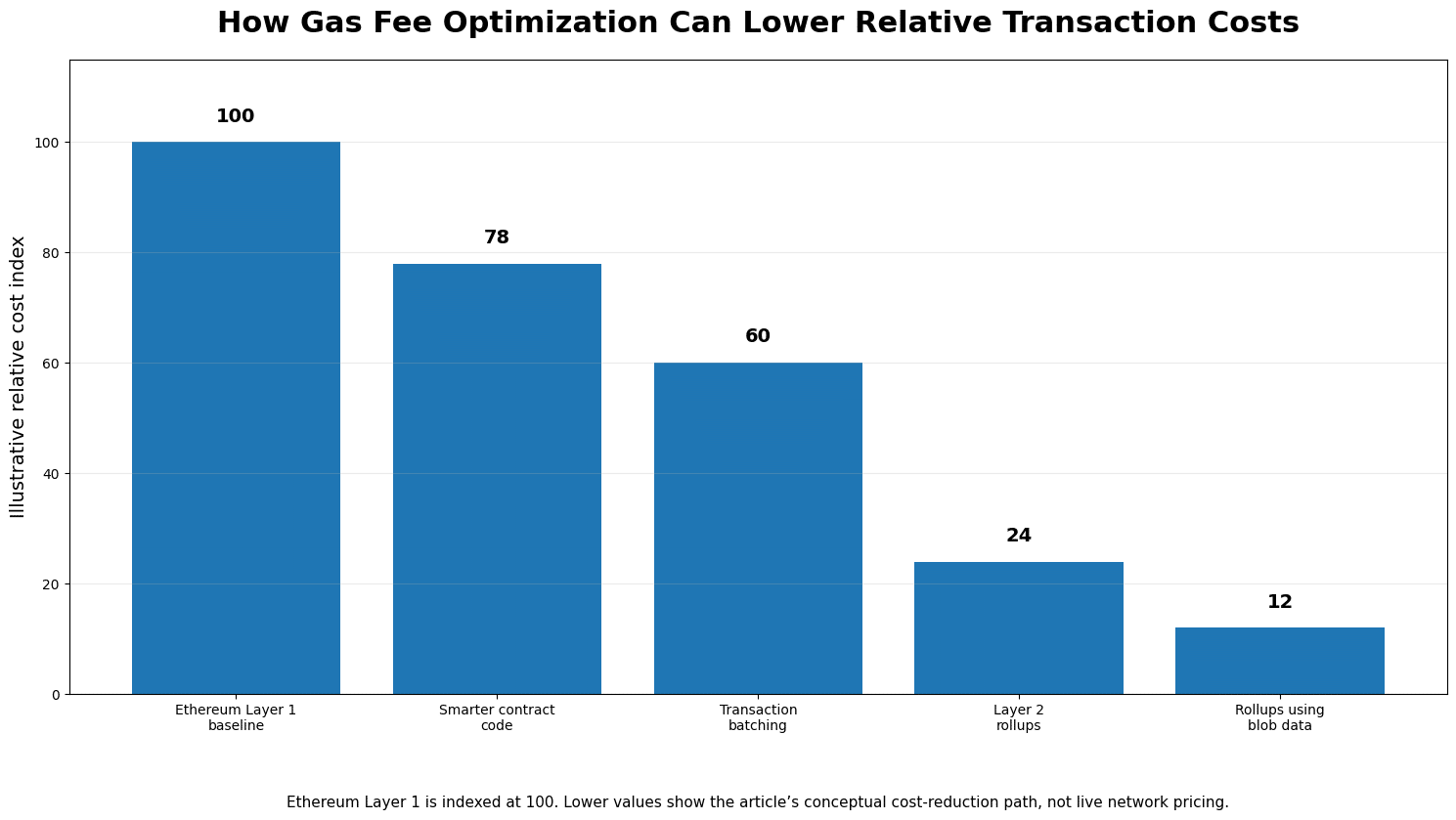
Optimistic Rollup treats transactions as valid by default unless challenged. Zero-knowledge Rollup uses cryptographic proof to confirm batches. Both models spread Ethereum's settlement costs among multiple users, reducing the fees everyone has to pay.
EIP-4844 introduces Blob transactions, providing Rollup with an independent and more efficient temporary data distribution space. This reduces reliance on expensive Calldata. Rollup fees still include execution costs and Ethereum data fees, and Blob pricing could become a significant part of the total fee.
Smarter contracts reduce unnecessary calculations
Applications can support Gas fee optimization through careful engineering. When contracts reduce storage writes, avoid double calculations, efficiently package data, and remove unnecessary external calls, their operating costs are lower.
Batch processing is another useful method. Instead of sending multiple separate transactions, a wallet or application can combine multiple compatible actions into a single request. For example, trading platforms can incorporate authorization and exchange logic, while treasury contracts can make payments to multiple recipients in one call.
Permit signature, account abstraction and Sponsorship Transactions can also improve the user experience. They don't eliminate network costs, but they can reduce duplication of steps or allow apps to pay fees on users 'behalf. EIP-7702 allows regular Ethereum accounts to use smart account features such as batch processing, custom authorization, recovery tools and flexible fee payment methods.
Wallets, timing and better routing
Wallets play an important role in Gas fee optimization: a well-designed wallet can estimate base fees, suggest appropriate priority fees, alert potential failures, and explain whether it is necessary to wait for faster confirmation.
Some wallets also simulate transactions before broadcast, reducing the risk of users paying for potentially failed operations.
Routing tools can compare different decentralized exchanges, cross-chain bridges, and Layer 2 networks. However, once authorization fees, cross-chain costs, slip points and withdrawal fees are included, the lowest quoted exchange may not be the cheapest complete path. Therefore, Gas fee optimization should measure the entire transaction path rather than just focusing on a visible number.
Compression technology improves Rollup economy
Rollup reduces costs by compressing numerous user operations into compact batches. Compression technology removes duplicate information, and batch submitters choose when and how to publish data. Operators can choose to use Blob or Calldata based on pricing and availability. The OP Stack guide states that when both methods are secured by Ethereum, the sorter can switch between the two.
Further Gas fee optimizations may come from stronger compression, shared sorting, proof aggregation, and improved data availability. Some Rollups use external data availability systems to reduce costs. This can reduce costs, but users will then have to rely on a different security model. The price itself is not enough. Data access, censorship resistance, withdrawal security and operator risk remain important.
Beyond Ethereum: Different technology models
Other blockchains achieve Gas fee optimization through parallel execution, shorter quacking times, dedicated virtual machines, or application-specific capacity.
Some systems charge a smaller fixed fee. Other systems use dynamic markets or price calculations, storage and data separately. Dedicated designs can increase efficiency because unrelated applications will not always compete for the same resources.
Still, lower fees do not automatically mean a stronger network. Users should evaluate the degree of decentralization, verifier requirements, risk of downtime, mobility, cross-chain bridge security, and the cost of migrating to other chains.
Key indicators to pay attention to
The following indicators can show whether Gas fee optimization is effective. Average transaction costs reflect overall cost trends, while median fees reduce the impact of extreme peaks. Gas usage per transaction helps measure contract efficiency. Block utilization shows how close the network is to full capacity.
Layer 2 users should focus on Blob fees, data availability costs, batch size, transaction failure rates, and the proportion of fees paid to Ethereum.
A useful assessment is to compare costs with safety, liquidity, finality and reliability. Cheap block space, if accompanied by weak security, may save money today, but will cause greater losses in the future.
Conclusion
Gas fee optimization is making progress at multiple levels. Ethereum has improved fee estimates, expanded Rollup capacity, and introduced Blob transactions to reduce data distribution costs. The Layer 2 network distributes settlement costs through large batches, while wallets and contracts reduce waste through simulation, batch processing, Permit, and efficient code.
However, the lowest fee does not always mean the best network. Sustainable Gas fee optimization must make blockchain activities affordable to ordinary users while maintaining security, data availability, and user control.
FAQs
What caused the increase in Ethereum Gas fees?
Fees rise when users compete for limited block space, especially during periods of market volatility, token issuance, or smart contract activity.
Can Layer 2 networks completely eliminate fees?
No. They reduce costs by processing transactions in batches and spreading settlement and data costs among multiple users.
Can wallets reduce transaction costs?
Wallets can improve estimation, simulate transactions, batch processing operations, and route activity through cheaper networks.
Is a low-cost blockchain always better?
Not necessarily. Security, decentralization, liquidity, reliability, cross-chain bridge risks and withdrawal options are equally important.
Key Glossary
Gas: A unit that measures the amount of computing work on the blockchain.
Basic fees: Ethereum contains the minimum fees required for transactions and is destroyed according to EIP-1559.
Priority fees: Optional fees paid to encourage transactions to be included more quickly.
Rollup:A Layer 2 network that processes transactions in batches and settles the results on another blockchain.
Blob: Temporary data space designed for efficient publishing of Rollup data.
Calldata: Transaction data processed on Ethereum has historically been used by Rollup for data publishing.
Account abstraction: wallet technology that supports batch processing, recovery, and sponsorship fees.
Data Availability: Participants 'ability to access and verify transaction information.
























