
 Exchange Ranking
 Top Exchanges
 24h Volume Ranking
 Popularity Ranking
 Exchange BTC Balance
 Proof of Reserves
 Decentralized Exchanges
 Funding Rate
 Funding Heatmap
 Liquidation Data
 Max Pain
 Long/Short Ratio
 Whale L/S Ratio
 Binance/Okex/Huobi L/S
 Bitfinex Margin L/S
 ETF Tracker
 Solana ETF
 XRP ETF
 Hong Kong ETF
 Bitcoin Treasuries
 Crypto Reversal
 Ethereum Reserves
 HyperLiquid Wallet Analysis
 Hyperliquid Whale Watch
 Large Transactions
 On-chain Movement
 Bitcoin ROI
 Stablecoin Market Cap
 Options Analysis
 News
News Articles
 Economic Calendar
 Features
 Wallet
 Contract Calculator


 Security
 Collections
 Watchlist
 Following
 BTC
BTC Key points: Bond yields have continued to rise since the outbreak of the war in Iran, and markets generally attribute this to inflationary expectations triggered by energy prices. However, five-year inflation expectations reflected in U.S. inflation-protected bonds are only 2.2%, and have been on a downward trend since May. The rise in real yields seems to be the driving force, which poses a negative for non-yielding assets such as Bitcoin.
Second-quarter bond sell-off continues
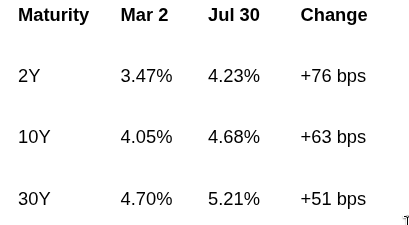
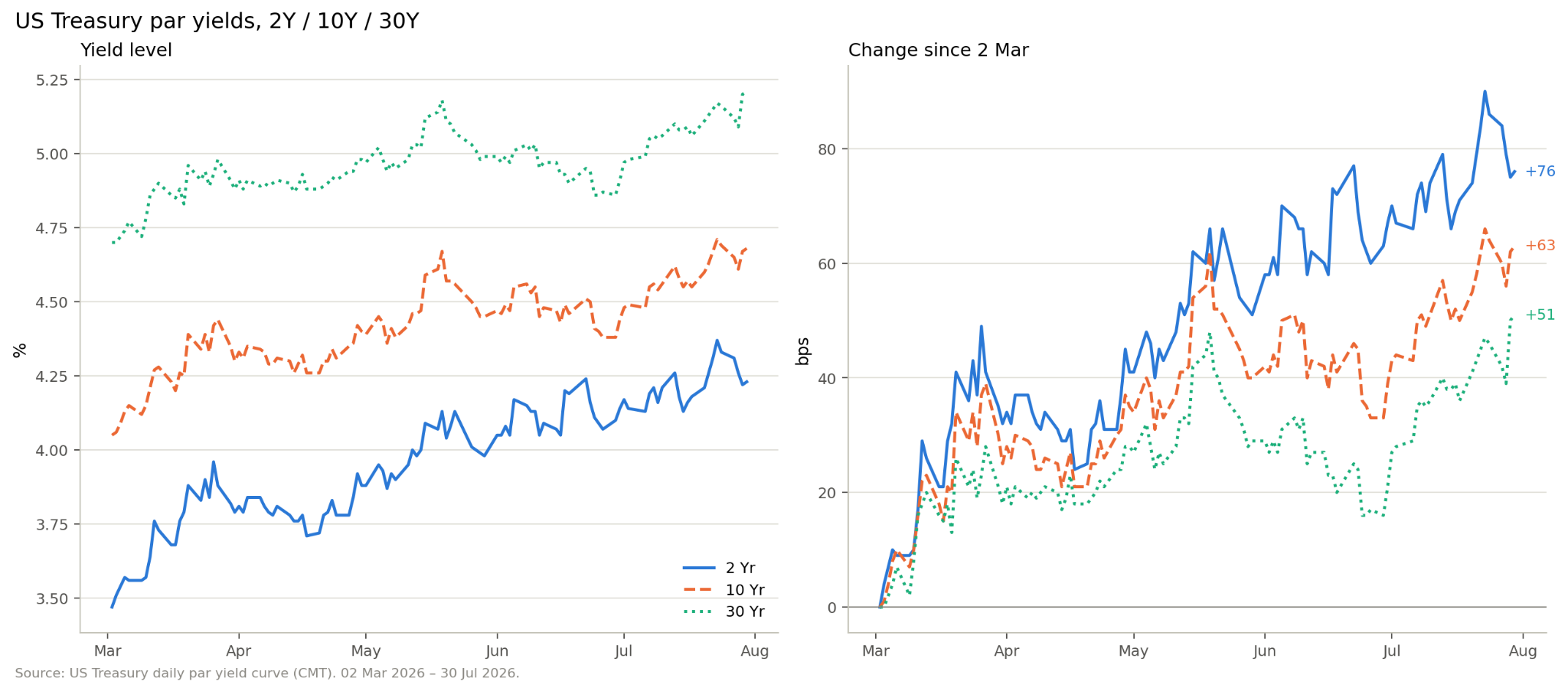
U.S. government bonds experienced months-long sell-off after yields hit local lows in early March. This week, after the latest meeting of the Federal Open Market Committee, the yield on the 30-year U.S. Treasury note hit its highest level since 2007 and made headlines. At the same time, the two-year Treasury yield rose 76 basis points over the period, and the market priced a 63% probability of the Fed raising interest rates in September, according to CME FedWatch.
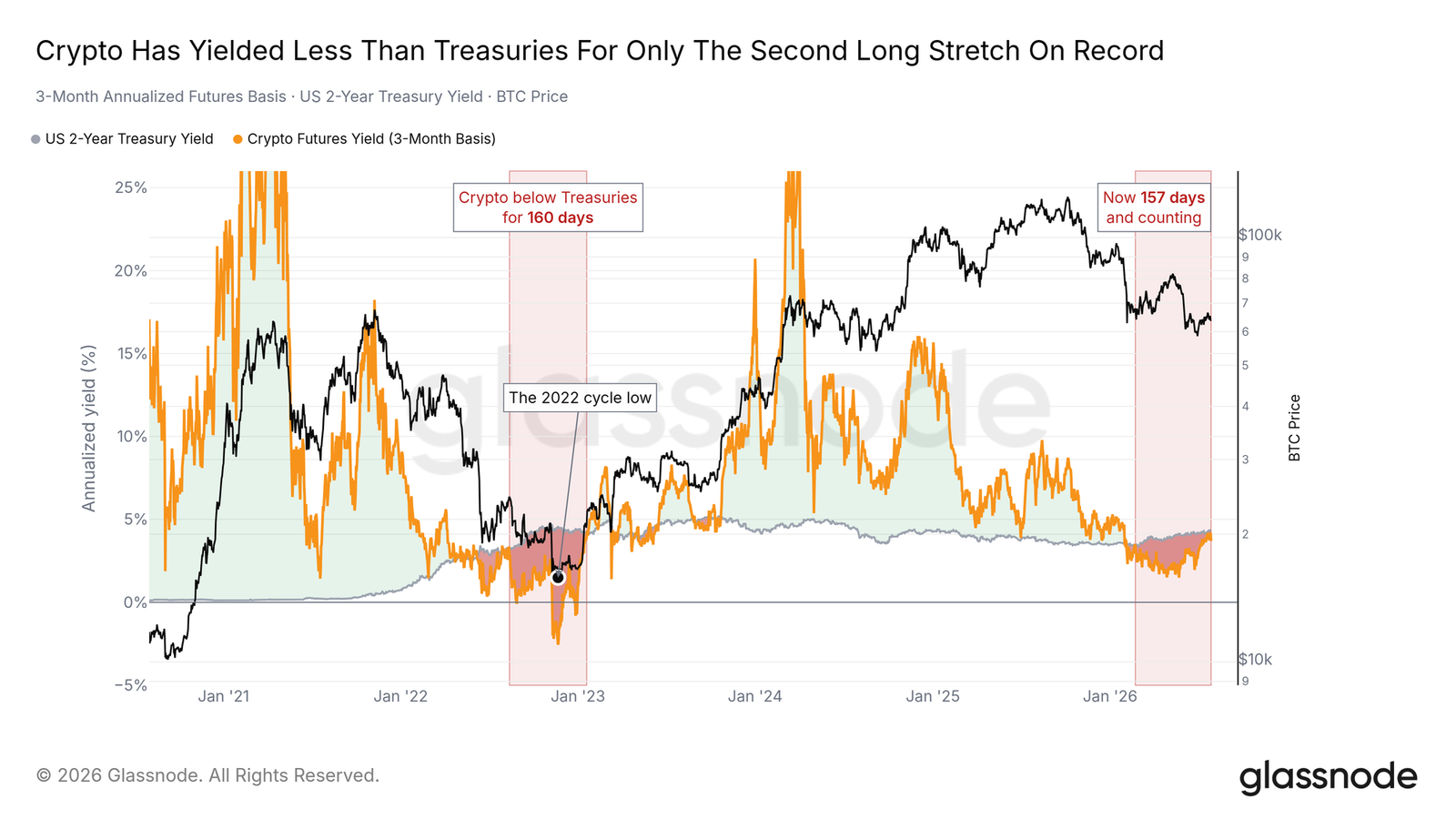
According to recent research by Glassnode, in the current environment of high interest rates, government bond investment is more profitable than carry trades in the cryptocurrency market for the first time since 2019.
Mainstream inflation narrative
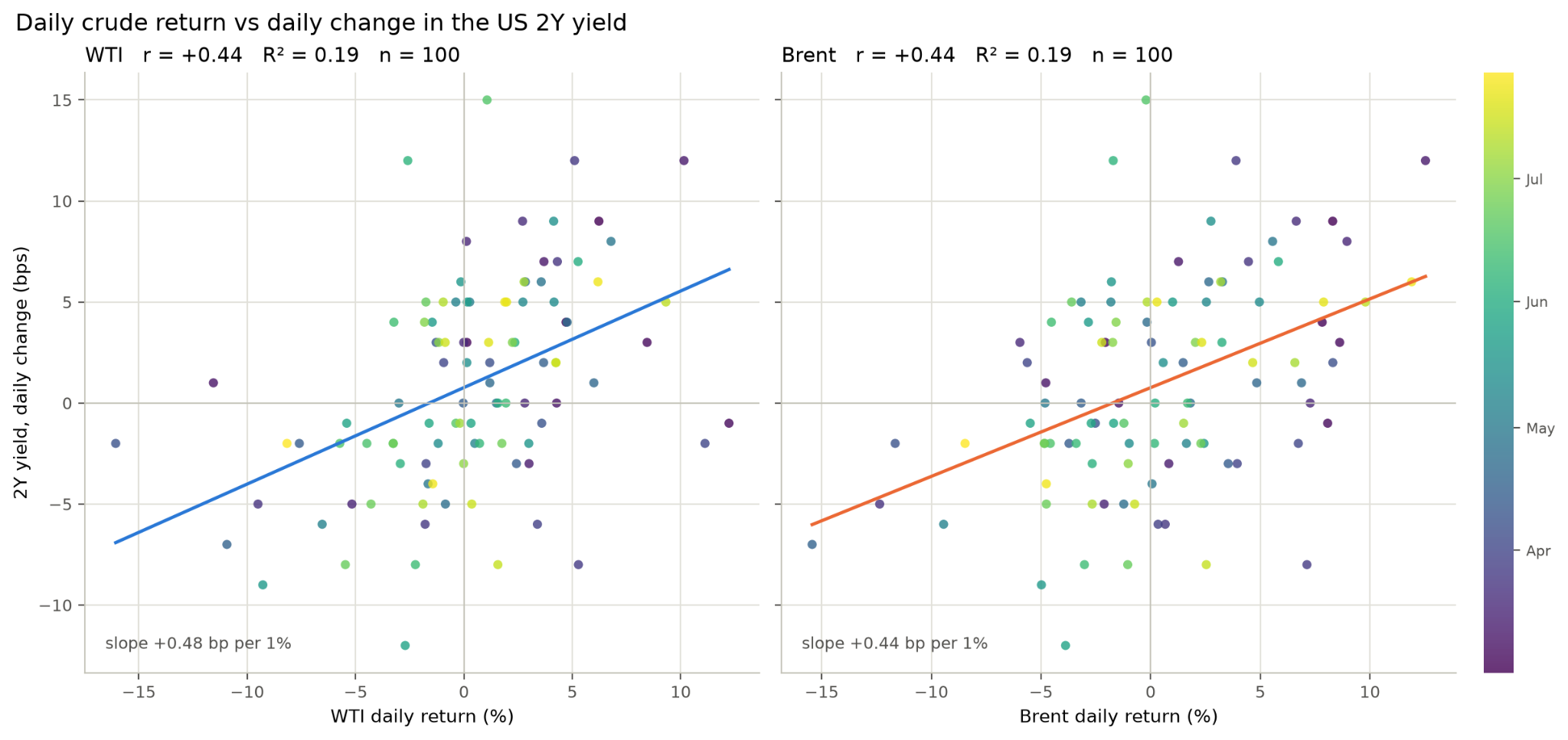
Bond sell-offs are often attributed to inflationary pressures from rising commodity and energy prices. This round of bond selling, which lasted for months, coincided with the outbreak of the Iranian war and the subsequent closure of the Strait of Hormuz. In addition, since March, there has been a correlation between two-year U.S. government bond yields, the daily closing prices of West Texas Intermediate and Brent crude, with a correlation coefficient r=0.44:
On Thursday, after President Donald Trump threatened Iran, WTI crude oil prices once again exceeded $85 a barrel, while bonds sold off ahead of a Federal Open Market Committee meeting. The conflict shows no sign of resolution in the short term, leading some to believe that higher interest rates are caused by inflationary expectations.
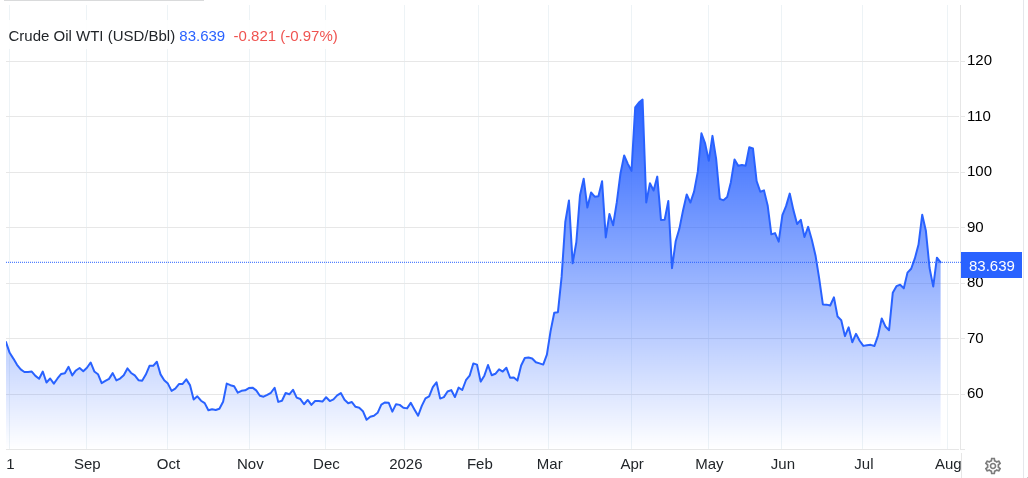
This has triggered widespread inflation fears in the mainstream financial media, such as recent Bloomberg headlines: "Global bonds falter as soaring oil reignite inflation threat,""U.S. yields hit two-month highs due to oil-induced inflation risks" or "Global bond sell-off intensified as rising oil prices scare investors." This narrative is also popular in the cryptocurrency and precious metals world, where inflation has always been focused on:
Market commentator and Bitcoin influencer "The Wolf of Wall Street" recently posted on X:
However, the way other treasury bonds are traded does not support the idea that inflation-drives bond yields.
TIPS suggests interest rate rise is "real"
While most analysts and commentators focus on conventional Treasury yields in their analysis, inflation-protected bonds provide a clear signal against the inflation narrative. Inflation-protected bonds are ordinary treasury bonds with principal payments adjusted upward based on the consumer price index for all cities. In addition to the inflation-protected principal, each TIPS also carries a fixed coupon rate. As a result, unlike ordinary bonds, both principal and interest payments are adjusted for inflation.
By comparing the yields of TIPS and ordinary treasury bonds of the same maturity, we can estimate future CPI inflation expectations, known as the so-called break-even interest rate. Although Treasury yields have been rising, the five-year break-even rate has fallen sharply since May.
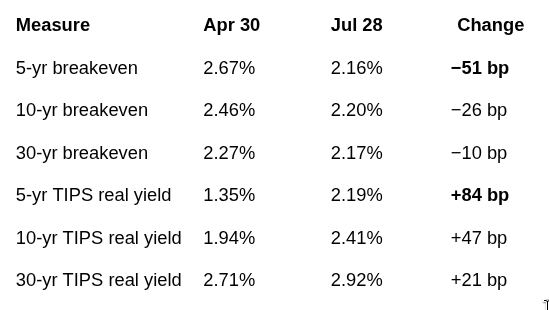
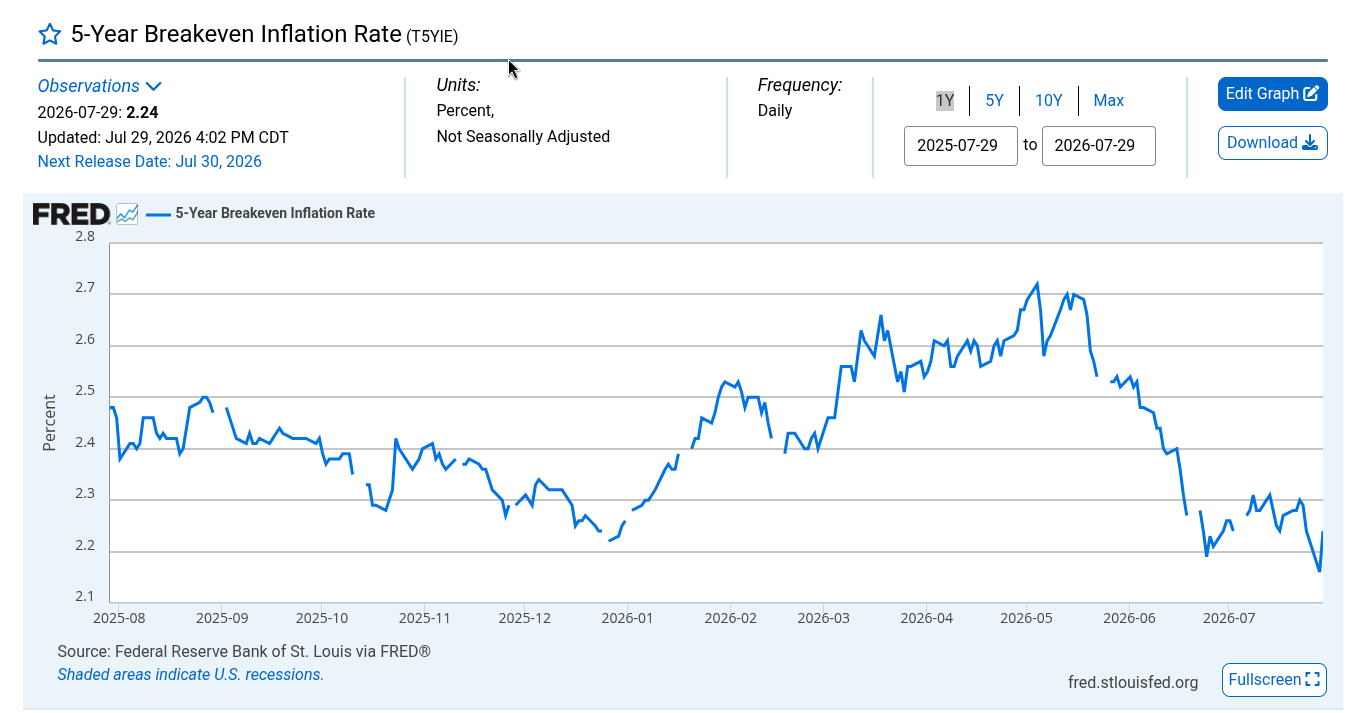
The five-year breakeven inflation rate is approximately 2.2%, indicating market expectations that the Fed will achieve its 2% target in the medium term. More convincingly, however, is the fact that the break-even rate moves in the opposite direction of nominal government bond yields. When the five-year nominal yield rose by 33 basis points, TIPS data showed that this was an 84 basis point increase in real yields, but was partially offset by a 51 basis point decline in expected inflation. While the inflation narrative remains fascinating, the market reality is not. The real story should be the rise in real yields.
What this might mean for cryptocurrencies
Overall, an increase in the "real" return on investment in bonds and stocks measured by CPI will make non-yielding assets such as Bitcoin relatively less attractive to some investors. In addition, the impact on the cryptocurrency market depends on the explanation for the rise in real interest rates, and there are currently multiple explanations.
Reserve clearing-no significant impact on cryptocurrencies.
Higher oil prices have widened trade deficits among Asian energy-importing countries. Because oil is usually priced and settled in U.S. dollars, there is a shortage in local European dollar markets in Asia, putting its exchange rates under pressure. The yen, the Philippine peso and the Indian rupee all require central bank intervention to defend the exchange rate. Because these measures are funded by selling U.S. Treasury bonds reserves, they put upward pressure on bond yields. Frederick Newman of HSBC has publicly stated that the bond sell-off was caused by foreign exchange pressure rather than judgments about the dollar.
Demand disruption-negative for cryptocurrencies.
An oil shock that lasts long enough will no longer be inflationary and will begin to trigger a recession. Neuberger Berman pointed out in his second-quarter outlook that investors underestimated the impact of continued energy prices on output. The credit crunch that coincides with the recession will adversely affect stocks and Bitcoin by severely restricting liquidity. As a real sign of a recessionary credit event, credit spreads are expected to widen.
Investment demand-may be negative for cryptocurrencies.
Real yields may also respond to expected economic growth and capital needs in the artificial intelligence industry. Government bond issuance is increasingly competing with record-setting corporate bond issuance by AI hyperscale companies. Goldman Sachs Research predicts that artificial intelligence capital expenditures will be approximately US$755 billion in 2026 and approximately US$920 billion in 2027. UBS raised its forecast for investment-grade bond issuance in 2026 to US$1.8 trillion, with technology sector supply raised to US$360 billion based on guidelines for ultra-large companies. As cryptocurrencies are competing for a similar base of capital and investors, this is likely to curb the industry's development.
























