
 Exchange Ranking
 Top Exchanges
 24h Volume Ranking
 Popularity Ranking
 Exchange BTC Balance
 Proof of Reserves
 Decentralized Exchanges
 Funding Rate
 Funding Heatmap
 Liquidation Data
 Max Pain
 Long/Short Ratio
 Whale L/S Ratio
 Binance/Okex/Huobi L/S
 Bitfinex Margin L/S
 ETF Tracker
 Solana ETF
 XRP ETF
 Hong Kong ETF
 Bitcoin Treasuries
 Crypto Reversal
 Ethereum Reserves
 HyperLiquid Wallet Analysis
 Hyperliquid Whale Watch
 Large Transactions
 On-chain Movement
 Bitcoin ROI
 Stablecoin Market Cap
 Options Analysis
 News
News Articles
 Economic Calendar
 Features
 Wallet
 Contract Calculator


 Security
 Collections
 Watchlist
 Following
 BTC
BTC Public bitcoin miners spend billions of dollars betting on AI and high-performance computing, returns have not kept pace
Public bitcoin miners are spending tens of billions of dollars chasing artificial intelligence (AI) and high-performance computing (HPC) business revenue, but returns have not kept pace, highlighting the huge upfront investment needed to diversify beyond Bitcoin mining.
In its latest issue of Miner Weekly, BlocksBridge Consulting reported that a group of 15 Bitcoin miners and AI data center companies spent a total of US$30.7 billion on capital assets during their latest 2026 reporting period, which is 42.6% higher than their $21.53 billion spent for the full year of 2025.
Specific to Bitcoin mining companies, the gap between capital expenditures and AI revenue is still significant. Nine comparable mining companies spent a total of US$5.11 billion on capital assets in the first half of 2026, but directly reported AI and HPC revenue was only US$341.2 million-a capital expenditure to revenue ratio of approximately 15 to 1.
BlocksBridge calculates capital expenditures based on cash purchases and investments in hardware, real estate, equipment and other productive assets, after deducting proceeds from asset sales and refunds.
Despite the gap, AI and HPC revenues are accelerating. The nine miners reported total revenue from these businesses of $205.8 million in the second quarter, up 52% quarter-on-quarter, with Core Scientific, TeraWulf and Bitdeer among them reporting growth. 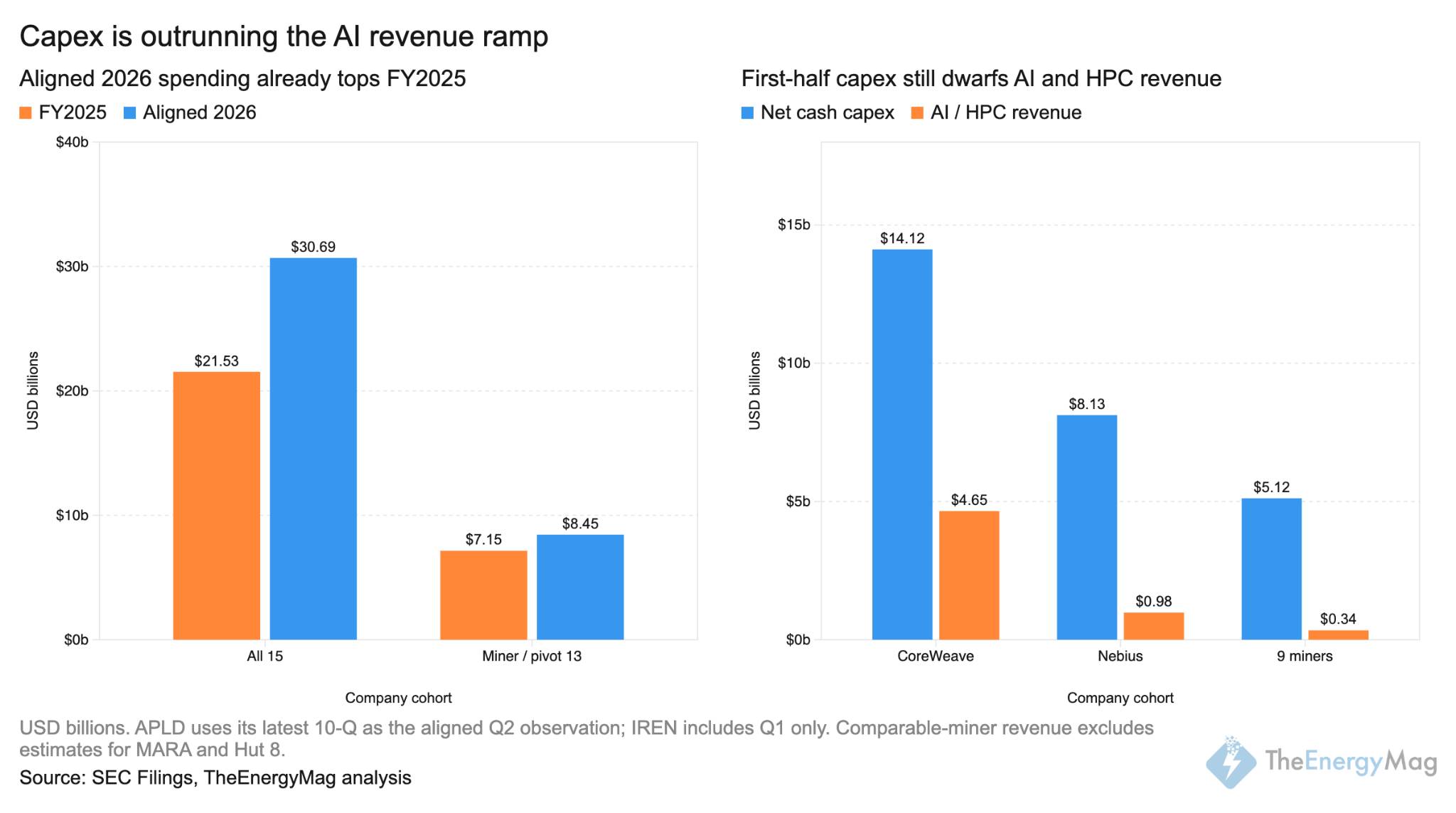
As of now, Bitcoin miners 'capital expenditures have far exceeded their AI and HPC revenues.
The high cost of switching to AI
AI and data centers have been touted as ways for Bitcoin miners to diversify amid challenges facing the mining industry, but BlocksBridge data shows that this transformation comes with huge upfront costs.
BlocksBridge said: "Power contracts and available land may give mining companies a starting advantage, but converting these assets into AI-ready production capacity also requires substations, buildings, cooling systems, network equipment and, in some business models, GPUs."
It remains to be seen whether the latest round of Bitcoin price recovery will provide relief to companies that still maintain large-scale mining operations.
This week, Bitcoin surged more than 13% to $72,000 after the U.S. Treasury Department said it would at least double the maximum size of long-term bond buybacks to $4 billion per operation (a move aimed at improving liquidity in the treasury bond market, initially lowering yields and boosting risk appetite).
In a sign of the shift to AI and HPC, Coinshares this week announced changes to its industry strategy for tracking exchange-traded funds. The fund is now renamed CoinShares Bitcoin Mining and Digital Power ETF (WGMI), with assets under management of US$222.4 million. Its investment portfolio contains 29 targets, covering Bitcoin miners, data center operators, AI semiconductors, power generation and HPC fields-Coinshares describes it as "the business that drives the digital economy."
























