Exchange Ranking
 Top Exchanges
 24h Volume Ranking
 Popularity Ranking
 Exchange BTC Balance
 Proof of Reserves
 Decentralized Exchanges
 Funding Rate
 Funding Heatmap
 Liquidation Data
 Max Pain
 Long/Short Ratio
 Whale L/S Ratio
 Binance/Okex/Huobi L/S
 Bitfinex Margin L/S
 ETF Tracker
 Solana ETF
 XRP ETF
 Hong Kong ETF
 Bitcoin Treasuries
 Crypto Reversal
 Ethereum Reserves
 HyperLiquid Wallet Analysis
 Hyperliquid Whale Watch
 Large Transactions
 On-chain Movement
 Bitcoin ROI
 Stablecoin Market Cap
 Options Analysis
 News
 Articles
 Economic Calendar
 Features
 Wallet
 Contract Calculator


 Security
 Collections
 Watchlist
 Following
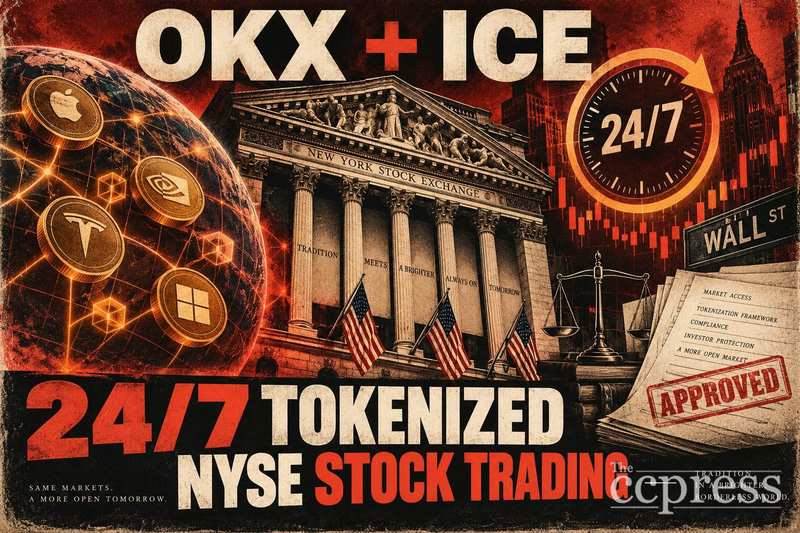
OKX and the Intercontinental Exchange jointly reported to the SEC that they plan to implement 24/7 tokenized stocks on the New York Stock Exchange
OKX and the Intercontinental Exchange (ICE) have jointly notified the U.S. Securities and Exchange Commission (SEC) that they plan to enable tokenized forms of stocks listed on the New York Stock Exchange for round-the-clock trading. This move will allow investors to break through the narrow window of traditional market hours and gain round-the-clock access to U.S. stock assets.
According to relevant reports, the filing was filed in accordance with the SEC's innovation exemption framework. This suggests that the two companies are actively seeking regulatory clearance before launching products rather than adopting a "kill first and report later" strategy. It should be emphasized that filing a filing with the SEC is not the same as obtaining approval. Regulatory agencies have not officially released the product, and a specific launch date has not yet been determined. The move by OKX and ICE aims to formally document the plan and initiate a regulatory review process.
What are tokenized NYSE stocks?
Tokenized stocks are financial instruments based on blockchain technology that aim to track the price performance of the underlying stock. In practice, holding tokenized shares in a NYSE listed company means that investors can directly obtain economic exposure to the stock without going through traditional brokerages or limited to trading hours from 9:30 a.m. to 4:00 p.m. EST.
"24/7 trading" is its core differentiation feature. For a long time, global investors far from New York's time zone have faced structural disadvantages when trading U.S. stocks. In theory, continuous and non-stop trading would remove this obstacle. However, details of specific mechanisms such as custody arrangements, settlement tracks, and investor qualifications have not been disclosed in detail in the public SEC filing information.
How to settle such transactions in practice remains an open issue. In contrast, Payward's integration of SGB-Net aims to achieve instant digital asset settlement, which is part of a parallel effort to resolve the friction point between traditional financial schedules and crypto-native expectations.
Why is the SEC the only critical audience?
Any tokenized equity product for the U.S. market is squaredly within the jurisdiction of the SEC. Stocks belong to the category of securities, and tokenizing them will not change this classification. Providing such products to U.S. investors without proper registration or exemptions will expose them to direct enforcement risks.
Filing through the innovation exemption path, OKX and ICE asked the SEC to evaluate the proposal under a framework designed specifically for new products, rather than forcing regulators to force the new structure into decades-old rules. The current core variable is: Will the SEC engage in interactions in a constructive way, or will it issue guidelines or enforcement guidance as a pretext?
Currently, the regulatory environment for financial products related to cryptocurrencies is still uncertain. Brad Garlinghouse recently admitted that industry efforts to promote the Clarity Act fell short of expectations, highlighting that comprehensive U.S. encryption legislation remains unresolved. Tokenized equity will also fall into this regulatory gray area.
At the same time, traditional financial institutions are also testing regulatory boundaries. The Community Banking Association's (ICBA) lawsuit against the Office of the Comptroller of the Currency (OCC) reflects how controversial the issue of who is qualified to operate new financial infrastructure in the United States is.
Future Development Outlook
The SEC may respond to this filing in a variety of ways: communicating directly with OKX and ICE, issuing a no-action letter, requesting more information, or not taking immediate action. These results are uncertain and no timetable for any response has been made public.
Before the product is officially launched, practical questions such as investor protection, market regulation, and interoperability with existing broker infrastructure all need to be answered. The filing opens a dialogue with regulators, but the dialogue is far from over.
The bigger question hanging over this filing is: Will the SEC view tokenization of NYSE shares as an innovation worthy of accommodation or a compliance issue waiting to erupt?